

L Le ev ve el l 1 1 C Ca as se e 1 15 5
O Ox xa az zo ol li in ne e N N- N N N- N N O Ox xi id de es s a as s
D Di ip po ol le es s i in n [ [3 3+ +2 2] ] C Cy yc cl lo oa ad dd di it ti io on ns s
K Ke ey y p po oi in nt t: : C Cy Cy Cy yc yc y yc yc yc yc y y l lo lo lo lo l loa ad dd dd d dd dd d dd d ddi di di d di di d dit ti ti ti t ti ti t tio io io io i ion ns s
Me
Me
Me H
N
O
O
H
EWG
R
N
Me
Me
Me
O
H
H
O
H
EWG
R
N
Me
Me
Me
O
H
H
O
R
EWG
H
major
minor
O Ox xa az zo ol li in ne e N N- N N N N- N N O Ox xi id de es s a as s D Di ip po ol le es s i in n [ [3 3+ +2 2] ] C Cy yc cl lo oa ad dd di it ti io on ns s
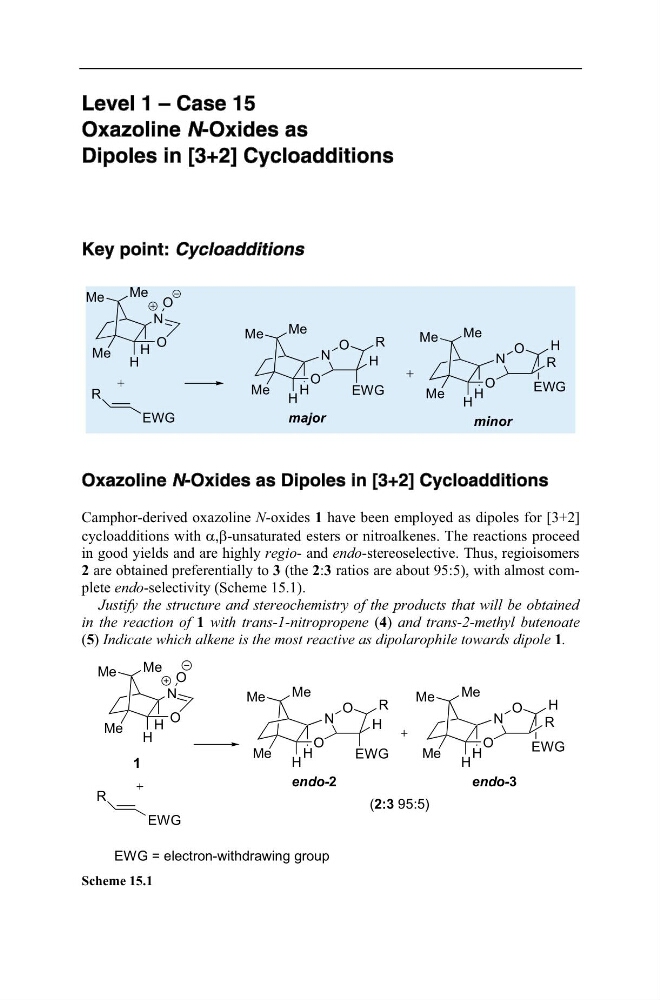
Camphor-derived oxazoline N-oxides N N
1 have been employed as dipoles for [3+2]
cycloadditions with DE-unsaturated esters or nitroalkenes. The reactions proceed
in good yields and are highly regio- and endo-stereoselective. Thus, regioisomers
2 are obtained preferentially to 3 (the 2:3 ratios are about 95:5), with almost complete endo-selectivity (Scheme 15.1).
Justify the structure and stereochemistry of the products that will be obtained
in the reaction of 1 with trans-1-nitropropene (4) and trans-2-methyl butenoate
(5) Indicate which alkene is the most reactive as dipolarophile towards dipole 1.
Me
Me H
O
Me
N
O
H
R
EWG
Me
Me H
H
O
EWG
N
Me
O
R
H
O
N
Me
Me
Me
O
H
H
H
EWG
R
endo-2
1
EWG = electron-withdrawing group
endo-3
(2:3 95:5)
Scheme 15.1
O Ox xa az zo ol li in ne e N N- N N N- N N O Ox xi id de es s a as s
D Di ip po ol le es s i in n [ [3 3+ +2 2] ] C Cy yc cl lo oa ad dd di it ti io on ns s
K Ke ey y p po oi in nt t: : C Cy Cy Cy yc yc y yc yc yc yc y y l lo lo lo lo l loa ad dd dd d dd dd d dd d ddi di di d di di d dit ti ti ti t ti ti t tio io io io i ion ns s
Me
Me
Me H
N
O
O
H
EWG
R
N
Me
Me
Me
O
H
H
O
H
EWG
R
N
Me
Me
Me
O
H
H
O
R
EWG
H
major
minor
O Ox xa az zo ol li in ne e N N- N N N N- N N O Ox xi id de es s a as s D Di ip po ol le es s i in n [ [3 3+ +2 2] ] C Cy yc cl lo oa ad dd di it ti io on ns s
Camphor-derived oxazoline N-oxides N N
1 have been employed as dipoles for [3+2]
cycloadditions with DE-unsaturated esters or nitroalkenes. The reactions proceed
in good yields and are highly regio- and endo-stereoselective. Thus, regioisomers
2 are obtained preferentially to 3 (the 2:3 ratios are about 95:5), with almost complete endo-selectivity (Scheme 15.1).
Justify the structure and stereochemistry of the products that will be obtained
in the reaction of 1 with trans-1-nitropropene (4) and trans-2-methyl butenoate
(5) Indicate which alkene is the most reactive as dipolarophile towards dipole 1.
Me
Me H
O
Me
N
O
H
R
EWG
Me
Me H
H
O
EWG
N
Me
O
R
H
O
N
Me
Me
Me
O
H
H
H
EWG
R
endo-2
1
EWG = electron-withdrawing group
endo-3
(2:3 95:5)
Scheme 15.1