

Cyclization of 2,3-Dibenzylidenesuccinates 99
B
A
H
B
A
H
A
B
A
B
H
H H
1,5-sigmatropic TS
Figure 14.2
As the [1,5]-sigmatropic hydrogen shift is suprafacial, the hydrogen would end
at the same face of the molecule and hence, the substituents on positions C1 and
C2 will have a cis relationship in the final product 2 (Scheme 14.2).
Considering the Woodward-Hoffmann rules, if the conrotatory six-electron
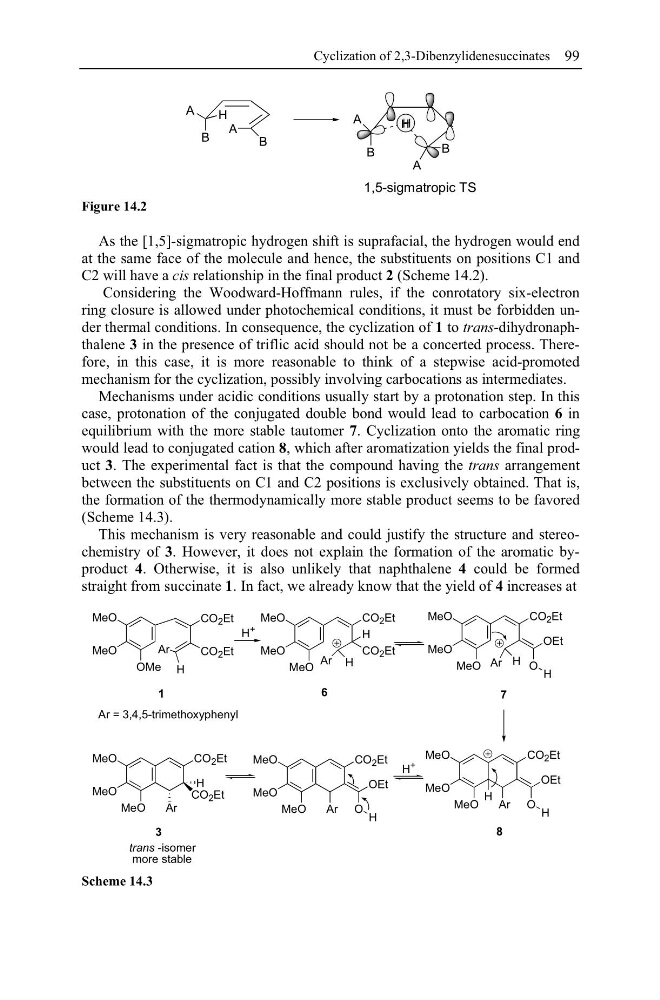
ring closure is allowed under photochemical conditions, it must be forbidden under thermal conditions. In consequence, the cyclization of 1 to trans-dihydronaphthalene 3 in the presence of triflic acid should not be a concerted process. Therefore, in this case, it is more reasonable to think of a stepwise acid-promoted
mechanism for the cyclization, possibly involving carbocations as intermediates.
Mechanisms under acidic conditions usually start by a protonation step. In this
case, protonation of the conjugated double bond would lead to carbocation 6 in
equilibrium with the more stable tautomer 7. Cyclization onto the aromatic ring
would lead to conjugated cation 8, which after aromatization yields the final product 3. The experimental fact is that the compound having the trans arrangement
between the substituents on C1 and C2 positions is exclusively obtained. That is,
the formation of the thermodynamically more stable product seems to be favored
(Scheme 14.3).
This mechanism is very reasonable and could justify the structure and stereochemistry of 3. However, it does not explain the formation of the aromatic byproduct 4. Otherwise, it is also unlikely that naphthalene 4 could be formed
straight from succinate 1. In fact, we already know that the yield of 4 increases at
H +
CO 2 Et
Ar
CO 2 Et
H
MeO
MeO
MeO
CO 2 Et
CO 2 Et
H
Ar
MeO
MeO
OMe
CO 2 Et
Ar O
OEt
H
MeO
MeO
MeO
CO 2 Et
CO 2 Et
H
Ar H
MeO
MeO
MeO
H +
CO 2 Et
Ar O
OEt
H
H
MeO
MeO
MeO
CO 2 Et
Ar
O
OEt
H
H
MeO
MeO
MeO
3
trans -isomer
more stable
6
7
8
Ar = 3,4,5-trimethoxyphenyl
1
Scheme 14.3
B
A
H
B
A
H
A
B
A
B
H
H H
1,5-sigmatropic TS
Figure 14.2
As the [1,5]-sigmatropic hydrogen shift is suprafacial, the hydrogen would end
at the same face of the molecule and hence, the substituents on positions C1 and
C2 will have a cis relationship in the final product 2 (Scheme 14.2).
Considering the Woodward-Hoffmann rules, if the conrotatory six-electron
ring closure is allowed under photochemical conditions, it must be forbidden under thermal conditions. In consequence, the cyclization of 1 to trans-dihydronaphthalene 3 in the presence of triflic acid should not be a concerted process. Therefore, in this case, it is more reasonable to think of a stepwise acid-promoted
mechanism for the cyclization, possibly involving carbocations as intermediates.
Mechanisms under acidic conditions usually start by a protonation step. In this
case, protonation of the conjugated double bond would lead to carbocation 6 in
equilibrium with the more stable tautomer 7. Cyclization onto the aromatic ring
would lead to conjugated cation 8, which after aromatization yields the final product 3. The experimental fact is that the compound having the trans arrangement
between the substituents on C1 and C2 positions is exclusively obtained. That is,
the formation of the thermodynamically more stable product seems to be favored
(Scheme 14.3).
This mechanism is very reasonable and could justify the structure and stereochemistry of 3. However, it does not explain the formation of the aromatic byproduct 4. Otherwise, it is also unlikely that naphthalene 4 could be formed
straight from succinate 1. In fact, we already know that the yield of 4 increases at
H +
CO 2 Et
Ar
CO 2 Et
H
MeO
MeO
MeO
CO 2 Et
CO 2 Et
H
Ar
MeO
MeO
OMe
CO 2 Et
Ar O
OEt
H
MeO
MeO
MeO
CO 2 Et
CO 2 Et
H
Ar H
MeO
MeO
MeO
H +
CO 2 Et
Ar O
OEt
H
H
MeO
MeO
MeO
CO 2 Et
Ar
O
OEt
H
H
MeO
MeO
MeO
3
trans -isomer
more stable
6
7
8
Ar = 3,4,5-trimethoxyphenyl
1
Scheme 14.3