

Level 1 – Case 14
98
Ar
Ar
CO 2 Et
CO 2 Et
2 Cl 2, '
EtOH
CO 2 Et
Ar
CO 2 Et
R
R
R
CO 2 Et
Ar
CO 2 Et
R
R
R
CO 2 Et
CO 2 Et
R
R
R
hQ
1
2
3
4
Ar = 3,4,5-trimethoxyphenyl
R = OMe
CF 3 SO 3 H
Scheme 14.1
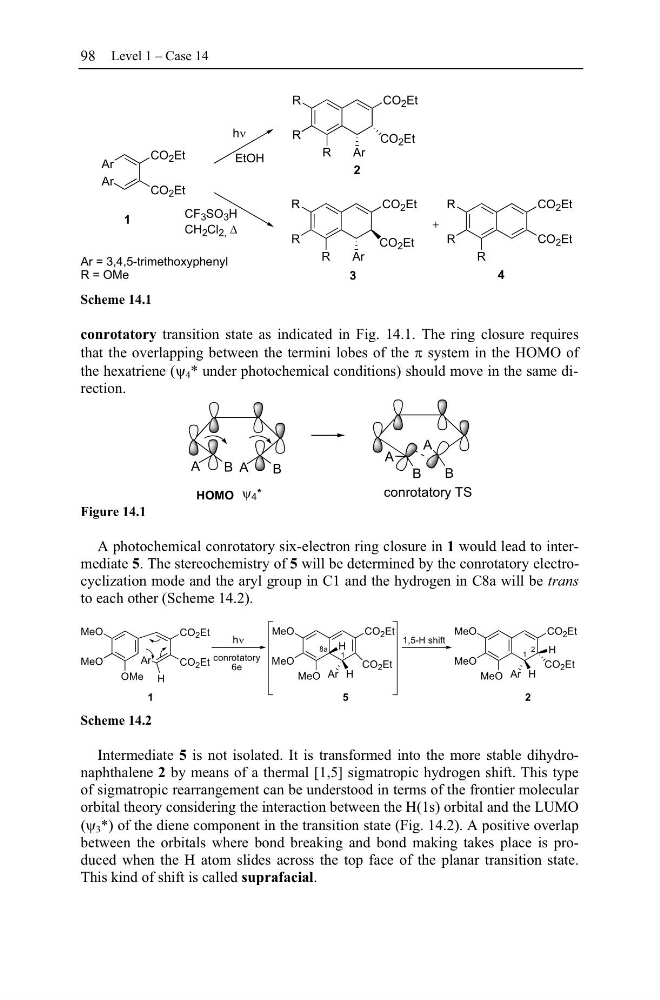
conrotatory transition state as indicated in Fig. 14.1. The ring closure requires
that the overlapping between the termini lobes of the S system in the HOMO of
the hexatriene (\ 4 * under photochemical conditions) should move in the same direction.
A A A
B
B
A A A
HOMO
A
B
B
A
\ 4 *
conrotatory TS
Figure 14.1
A photochemical conrotatory six-electron ring closure in 1 would lead to intermediate 5. The stereochemistry of 5 will be determined by the conrotatory electrocyclization mode and the aryl group in C1 and the hydrogen in C8a will be trans
to each other (Scheme 14.2).
CO 2 Et
CO 2 Et
H
Ar
CO 2 Et
CO 2 Et
H
H
Ar
CO 2 Et
CO 2 Et
H
Ar
H
hQ
1
conrotatory
6e
5
1,5-H shift
2
1
8a
MeO
MeO
OMe
MeO
MeO
MeO
MeO
MeO
MeO
1
2
Scheme 14.2
Intermediate 5 is not isolated. It is transformed into the more stable dihydronaphthalene 2 by means of a thermal [1,5] sigmatropic hydrogen shift. This type
of sigmatropic rearrangement can be understood in terms of the frontier molecular
orbital theory considering the interaction between the H(1s) orbital and the LUMO
(\ 3 *) of the diene component in the transition state (Fig. 14.2). A positive overlap
between the orbitals where bond breaking and bond making takes place is produced when the H atom slides across the top face of the planar transition state.
This kind of shift is called suprafacial.
98
Ar
Ar
CO 2 Et
CO 2 Et
2 Cl 2, '
EtOH
CO 2 Et
Ar
CO 2 Et
R
R
R
CO 2 Et
Ar
CO 2 Et
R
R
R
CO 2 Et
CO 2 Et
R
R
R
hQ
1
2
3
4
Ar = 3,4,5-trimethoxyphenyl
R = OMe
CF 3 SO 3 H
Scheme 14.1
conrotatory transition state as indicated in Fig. 14.1. The ring closure requires
that the overlapping between the termini lobes of the S system in the HOMO of
the hexatriene (\ 4 * under photochemical conditions) should move in the same direction.
A A A
B
B
A A A
HOMO
A
B
B
A
\ 4 *
conrotatory TS
Figure 14.1
A photochemical conrotatory six-electron ring closure in 1 would lead to intermediate 5. The stereochemistry of 5 will be determined by the conrotatory electrocyclization mode and the aryl group in C1 and the hydrogen in C8a will be trans
to each other (Scheme 14.2).
CO 2 Et
CO 2 Et
H
Ar
CO 2 Et
CO 2 Et
H
H
Ar
CO 2 Et
CO 2 Et
H
Ar
H
hQ
1
conrotatory
6e
5
1,5-H shift
2
1
8a
MeO
MeO
OMe
MeO
MeO
MeO
MeO
MeO
MeO
1
2
Scheme 14.2
Intermediate 5 is not isolated. It is transformed into the more stable dihydronaphthalene 2 by means of a thermal [1,5] sigmatropic hydrogen shift. This type
of sigmatropic rearrangement can be understood in terms of the frontier molecular
orbital theory considering the interaction between the H(1s) orbital and the LUMO
(\ 3 *) of the diene component in the transition state (Fig. 14.2). A positive overlap
between the orbitals where bond breaking and bond making takes place is produced when the H atom slides across the top face of the planar transition state.
This kind of shift is called suprafacial.