

L Le ev ve el l 1 1 C Ca as se e 1 14 4
C Cy yc cl li iz za at ti io on n o of f 2 2, ,3 3- -D Di ib be en nz zy yl li id de en ne es su uc cc ci in na at te es s
K Ke ey y p po oi in nt t: : E El E El El E El E E e
le l le le le l lec ct tr t tr tr t tr t t o
ro r ro ro ro ro r roc cy cy cy yc y yc yc yc yc yc y y l li li li l li li l liz i iz i i iz i i a
za z za za za za z zat ti ti ti t ti ti t tio io io io i ion ns s. .
S Si ig i ig g
igm m m
gma at tr t tr tr t tr t t o
ro r ro ro ro ro r rop op op pi ic ic ic ic i ic R Re ea ar rr r rr rr r rr r r a
ra r ra ra ra ra r ran ng ge em me en nt ts ts t ts ts ts ts t t
A Ar
A Ar
CO 2 Et
CO 2 Et
CH 2 Cl 2, '
CO 2 Et
Ar
CO 2 Et
R
R
R
CO 2 Et
Ar
CO 2 Et
R
R
R
CO 2 Et
CO 2 Et
R
R
R
CF 3 SO 3 H
hQ
C Cy yc cl li iz za at ti io on n o of f 2 2, ,3 3- -D Di ib be en nz zy yl li id de en ne es su uc cc ci in na at te es s
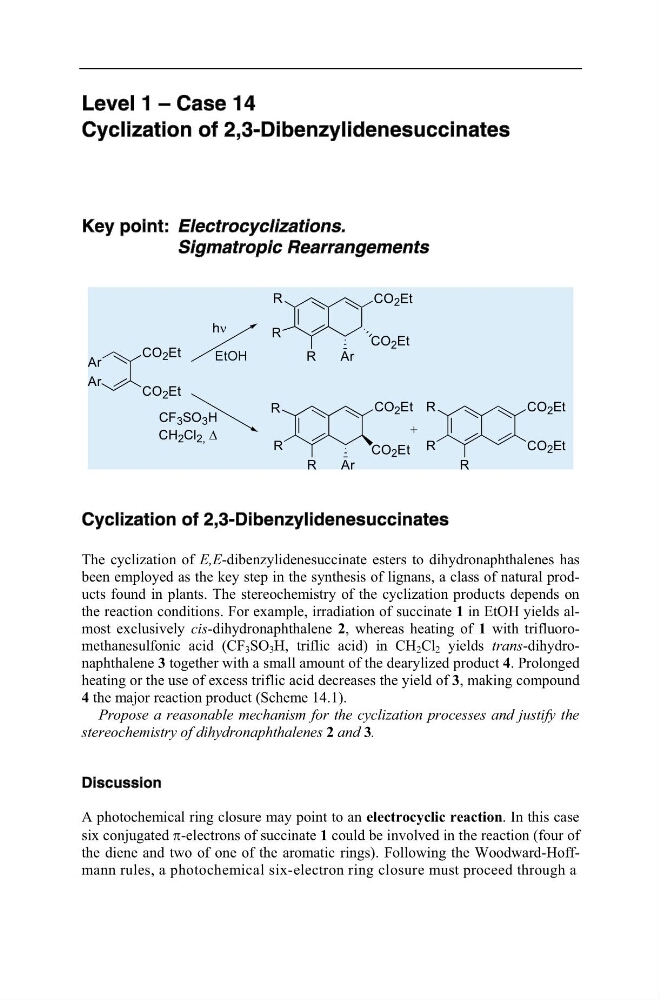
The cyclization of E,E-dibenzylidenesuccinate esters to dihydronaphthalenes has
been employed as the key step in the synthesis of lignans, a class of natural products found in plants. The stereochemistry of the cyclization products depends on
the reaction conditions. For example, irradiation of succinate 1 in EtOH yields almost exclusively cis-dihydronaphthalene 2, whereas heating of 1 with trifluoromethanesulfonic acid (CF 3 SO 3 H, triflic acid) in CH 2 Cl 2 yields trans-dihydronaphthalene 3 together with a small amount of the dearylized product 4. Prolonged
heating or the use of excess triflic acid decreases the yield of
f f
3, making compound
4 the major reaction product (Scheme 14.1).
Propose a reasonable mechanism for the cyclization processes and justify the
stereochemistry of dihydronaphthalenes 2 and 3.
D Di is sc cu us ss si io on n
A photochemical ring closure may point to an electrocyclic reaction. In this case
six conjugated S-electrons of succinate 1 could be involved in the reaction (four of
the diene and two of one of the aromatic rings). Following the Woodward-Hoffmann rules, a photochemical six-electron ring closure must proceed through a
C Cy yc cl li iz za at ti io on n o of f 2 2, ,3 3- -D Di ib be en nz zy yl li id de en ne es su uc cc ci in na at te es s
K Ke ey y p po oi in nt t: : E El E El El E El E E e
le l le le le l lec ct tr t tr tr t tr t t o
ro r ro ro ro ro r roc cy cy cy yc y yc yc yc yc yc y y l li li li l li li l liz i iz i i iz i i a
za z za za za za z zat ti ti ti t ti ti t tio io io io i ion ns s. .
S Si ig i ig g
igm m m
gma at tr t tr tr t tr t t o
ro r ro ro ro ro r rop op op pi ic ic ic ic i ic R Re ea ar rr r rr rr r rr r r a
ra r ra ra ra ra r ran ng ge em me en nt ts ts t ts ts ts ts t t
A Ar
A Ar
CO 2 Et
CO 2 Et
CH 2 Cl 2, '
CO 2 Et
Ar
CO 2 Et
R
R
R
CO 2 Et
Ar
CO 2 Et
R
R
R
CO 2 Et
CO 2 Et
R
R
R
CF 3 SO 3 H
hQ
C Cy yc cl li iz za at ti io on n o of f 2 2, ,3 3- -D Di ib be en nz zy yl li id de en ne es su uc cc ci in na at te es s
The cyclization of E,E-dibenzylidenesuccinate esters to dihydronaphthalenes has
been employed as the key step in the synthesis of lignans, a class of natural products found in plants. The stereochemistry of the cyclization products depends on
the reaction conditions. For example, irradiation of succinate 1 in EtOH yields almost exclusively cis-dihydronaphthalene 2, whereas heating of 1 with trifluoromethanesulfonic acid (CF 3 SO 3 H, triflic acid) in CH 2 Cl 2 yields trans-dihydronaphthalene 3 together with a small amount of the dearylized product 4. Prolonged
heating or the use of excess triflic acid decreases the yield of
f f
3, making compound
4 the major reaction product (Scheme 14.1).
Propose a reasonable mechanism for the cyclization processes and justify the
stereochemistry of dihydronaphthalenes 2 and 3.
D Di is sc cu us ss si io on n
A photochemical ring closure may point to an electrocyclic reaction. In this case
six conjugated S-electrons of succinate 1 could be involved in the reaction (four of
the diene and two of one of the aromatic rings). Following the Woodward-Hoffmann rules, a photochemical six-electron ring closure must proceed through a