

72
2 Analytical Properties
C.
TR=~
Canal
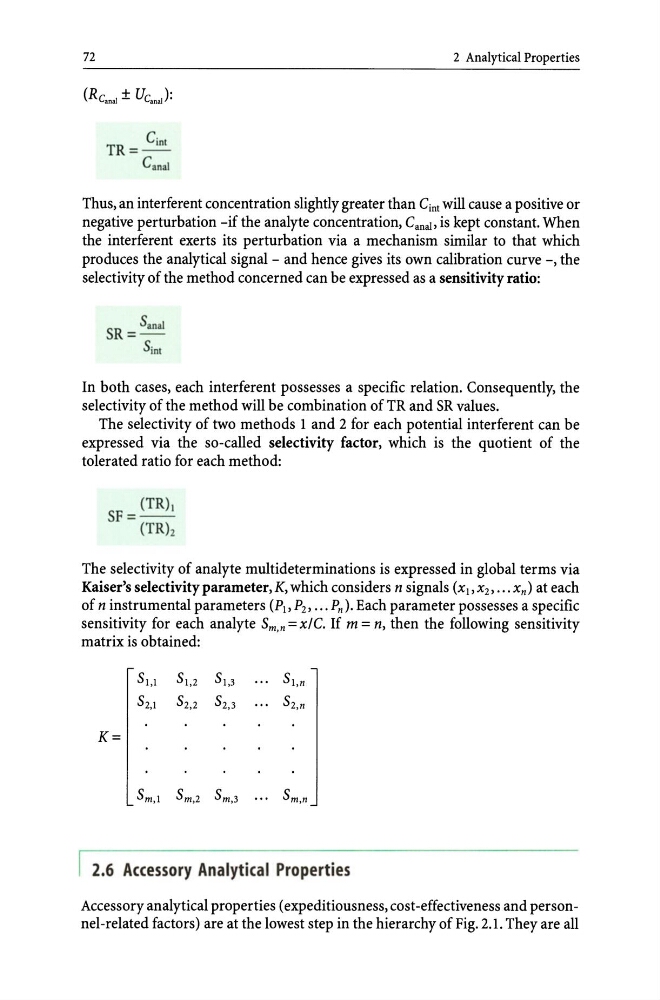
Thus, an interferent concentration slightly greater than Cint will cause a positive or
negative perturbation -if the analyte concentration, Canal' is kept constant. When
the interferent exerts its perturbation via a mechanism similar to that which
produces the analytical signal - and hence gives its own calibration curve -, the
selectivity of the method concerned can be expressed as a sensitivity ratio:
In both cases, each interferent possesses a specific relation. Consequently, the
selectivity of the method will be combination of TR and SR values.
The selectivity of two methods 1 and 2 for each potential interferent can be
expressed via the so-called selectivity factor, which is the quotient of the
tolerated ratio for each method:
(TR),
SF= - -
(TRh
The selectivity of analyte multideterminations is expressed in global terms via
Kaiser's selectivity parameter, K, which considers n signals (XI' X2, ... xn) at each
of n instrumental parameters (PI' P2 , ••• Pn). Each parameter possesses a specific
sensitivity for each analyte 5m,n = x/C. If m = n, then the following sensitivity
matrix is obtained:
51,1 51,2 51,3
51•n
52,1 52,2 52,3
52,n
K=
5m,1 5m,2 5m,3
5m,n
2.6 Accessory Analytical Properties
Accessory analytical properties (expeditiousness, cost -effectiveness and personnel-related factors) are at the lowest step in the hierarchy of Fig. 2.1. They are all
2 Analytical Properties
C.
TR=~
Canal
Thus, an interferent concentration slightly greater than Cint will cause a positive or
negative perturbation -if the analyte concentration, Canal' is kept constant. When
the interferent exerts its perturbation via a mechanism similar to that which
produces the analytical signal - and hence gives its own calibration curve -, the
selectivity of the method concerned can be expressed as a sensitivity ratio:
In both cases, each interferent possesses a specific relation. Consequently, the
selectivity of the method will be combination of TR and SR values.
The selectivity of two methods 1 and 2 for each potential interferent can be
expressed via the so-called selectivity factor, which is the quotient of the
tolerated ratio for each method:
(TR),
SF= - -
(TRh
The selectivity of analyte multideterminations is expressed in global terms via
Kaiser's selectivity parameter, K, which considers n signals (XI' X2, ... xn) at each
of n instrumental parameters (PI' P2 , ••• Pn). Each parameter possesses a specific
sensitivity for each analyte 5m,n = x/C. If m = n, then the following sensitivity
matrix is obtained:
51,1 51,2 51,3
51•n
52,1 52,2 52,3
52,n
K=
5m,1 5m,2 5m,3
5m,n
2.6 Accessory Analytical Properties
Accessory analytical properties (expeditiousness, cost -effectiveness and personnel-related factors) are at the lowest step in the hierarchy of Fig. 2.1. They are all