

2.6 Accessory Analytical Properties
73
attributes of the analytical process and determine laboratory productivity.
Despite their seemingly lesser significance, these properties are frequent
priority targets. All three are related to one another and to the other two groups
of analytical properties.
2.6.1 Expeditiousness
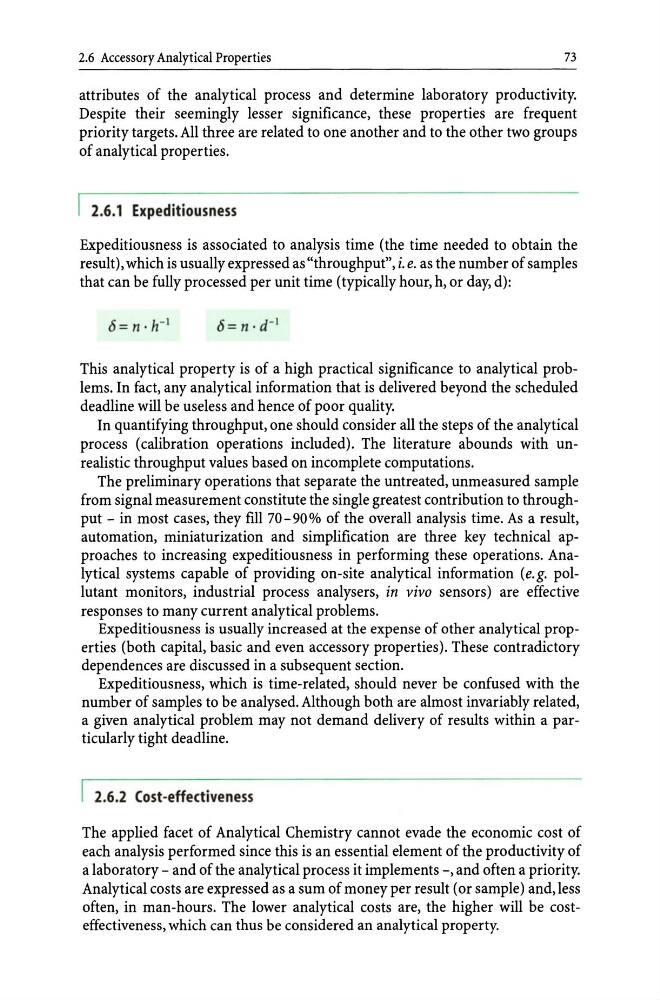
Expeditiousness is associated to analysis time (the time needed to obtain the
result), which is usually expressed as "throughput", i. e. as the number of samples
that can be fully processed per unit time (typically hour, h, or day, d):
This analytical property is of a high practical significance to analytical problems. In fact, any analytical information that is delivered beyond the scheduled
deadline will be useless and hence of poor quality.
In quantifying throughput, one should consider all the steps of the analytical
process (calibration operations included). The literature abounds with unrealistic throughput values based on incomplete computations.
The preliminary operations that separate the untreated, unmeasured sample
from signal measurement constitute the single greatest contribution to throughput - in most cases, they fill 70-90% of the overall analysis time. As a result,
automation, miniaturization and simplification are three key technical approaches to increasing expeditiousness in performing these operations. Analytical systems capable of providing on-site analytical information (e.g. pollutant monitors, industrial process analysers, in vivo sensors) are effective
responses to many current analytical problems.
Expeditiousness is usually increased at the expense of other analytical properties (both capital, basic and even accessory properties). These contradictory
dependences are discussed in a subsequent section.
Expeditiousness, which is time-related, should never be confused with the
number of samples to be analysed. Although both are almost invariably related,
a given analytical problem may not demand delivery of results within a particularly tight deadline.
I 2.6.2 Cost-effectiveness
The applied facet of Analytical Chemistry cannot evade the economic cost of
each analysis performed since this is an essential element of the productivity of
a laboratory - and of the analytical process it implements -, and often a priority.
Analytical costs are expressed as a sum of money per result (or sample) and, less
often, in man-hours. The lower analytical costs are, the higher will be costeffectiveness, which can thus be considered an analytical property.
73
attributes of the analytical process and determine laboratory productivity.
Despite their seemingly lesser significance, these properties are frequent
priority targets. All three are related to one another and to the other two groups
of analytical properties.
2.6.1 Expeditiousness
Expeditiousness is associated to analysis time (the time needed to obtain the
result), which is usually expressed as "throughput", i. e. as the number of samples
that can be fully processed per unit time (typically hour, h, or day, d):
This analytical property is of a high practical significance to analytical problems. In fact, any analytical information that is delivered beyond the scheduled
deadline will be useless and hence of poor quality.
In quantifying throughput, one should consider all the steps of the analytical
process (calibration operations included). The literature abounds with unrealistic throughput values based on incomplete computations.
The preliminary operations that separate the untreated, unmeasured sample
from signal measurement constitute the single greatest contribution to throughput - in most cases, they fill 70-90% of the overall analysis time. As a result,
automation, miniaturization and simplification are three key technical approaches to increasing expeditiousness in performing these operations. Analytical systems capable of providing on-site analytical information (e.g. pollutant monitors, industrial process analysers, in vivo sensors) are effective
responses to many current analytical problems.
Expeditiousness is usually increased at the expense of other analytical properties (both capital, basic and even accessory properties). These contradictory
dependences are discussed in a subsequent section.
Expeditiousness, which is time-related, should never be confused with the
number of samples to be analysed. Although both are almost invariably related,
a given analytical problem may not demand delivery of results within a particularly tight deadline.
I 2.6.2 Cost-effectiveness
The applied facet of Analytical Chemistry cannot evade the economic cost of
each analysis performed since this is an essential element of the productivity of
a laboratory - and of the analytical process it implements -, and often a priority.
Analytical costs are expressed as a sum of money per result (or sample) and, less
often, in man-hours. The lower analytical costs are, the higher will be costeffectiveness, which can thus be considered an analytical property.