

2.5 Basic Analytical Properties
71
determination of a single analyte (or the total analyte concentration in a mixture) may arise from the sample matrix. The discriminate determination of
several analytes can additionally be subject to mutual interferences between
analytes.
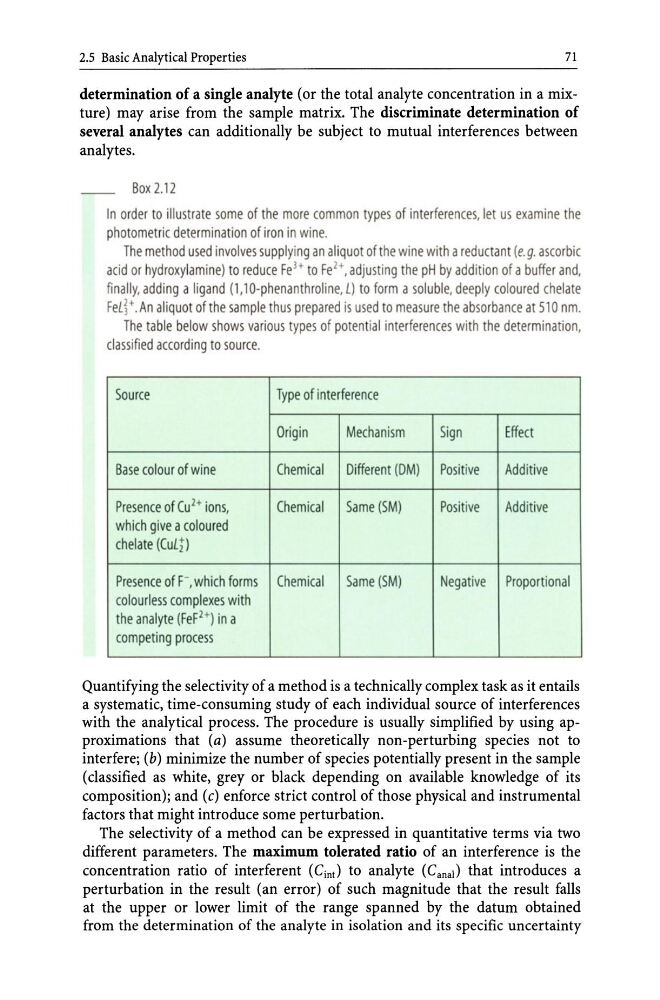
Box 2.12
In order to illustrate some of the more common types of interferences, let us examine the
photometric determination of iron in wine.
The method used involves supplying an aliquot of the wine with a reductant (e. g. ascorbic
acid or hydroxylamine) to reduce Fe 3 + to Fe 2 +, adjusting the pH by addition of a buffer and,
fina lly, adding a ligand (1, 10-phenanthroline, L) to form a sol uble, deeply coloured chelate
FeW . An aliquot of the sample thus prepared is used to measure the absorbance at 510 nm.
The table below shows va rious types of potential interferences with the determination,
classified according to source.
Source
Type of interference
Origin
Mechanism
Sign
Effect
Base colour of wine
Chemical
Different (DM) Positive
Additive
Presence of Cu 2 + ions,
Chemical
Same (SM)
Positive
Additive
which give a coloured
chelate (Cum
Presence of F-, which forms Chemical Same (SM)
Negative Proportional
colourless complexes with
the analyte (FeF 2 +) in a
competing process
Quantifying the selectivity of a method is a technically complex task as it entails
a systematic, time-consuming study of each individual source of interferences
with the analytical process. The procedure is usually simplified by using approximations that (a) assume theoretically non-perturbing species not to
interfere; (b) minimize the number of species potentially present in the sample
(classified as white, grey or black depending on available knowledge of its
composition); and (c) enforce strict control of those physical and instrumental
factors that might introduce some perturbation.
The selectivity of a method can be expressed in quantitative terms via two
different parameters. The maximum tolerated ratio of an interference is the
concentration ratio of interferent (Cint ) to analyte (Canal) that introduces a
perturbation in the result (an error) of such magnitude that the result falls
at the upper or lower limit of the range spanned by the datum obtained
from the determination of the analyte in isolation and its specific uncertainty
71
determination of a single analyte (or the total analyte concentration in a mixture) may arise from the sample matrix. The discriminate determination of
several analytes can additionally be subject to mutual interferences between
analytes.
Box 2.12
In order to illustrate some of the more common types of interferences, let us examine the
photometric determination of iron in wine.
The method used involves supplying an aliquot of the wine with a reductant (e. g. ascorbic
acid or hydroxylamine) to reduce Fe 3 + to Fe 2 +, adjusting the pH by addition of a buffer and,
fina lly, adding a ligand (1, 10-phenanthroline, L) to form a sol uble, deeply coloured chelate
FeW . An aliquot of the sample thus prepared is used to measure the absorbance at 510 nm.
The table below shows va rious types of potential interferences with the determination,
classified according to source.
Source
Type of interference
Origin
Mechanism
Sign
Effect
Base colour of wine
Chemical
Different (DM) Positive
Additive
Presence of Cu 2 + ions,
Chemical
Same (SM)
Positive
Additive
which give a coloured
chelate (Cum
Presence of F-, which forms Chemical Same (SM)
Negative Proportional
colourless complexes with
the analyte (FeF 2 +) in a
competing process
Quantifying the selectivity of a method is a technically complex task as it entails
a systematic, time-consuming study of each individual source of interferences
with the analytical process. The procedure is usually simplified by using approximations that (a) assume theoretically non-perturbing species not to
interfere; (b) minimize the number of species potentially present in the sample
(classified as white, grey or black depending on available knowledge of its
composition); and (c) enforce strict control of those physical and instrumental
factors that might introduce some perturbation.
The selectivity of a method can be expressed in quantitative terms via two
different parameters. The maximum tolerated ratio of an interference is the
concentration ratio of interferent (Cint ) to analyte (Canal) that introduces a
perturbation in the result (an error) of such magnitude that the result falls
at the upper or lower limit of the range spanned by the datum obtained
from the determination of the analyte in isolation and its specific uncertainty