

2.5 Basic Analytical Properties
63
How many will be significant? The ru le of thumb here is to use the standard deviation to
estimate the uncertainty of the digits. If 5 = 0.01324, then the second decimal place will be
uncertain and the mean should be expressed as
x = 10.23 or X = 10.234
The subscript is used to avoid losing potentially important information - whether to keep it
or leave it out ca n be decided upon later.
Rounding is a frequent need when the uncertain digit in a number is followed by others.
If the digit to the right is greater than 5, then the uncertain digit is increased by one (e. g.
3.248 is rounded to 3.25); if it is less than 5, the digit is left unchanged (e. g. 3.242 is rounded
to 3.24); finally, if it is exactly 5, the digit is rounded to the nearest even number (e. g. 9.65
becomes 9.6, and 4.75 is rounded to 4.8).
The position of zeros alters the number of Significant figures in a series of non-zero digits.
Their distribution in decimal numbers does not change, however.
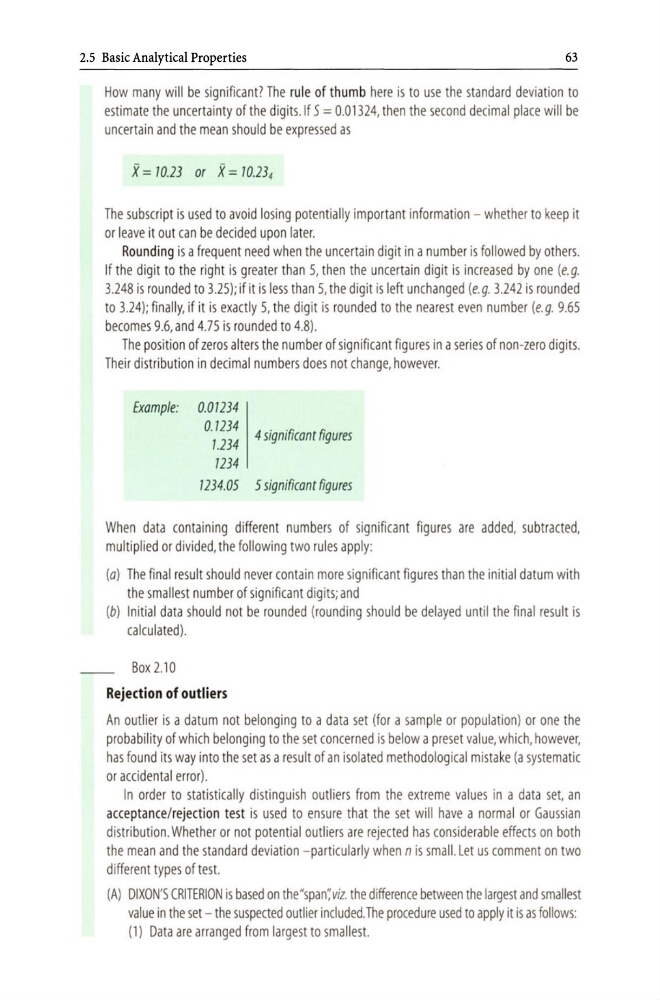
Example: 0.01234
0.1234
1.234
1234
4 significant figures
1234.05 5 significant figures
When data containing different numbers of significant figures are added, subtracted,
multiplied or divided, the following two rules apply:
(a) The final result should never contain more significant figures than the initial datum with
the smallest number of significant digits; and
(b) Initial data should not be rounded (rounding should be delayed until the final resu lt is
calculated).
Box 2.10
Rejection of outliers
An outlier is a datum not belonging to a data set (for a sample or population) or one the
probability of which belonging to the set concerned is below a preset value, which, however,
has found its way into the set as a result of an isolated methodological mistake (a systematic
or accidental error).
In order to statistically distinguish outliers from the extreme values in a data set, an
acceptance/rejection test is used to ensure that the set will have a normal or Gaussian
distribution. Whether or not potential outliers are rejected has considerable effects on both
the mean and the standard deviation - particularly when n is small. Let us comment on two
different types of test.
(A) DIXON'S CRITERION is based on the"span7viz. the difference between the largest and smallest
value in the set - the suspected outlier inciuded.The procedure used to apply it is as follows:
(1) Data are arranged from largest to smallest.
63
How many will be significant? The ru le of thumb here is to use the standard deviation to
estimate the uncertainty of the digits. If 5 = 0.01324, then the second decimal place will be
uncertain and the mean should be expressed as
x = 10.23 or X = 10.234
The subscript is used to avoid losing potentially important information - whether to keep it
or leave it out ca n be decided upon later.
Rounding is a frequent need when the uncertain digit in a number is followed by others.
If the digit to the right is greater than 5, then the uncertain digit is increased by one (e. g.
3.248 is rounded to 3.25); if it is less than 5, the digit is left unchanged (e. g. 3.242 is rounded
to 3.24); finally, if it is exactly 5, the digit is rounded to the nearest even number (e. g. 9.65
becomes 9.6, and 4.75 is rounded to 4.8).
The position of zeros alters the number of Significant figures in a series of non-zero digits.
Their distribution in decimal numbers does not change, however.
Example: 0.01234
0.1234
1.234
1234
4 significant figures
1234.05 5 significant figures
When data containing different numbers of significant figures are added, subtracted,
multiplied or divided, the following two rules apply:
(a) The final result should never contain more significant figures than the initial datum with
the smallest number of significant digits; and
(b) Initial data should not be rounded (rounding should be delayed until the final resu lt is
calculated).
Box 2.10
Rejection of outliers
An outlier is a datum not belonging to a data set (for a sample or population) or one the
probability of which belonging to the set concerned is below a preset value, which, however,
has found its way into the set as a result of an isolated methodological mistake (a systematic
or accidental error).
In order to statistically distinguish outliers from the extreme values in a data set, an
acceptance/rejection test is used to ensure that the set will have a normal or Gaussian
distribution. Whether or not potential outliers are rejected has considerable effects on both
the mean and the standard deviation - particularly when n is small. Let us comment on two
different types of test.
(A) DIXON'S CRITERION is based on the"span7viz. the difference between the largest and smallest
value in the set - the suspected outlier inciuded.The procedure used to apply it is as follows:
(1) Data are arranged from largest to smallest.