

2.5 Basic Analytical Properties
61
In summary, repeatability reflects the minimum possible dispersion (highest
precision) and reproducibility the maximum possible dispersion (lowest precision) of a given analytical process. These two extremes represent the upper and
lower limits for the parameters on the basis of which dispersion is expressed. As
can be seen in Fig. 2.9, there exists a diffuse zone in between that is rather difficult to assign categorically.
It should be noted that the general definition of precision and the practical
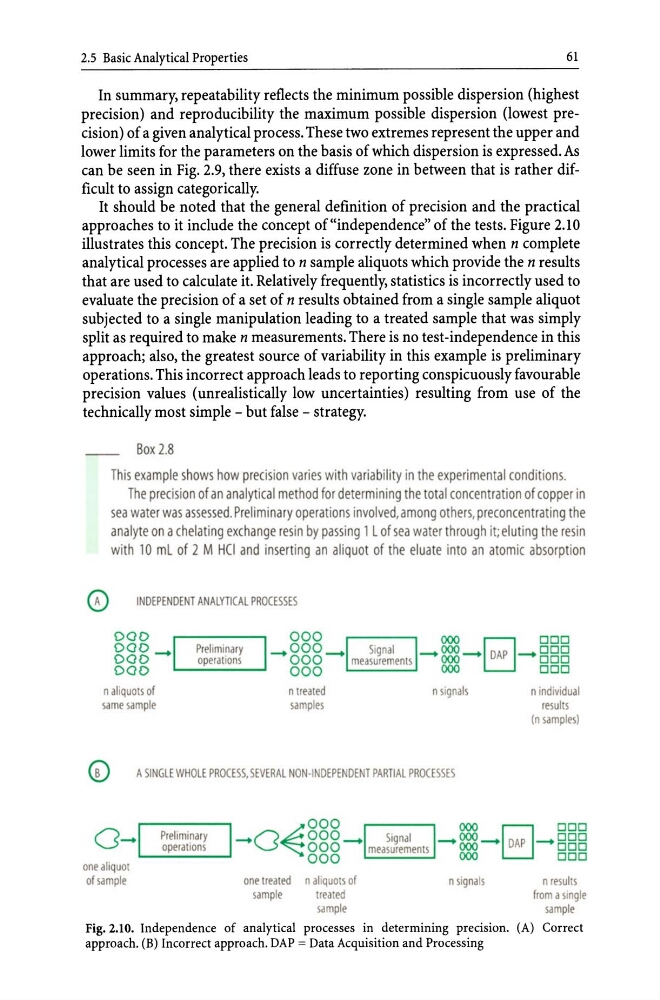
approaches to it include the concept of "independence" of the tests. Figure 2.10
illustrates this concept. The precision is correctly determined when n complete
analytical processes are applied to n sample aliquots which provide the n results
that are used to calculate it. Relatively frequently, statistics is incorrectly used to
evaluate the precision of a set of n results obtained from a single sample aliquot
subjected to a single manipulation leading to a treated sample that was simply
split as required to make n measurements. There is no test-independence in this
approach; also, the greatest source of variability in this example is preliminary
operations. This incorrect approach leads to reporting conspicuously favourable
precision values (unrealistically low uncertainties) resulting from use of the
technically most simple - but false - strategy.
Box 2.B
This example shows how precision varies with variability in the experimental cond itions.
The precision of an analytical method for determining the total concentration of copper in
sea water was assessed. Preliminary operations involved,among others, preconcentrating the
analyte on a chelating exchange resin by passing 1 L of sea water through it; eluting the resin
with 10 mL of 2 M HCI and inserting an aliquot of the eluate into an atomic absorption
(0 INDEPENDENT ANALYTICAL PROCESSES
DOD
DOD_
DOD
DOD
n aliQuots of
same sample
Preliminary
operations
n treated
samples
n signals
n individual
results
(n samples)
G) A SINGLE WHOLE PROCESS, SEVERAL NON-INDEPENDENT PARTIAL PROCESSES
Gone aliquot
of sample
Preliminary
operations
one treated
sample
n aliQuots of
treated
sample
000
BODO
-888- DAP -888
1....-_ _ --1
000
000
n signals
n results
from a single
sample
Fig. 2.10. Independence of analytical processes in determining precision.
approach. (B) Incorrect approach. DAP = Data Acquisition and Processing
(A) Correct
61
In summary, repeatability reflects the minimum possible dispersion (highest
precision) and reproducibility the maximum possible dispersion (lowest precision) of a given analytical process. These two extremes represent the upper and
lower limits for the parameters on the basis of which dispersion is expressed. As
can be seen in Fig. 2.9, there exists a diffuse zone in between that is rather difficult to assign categorically.
It should be noted that the general definition of precision and the practical
approaches to it include the concept of "independence" of the tests. Figure 2.10
illustrates this concept. The precision is correctly determined when n complete
analytical processes are applied to n sample aliquots which provide the n results
that are used to calculate it. Relatively frequently, statistics is incorrectly used to
evaluate the precision of a set of n results obtained from a single sample aliquot
subjected to a single manipulation leading to a treated sample that was simply
split as required to make n measurements. There is no test-independence in this
approach; also, the greatest source of variability in this example is preliminary
operations. This incorrect approach leads to reporting conspicuously favourable
precision values (unrealistically low uncertainties) resulting from use of the
technically most simple - but false - strategy.
Box 2.B
This example shows how precision varies with variability in the experimental cond itions.
The precision of an analytical method for determining the total concentration of copper in
sea water was assessed. Preliminary operations involved,among others, preconcentrating the
analyte on a chelating exchange resin by passing 1 L of sea water through it; eluting the resin
with 10 mL of 2 M HCI and inserting an aliquot of the eluate into an atomic absorption
(0 INDEPENDENT ANALYTICAL PROCESSES
DOD
DOD_
DOD
DOD
n aliQuots of
same sample
Preliminary
operations
n treated
samples
n signals
n individual
results
(n samples)
G) A SINGLE WHOLE PROCESS, SEVERAL NON-INDEPENDENT PARTIAL PROCESSES
Gone aliquot
of sample
Preliminary
operations
one treated
sample
n aliQuots of
treated
sample
000
BODO
-888- DAP -888
1....-_ _ --1
000
000
n signals
n results
from a single
sample
Fig. 2.10. Independence of analytical processes in determining precision.
approach. (B) Incorrect approach. DAP = Data Acquisition and Processing
(A) Correct