

60
Factors affecting variability of results
Sample
Method
Instruments
Apparatus
Reagents
Standards
Time
Others
S
m
e
Testing
conditions
Same
Same
o
e
e
n
2 Analytical Properties
]
Constant due to
cha racteris ics of
study
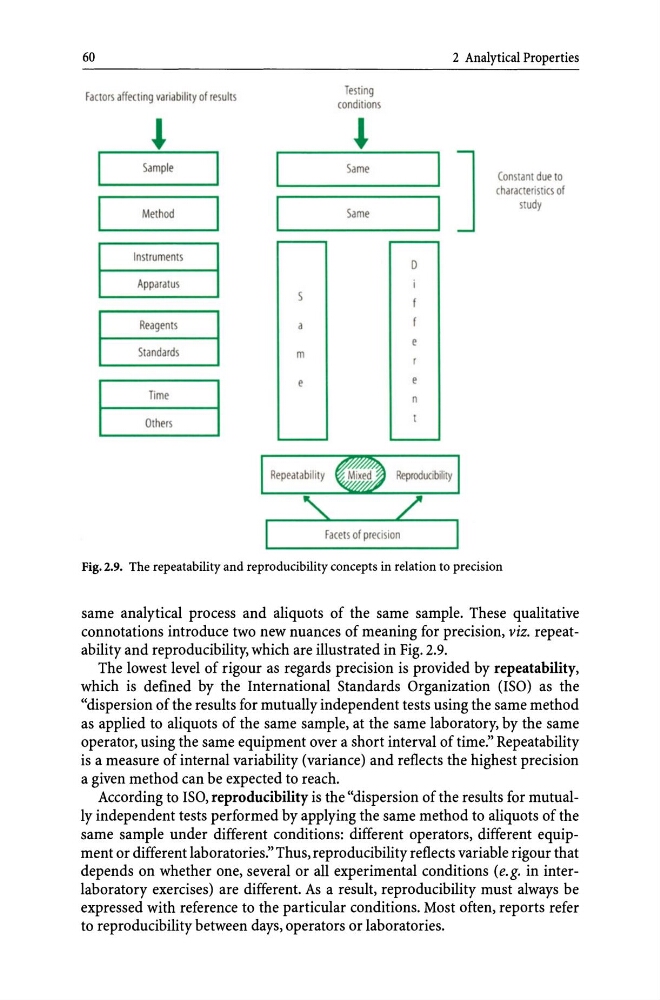
Fig. 2.9. The repeatability and reproducibility concepts in relation to precision
same analytical process and aliquots of the same sample. These qualitative
connotations introduce two new nuances of meaning for precision, viz. repeatability and reproducibility, which are illustrated in Fig. 2.9.
The lowest level of rigour as regards precision is provided by repeatability,
which is defined by the International Standards Organization (ISO) as the
"dispersion of the results for mutually independent tests using the same method
as applied to aliquots of the same sample, at the same laboratory, by the same
operator, using the same equipment over a short interval of time:' Repeatability
is a measure of internal variability (variance) and reflects the highest precision
a given method can be expected to reach.
According to ISO, reproducibility is the "dispersion of the results for mutually independent tests performed by applying the same method to aliquots of the
same sample under different conditions: different operators, different equipment or different laboratories." Thus, reproducibility reflects variable rigour that
depends on whether one, several or all experimental conditions (e.g. in interlaboratory exercises) are different. As a result, reproducibility must always be
expressed with reference to the particular conditions. Most often, reports refer
to reproducibility between days, operators or laboratories.
Factors affecting variability of results
Sample
Method
Instruments
Apparatus
Reagents
Standards
Time
Others
S
m
e
Testing
conditions
Same
Same
o
e
e
n
2 Analytical Properties
]
Constant due to
cha racteris ics of
study
Fig. 2.9. The repeatability and reproducibility concepts in relation to precision
same analytical process and aliquots of the same sample. These qualitative
connotations introduce two new nuances of meaning for precision, viz. repeatability and reproducibility, which are illustrated in Fig. 2.9.
The lowest level of rigour as regards precision is provided by repeatability,
which is defined by the International Standards Organization (ISO) as the
"dispersion of the results for mutually independent tests using the same method
as applied to aliquots of the same sample, at the same laboratory, by the same
operator, using the same equipment over a short interval of time:' Repeatability
is a measure of internal variability (variance) and reflects the highest precision
a given method can be expected to reach.
According to ISO, reproducibility is the "dispersion of the results for mutually independent tests performed by applying the same method to aliquots of the
same sample under different conditions: different operators, different equipment or different laboratories." Thus, reproducibility reflects variable rigour that
depends on whether one, several or all experimental conditions (e.g. in interlaboratory exercises) are different. As a result, reproducibility must always be
expressed with reference to the particular conditions. Most often, reports refer
to reproducibility between days, operators or laboratories.