

2.5 Basic Analytical Properties
59
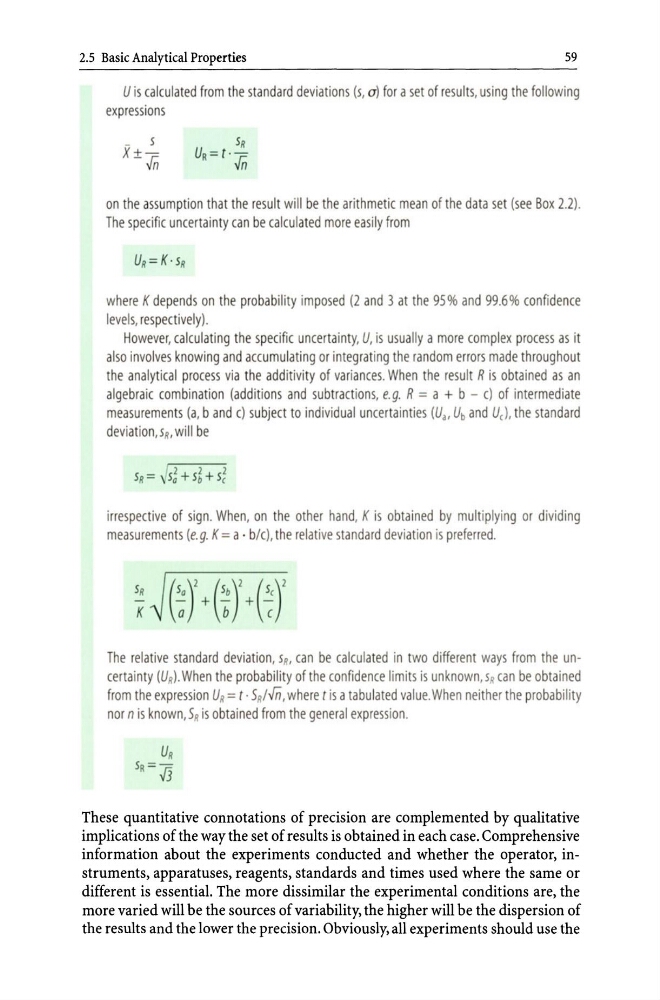
U is calculated from the standard deviations (5,0) for a set of results, using the following
expressions
_
5
X+-.rn
on the assumption that the result will be the arithmetic mean of the data set (see Box 2.2l.
The specific uncertainty can be calculated more easily from
where K depends on the probability imposed (2 and 3 at the 95% and 99.6% confidence
levels, respectively).
However, calculating the specific uncertainty, U, is usually a more complex process as it
also involves knowing and accumulating or integrating the random errors made throughout
the analytical process via the additivity of variances. When the result R is obtained as an
algebraic combination (additions and subtractions, e.g. R = a + b - c) of intermediate
measurements (a, b and c) subject to individual uncertainties (Ua, Ub and Uel, the standard
deviation, SR, will be
irrespective of sign. When, on the other hand, K is obtained by mUltiplying or dividing
measurements (e.g. K = a . b/cl. the relative standard deviation is preferred.
The relative standard deviation, SR, can be calculated in two different ways from the uncerta inty (UR)' When the probability of the confidence limits is unknown, SR can be obtained
from the expression UR = r· SR/.Jn, where r is a tabulated value. When neither the probability
nor n is known, SR is obtained from the general expression.
These quantitative connotations of precision are complemented by qualitative
implications of the way the set of results is obtained in each case. Comprehensive
information about the experiments conducted and whether the operator, instruments, apparatuses, reagents, standards and times used where the same or
different is essential. The more dissimilar the experimental conditions are, the
more varied will be the sources of variability, the higher will be the dispersion of
the results and the lower the precision. Obviously, all experiments should use the
59
U is calculated from the standard deviations (5,0) for a set of results, using the following
expressions
_
5
X+-.rn
on the assumption that the result will be the arithmetic mean of the data set (see Box 2.2l.
The specific uncertainty can be calculated more easily from
where K depends on the probability imposed (2 and 3 at the 95% and 99.6% confidence
levels, respectively).
However, calculating the specific uncertainty, U, is usually a more complex process as it
also involves knowing and accumulating or integrating the random errors made throughout
the analytical process via the additivity of variances. When the result R is obtained as an
algebraic combination (additions and subtractions, e.g. R = a + b - c) of intermediate
measurements (a, b and c) subject to individual uncertainties (Ua, Ub and Uel, the standard
deviation, SR, will be
irrespective of sign. When, on the other hand, K is obtained by mUltiplying or dividing
measurements (e.g. K = a . b/cl. the relative standard deviation is preferred.
The relative standard deviation, SR, can be calculated in two different ways from the uncerta inty (UR)' When the probability of the confidence limits is unknown, SR can be obtained
from the expression UR = r· SR/.Jn, where r is a tabulated value. When neither the probability
nor n is known, SR is obtained from the general expression.
These quantitative connotations of precision are complemented by qualitative
implications of the way the set of results is obtained in each case. Comprehensive
information about the experiments conducted and whether the operator, instruments, apparatuses, reagents, standards and times used where the same or
different is essential. The more dissimilar the experimental conditions are, the
more varied will be the sources of variability, the higher will be the dispersion of
the results and the lower the precision. Obviously, all experiments should use the