

58
2 Analytical Properties
The standard deviation (5,0') has the same dimensions (e.g. mglmL) as the result
to which it applies.
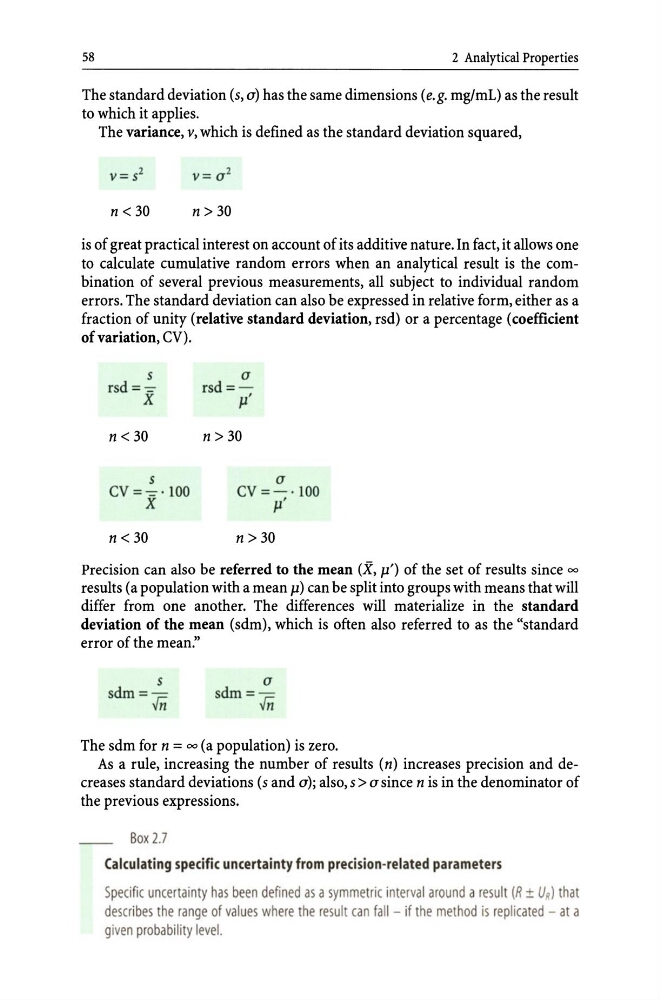
The variance, v, which is defined as the standard deviation squared,
n < 30
n > 30
is of great practical interest on account of its additive nature. In fact, it allows one
to calculate cumulative random errors when an analytical result is the combination of several previous measurements, all subject to individual random
errors. The standard deviation can also be expressed in relative form, either as a
fraction of unity (relative standard deviation, rsd) or a percentage (coefficient
of variation, CV).
5
rsd= =
X
n < 30
5
CV = = ·100
X
n < 30
0'
rsd= -
J.l'
n > 30
0'
CV= -· 100
J.l'
n> 30
Precision can also be referred to the mean (X, ]1') of the set of results since 00
results (a population with a mean]1) can be split into groups with means that will
differ from one another. The differences will materialize in the standard
deviation of the mean (sdm), which is often also referred to as the "standard
error of the mean."
5
sdm = -
rn
0'
sdm =rn
The sdm for n = 00 (a population) is zero.
As a rule, increasing the number of results (n) increases precision and decreases standard deviations (s and 0'); also,s> 0' since n is in the denominator of
the previous expressions.
Box 2.7
Calculating specific uncertainty from precision-related parameters
Specific uncertainty has been defined as a symmetric interval around a result (R ± URI that
describes the range of values where the result can fall - if the method is replicated - at a
given probability level.
2 Analytical Properties
The standard deviation (5,0') has the same dimensions (e.g. mglmL) as the result
to which it applies.
The variance, v, which is defined as the standard deviation squared,
n < 30
n > 30
is of great practical interest on account of its additive nature. In fact, it allows one
to calculate cumulative random errors when an analytical result is the combination of several previous measurements, all subject to individual random
errors. The standard deviation can also be expressed in relative form, either as a
fraction of unity (relative standard deviation, rsd) or a percentage (coefficient
of variation, CV).
5
rsd= =
X
n < 30
5
CV = = ·100
X
n < 30
0'
rsd= -
J.l'
n > 30
0'
CV= -· 100
J.l'
n> 30
Precision can also be referred to the mean (X, ]1') of the set of results since 00
results (a population with a mean]1) can be split into groups with means that will
differ from one another. The differences will materialize in the standard
deviation of the mean (sdm), which is often also referred to as the "standard
error of the mean."
5
sdm = -
rn
0'
sdm =rn
The sdm for n = 00 (a population) is zero.
As a rule, increasing the number of results (n) increases precision and decreases standard deviations (s and 0'); also,s> 0' since n is in the denominator of
the previous expressions.
Box 2.7
Calculating specific uncertainty from precision-related parameters
Specific uncertainty has been defined as a symmetric interval around a result (R ± URI that
describes the range of values where the result can fall - if the method is replicated - at a
given probability level.