

54
2 Analytical Properties
Box 2.5
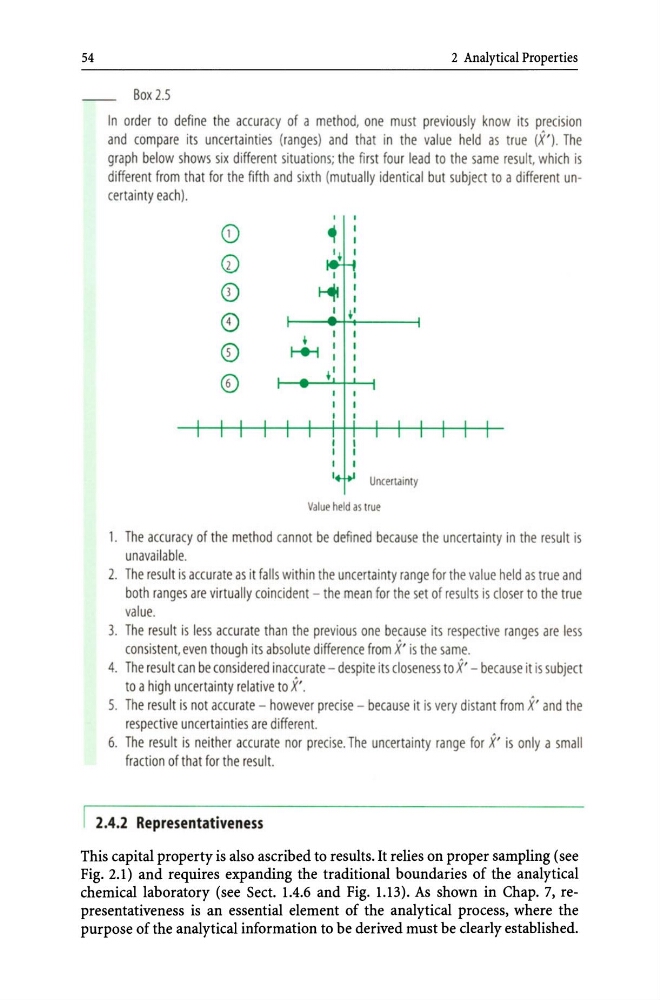
In order to define the accuracy of a method, one must previously know its precision
and compare its uncertainties (ranges) and that in the value held as true (X') . The
graph below shows six different situations; the first four lead to the same result, which is
different from that for the fifth and sixth (mutually identical but subject to a different un -
certainty each) .
CD
~
CD
t. t
CD
HIt
t
t
0)
I .'
CD
•
~ I
Uncertainty
Value held as true
1. The accuracy of the method cannot be defined because the uncertainty in the result is
unavailable.
2. The result is accurate as it fal ls within the uncertainty range for the value held as true and
both ranges are virtually coincident - the mean for the set of results is closer to the true
value.
3. The result is less accurate than the previous one because its respective ranges are less
consistent, even though its absolute difference from X' is the same.
4. The result can be considered inaccurate - despite its closeness to X' - because it is subject
to a high uncertainty relative to X' .
5. The result is not accurate - however precise - because it is very distant from X' and the
respective uncerta inties are different.
6. The result is neither accurate nor precise. The uncertainty range for X' is only a small
fraction of that for the result.
2.4.2 Representativeness
This capital property is also ascribed to results. It relies on proper sampling (see
Fig. 2.1) and requires expanding the traditional boundaries of the analytical
chemical laboratory (see Sect. 1.4.6 and Fig. 1.13). As shown in Chap. 7, representativeness is an essential element of the analytical process, where the
purpose of the analytical information to be derived must be clearly established.
2 Analytical Properties
Box 2.5
In order to define the accuracy of a method, one must previously know its precision
and compare its uncertainties (ranges) and that in the value held as true (X') . The
graph below shows six different situations; the first four lead to the same result, which is
different from that for the fifth and sixth (mutually identical but subject to a different un -
certainty each) .
CD
~
CD
t. t
CD
HIt
t
t
0)
I .'
CD
•
~ I
Uncertainty
Value held as true
1. The accuracy of the method cannot be defined because the uncertainty in the result is
unavailable.
2. The result is accurate as it fal ls within the uncertainty range for the value held as true and
both ranges are virtually coincident - the mean for the set of results is closer to the true
value.
3. The result is less accurate than the previous one because its respective ranges are less
consistent, even though its absolute difference from X' is the same.
4. The result can be considered inaccurate - despite its closeness to X' - because it is subject
to a high uncertainty relative to X' .
5. The result is not accurate - however precise - because it is very distant from X' and the
respective uncerta inties are different.
6. The result is neither accurate nor precise. The uncertainty range for X' is only a small
fraction of that for the result.
2.4.2 Representativeness
This capital property is also ascribed to results. It relies on proper sampling (see
Fig. 2.1) and requires expanding the traditional boundaries of the analytical
chemical laboratory (see Sect. 1.4.6 and Fig. 1.13). As shown in Chap. 7, representativeness is an essential element of the analytical process, where the
purpose of the analytical information to be derived must be clearly established.