

2.4 Capital Analytical Properties
53
I 2.4.1 Accuracy
Accuracy is defined in broad terms as the "degree of consistency between the
result of a determination (Xi) or the mean of n results (i, p') and the true value
(X, intrinsic information) of the analyte, measurand or determinand in a
sample?' This definition is purely theoretical; to endow it with practical significance, the true value (X), which is purely ideal, must be replaced with the value
held as true (X').
Mathematically, accuracy is characterized by a systematic (or gross) error,
which is a difference with a fixed sign (positive or negative). It can be expressed
in absolute (a difference and its sign) or relative terms (a fraction of unity or percentage).
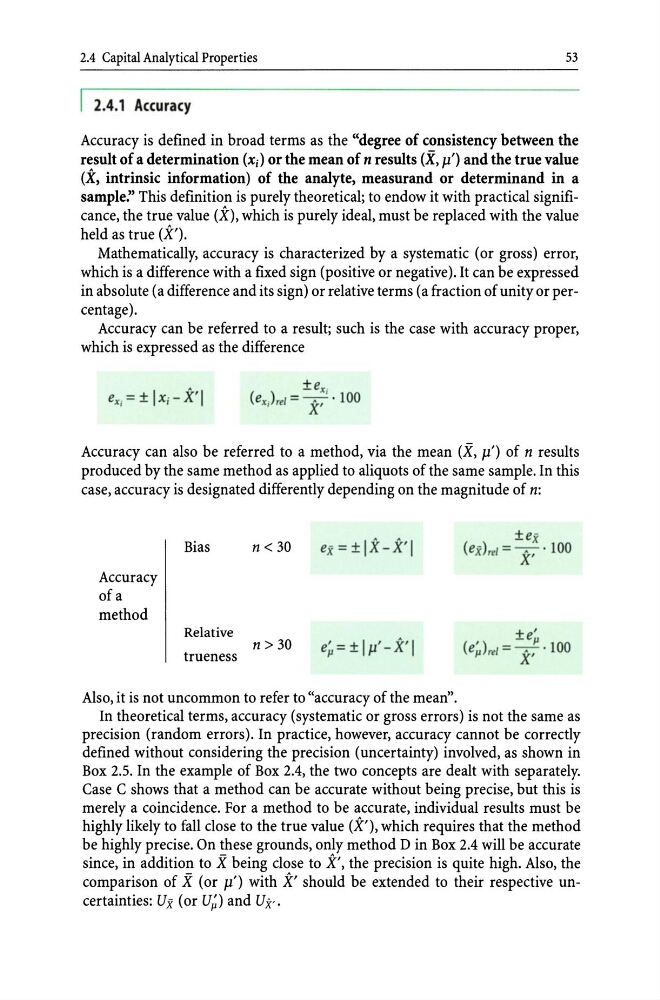
Accuracy can be referred to a result; such is the case with accuracy proper,
which is expressed as the difference
Accuracy can also be referred to a method, via the mean (i, p') of n results
produced by the same method as applied to aliquots of the same sample. In this
case, accuracy is designated differently depending on the magnitude of n:
Bias
n < 30
ex = ±IX -X'I
Accuracy
ofa
method
Relative n> 30
e~ = ± I p' - X' I
trueness
Also, it is not uncommon to refer to "accuracy of the mean".
±ex
(ex)re/ = -.- . 100
X'
I
±e~
(e .. ),,/ = -.- . 100
,.
X'
In theoretical terms, accuracy (systematic or gross errors) is not the same as
precision (random errors). In practice, however, accuracy cannot be correctly
defined without considering the precision (uncertainty) involved, as shown in
Box 2.5. In the example of Box 2.4, the two concepts are dealt with separately.
Case C shows that a method can be accurate without being precise, but this is
merely a coincidence. For a method to be accurate, individual results must be
highly likely to fall close to the true value (X'), which requires that the method
be highly precise. On these grounds, only method D in Box 2.4 will be accurate
since, in addition to i being close to X', the precision is quite high. Also, the
comparison of i (or p') with X' should be extended to their respective uncertainties: Ux (or U~) and Ux'.
53
I 2.4.1 Accuracy
Accuracy is defined in broad terms as the "degree of consistency between the
result of a determination (Xi) or the mean of n results (i, p') and the true value
(X, intrinsic information) of the analyte, measurand or determinand in a
sample?' This definition is purely theoretical; to endow it with practical significance, the true value (X), which is purely ideal, must be replaced with the value
held as true (X').
Mathematically, accuracy is characterized by a systematic (or gross) error,
which is a difference with a fixed sign (positive or negative). It can be expressed
in absolute (a difference and its sign) or relative terms (a fraction of unity or percentage).
Accuracy can be referred to a result; such is the case with accuracy proper,
which is expressed as the difference
Accuracy can also be referred to a method, via the mean (i, p') of n results
produced by the same method as applied to aliquots of the same sample. In this
case, accuracy is designated differently depending on the magnitude of n:
Bias
n < 30
ex = ±IX -X'I
Accuracy
ofa
method
Relative n> 30
e~ = ± I p' - X' I
trueness
Also, it is not uncommon to refer to "accuracy of the mean".
±ex
(ex)re/ = -.- . 100
X'
I
±e~
(e .. ),,/ = -.- . 100
,.
X'
In theoretical terms, accuracy (systematic or gross errors) is not the same as
precision (random errors). In practice, however, accuracy cannot be correctly
defined without considering the precision (uncertainty) involved, as shown in
Box 2.5. In the example of Box 2.4, the two concepts are dealt with separately.
Case C shows that a method can be accurate without being precise, but this is
merely a coincidence. For a method to be accurate, individual results must be
highly likely to fall close to the true value (X'), which requires that the method
be highly precise. On these grounds, only method D in Box 2.4 will be accurate
since, in addition to i being close to X', the precision is quite high. Also, the
comparison of i (or p') with X' should be extended to their respective uncertainties: Ux (or U~) and Ux'.