

52
2 Analytical Properties
as true, X' , is known beforehand. Each method produces n results the respective means of
which are XA, X s , Xc and Xo. A graphical depiction of the results and means allows one to
envisage the different types of errors involved and provides a qualitative description of two
analytical properties: accuracy and precision.
As far as systematic errors are concerned, methods A and B are subject to bias, 1 XA - X' 1 >
I Xs - X' I, whereas methods C and 0 are not. Both means, XA and Xs, are subject to a
negative error. Each datum possesses an intrinsic accuracy that is its specific difference from
X'; such a difference coincides with the respective means for methods C and 0 (Xc and Xo).
Regarding random errors, the results of methods A and C are highly disperse (i. e. the differences from the respective means are significant), whereas those of methods Band Dare
tightly clustered around their means.Therefore, methods Band C are more precise than are A
and C.
2.4 Capital Analytical Properties
The adjective "capital" is synonymous with "foremost" and "topmost", and is
used here to qualify the top-rank properties in the hierarchy of Fig. 2.1 (accuracy
and representativeness). These two are directly ascribed to results and hence to
analytical information, the Analytical Chemistry key word around which all
others revolve (see Fig. 1.10).
It is very important to realize that both capital properties are indispensable
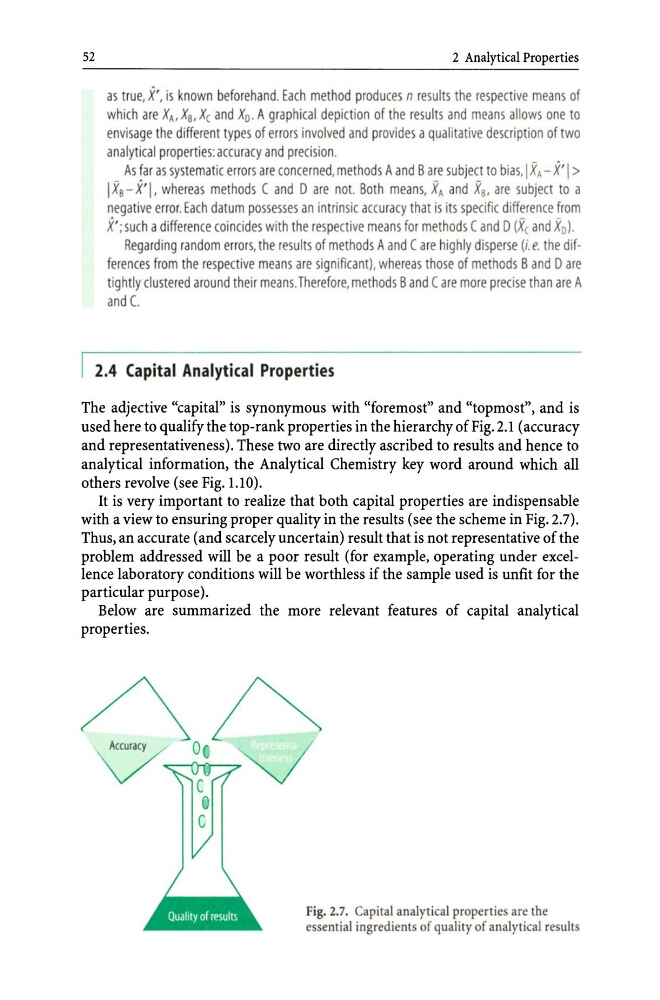
with a view to ensuring proper quality in the results (see the scheme in Fig. 2.7).
Thus, an accurate (and scarcely uncertain) result that is not representative of the
problem addressed will be a poor result (for example, operating under excellence laboratory conditions will be worthless if the sample used is unfit for the
particular purpose).
Below are summarized the more relevant features of capital analytical
properties.
Fig. 2.7. Capital analytical properties are the
essential ingredients of quality of analytical results
2 Analytical Properties
as true, X' , is known beforehand. Each method produces n results the respective means of
which are XA, X s , Xc and Xo. A graphical depiction of the results and means allows one to
envisage the different types of errors involved and provides a qualitative description of two
analytical properties: accuracy and precision.
As far as systematic errors are concerned, methods A and B are subject to bias, 1 XA - X' 1 >
I Xs - X' I, whereas methods C and 0 are not. Both means, XA and Xs, are subject to a
negative error. Each datum possesses an intrinsic accuracy that is its specific difference from
X'; such a difference coincides with the respective means for methods C and 0 (Xc and Xo).
Regarding random errors, the results of methods A and C are highly disperse (i. e. the differences from the respective means are significant), whereas those of methods Band Dare
tightly clustered around their means.Therefore, methods Band C are more precise than are A
and C.
2.4 Capital Analytical Properties
The adjective "capital" is synonymous with "foremost" and "topmost", and is
used here to qualify the top-rank properties in the hierarchy of Fig. 2.1 (accuracy
and representativeness). These two are directly ascribed to results and hence to
analytical information, the Analytical Chemistry key word around which all
others revolve (see Fig. 1.10).
It is very important to realize that both capital properties are indispensable
with a view to ensuring proper quality in the results (see the scheme in Fig. 2.7).
Thus, an accurate (and scarcely uncertain) result that is not representative of the
problem addressed will be a poor result (for example, operating under excellence laboratory conditions will be worthless if the sample used is unfit for the
particular purpose).
Below are summarized the more relevant features of capital analytical
properties.
Fig. 2.7. Capital analytical properties are the
essential ingredients of quality of analytical results