

44
2 Analytical Properties
(e) a routine determination of n = 40 aliquots that yielded ]1' _ Up' = 3.35 ± 0.20 mg/L; and
(d) an interlaboratory exercise involving 14 laboratories that analysed 8 samples each to
provide 14 means (X,) from which a global mean x: = 3.30 ± 0.15 mg/L for the exercise
was calculated.
As can be seen, specific uncertainties decrease from Ux, - which cannot be determined - to
UIJ·.ln this example, special interlaboratory testing led to Jower uncertainty.
The generic uncertainty in x, is very large but that in X' is very small because the latter is
very close to the true value (Xl. Also, the specific uncertainty (ux-l is quite small.
Even though the referential value (X', considered to be the true value) is subject
to little generic uncertainty, its specific uncertainty, Ux" can be greater or less
than Up' inasmuch as it is calculated from n' means (in') obtained by n' laboratories analysing different aliquots of the same sample, which will have introduced much more significant sources or variability. The specific uncertainty in
the mean of 00 results, p, is theoretically zero.
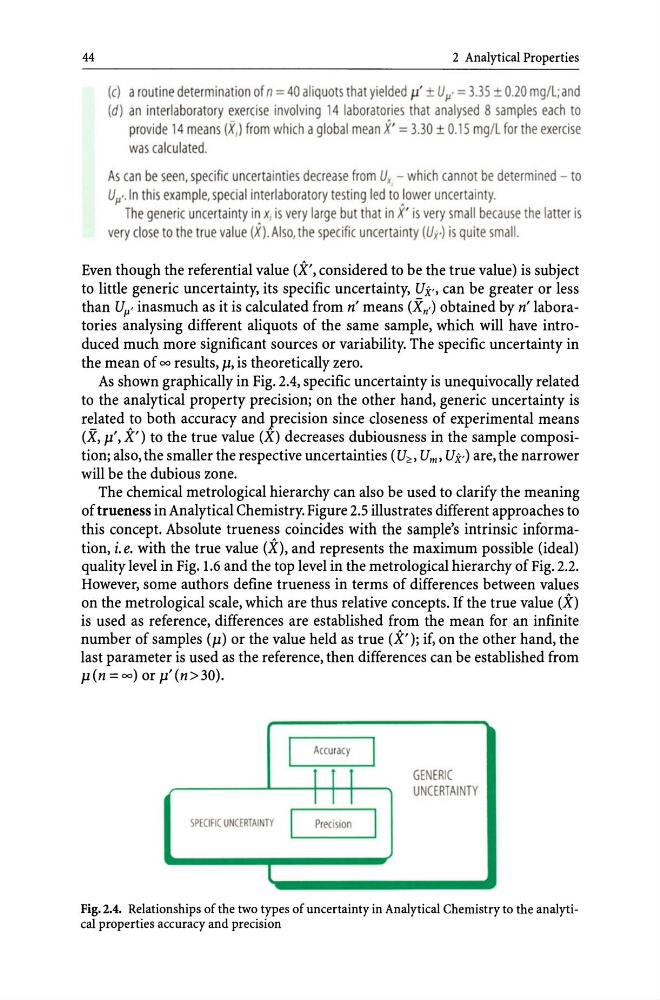
As shown graphically in Fig. 2.4, specific uncertainty is unequivocally related
to the analytical property precision; on the other hand, generic uncertainty is
r~ated !o both accuracy and precision since closeness of experimental means
(X, p', X') to the true value (X) decreases dubiousness in the sample composition; also, the smaller the respective uncertainties (U?, U m' U x' ) are, the narrower
will be the dubious zone.
The chemical metrological hierarchy can also be used to clarify the meaning
of trueness in Analytical Chemistry. Figure 2.5 illustrates different approaches to
this concept. Absolute trueness coincides with the sample's intrinsic information, i. e. with the true value (X), and represents the maximum possible (ideal)
quality level in Fig. 1.6 and the top level in the metrological hierarchy of Fig. 2.2.
However, some authors define trueness in terms of differences between values
on the metrological scale, which are thus relative concepts. If the true value (X)
is used as reference, differences are established from the mean for an infinite
number of samples (]1) or the value held as true (X') ; if, on the other hand, the
last parameter is used as the reference, then differences can be established from
p(n =00) or p'(n>30).
I
Accuracy
I
t t t
GENERIC
I I I
UNCERTAINTY
SPECIFIC UNCERTAINTY
I
Precision
I
l
Fig. 2.4. Relationships of the two types of uncertainty in Analytical Chemistry to the analytical properties accuracy and precision
2 Analytical Properties
(e) a routine determination of n = 40 aliquots that yielded ]1' _ Up' = 3.35 ± 0.20 mg/L; and
(d) an interlaboratory exercise involving 14 laboratories that analysed 8 samples each to
provide 14 means (X,) from which a global mean x: = 3.30 ± 0.15 mg/L for the exercise
was calculated.
As can be seen, specific uncertainties decrease from Ux, - which cannot be determined - to
UIJ·.ln this example, special interlaboratory testing led to Jower uncertainty.
The generic uncertainty in x, is very large but that in X' is very small because the latter is
very close to the true value (Xl. Also, the specific uncertainty (ux-l is quite small.
Even though the referential value (X', considered to be the true value) is subject
to little generic uncertainty, its specific uncertainty, Ux" can be greater or less
than Up' inasmuch as it is calculated from n' means (in') obtained by n' laboratories analysing different aliquots of the same sample, which will have introduced much more significant sources or variability. The specific uncertainty in
the mean of 00 results, p, is theoretically zero.
As shown graphically in Fig. 2.4, specific uncertainty is unequivocally related
to the analytical property precision; on the other hand, generic uncertainty is
r~ated !o both accuracy and precision since closeness of experimental means
(X, p', X') to the true value (X) decreases dubiousness in the sample composition; also, the smaller the respective uncertainties (U?, U m' U x' ) are, the narrower
will be the dubious zone.
The chemical metrological hierarchy can also be used to clarify the meaning
of trueness in Analytical Chemistry. Figure 2.5 illustrates different approaches to
this concept. Absolute trueness coincides with the sample's intrinsic information, i. e. with the true value (X), and represents the maximum possible (ideal)
quality level in Fig. 1.6 and the top level in the metrological hierarchy of Fig. 2.2.
However, some authors define trueness in terms of differences between values
on the metrological scale, which are thus relative concepts. If the true value (X)
is used as reference, differences are established from the mean for an infinite
number of samples (]1) or the value held as true (X') ; if, on the other hand, the
last parameter is used as the reference, then differences can be established from
p(n =00) or p'(n>30).
I
Accuracy
I
t t t
GENERIC
I I I
UNCERTAINTY
SPECIFIC UNCERTAINTY
I
Precision
I
l
Fig. 2.4. Relationships of the two types of uncertainty in Analytical Chemistry to the analytical properties accuracy and precision