

2.2 The Chemical Metrological Hierarchy: Uncertainty and Trueness
43
tage terms. The true value, X, is subject to zero specific uncertainty, which coincides with the absolute absence of dubiousness in the analyte proportion in the
sample. This is intrinsic information that corresponds to ideal quality (see
Fig.1.6).
Partial specific uncertainty exists over an interval ± U around a specific
datum; the interval includes the analyte proportion in the sample. The ultimate
expression of partial specific uncertainty is that consisting of a single result (Xi),
which expresses no interval by itself; however, it is subject to less generic uncertainty as regards the maximum dubiousness since it bounds an approximate
zone or interval where the information sought may lie. The mean of n < 30
results, X, obtained by analysing multiple aliquots of the same sample, is subject
to a statistical uncertainty ± Ux, as is the mean of n> 30 results (± p'). As n
increases, the uncertainty decreases (I UX I> 1 UI" I), and X and p' approach the
true value - from which Xi can be more or less distant.
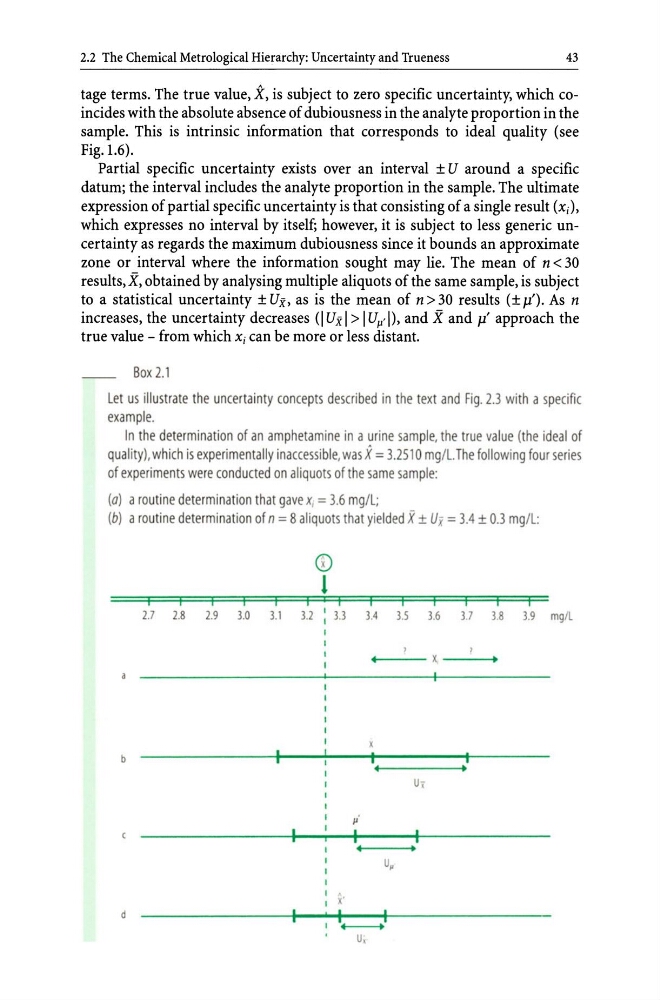
Box 2.1
Let us illustrate the uncertainty concepts described in the text and Fig. 2J with a specific
example.
In the determination of an amphetamine in a urine sample. the true value (the ideal of
quality). which is experimentally inaccessible. was X = 3.2510 mg/L. The following four series
of experiments were conducted on aliquots of the same sample:
(a) a routine determination that gave x, = 3.6 mg/L;
(b) a routine determination of n = 8 aliquots that yielded X ± Vx = 3.4 ± OJ mg/L:
I
I
I
I
2.7
2.8
2.9 3.0
3.1
3.2
b
d
CD
1
I I
I
I
I
I
3.3
3.4
3.5
3.6
3.7
x
x
I
I
... 4 - - - -...
".
u~
,
A
, x'
I
I
,+-----+
U,
u.
I
I
3.8
3.9 mg/L
43
tage terms. The true value, X, is subject to zero specific uncertainty, which coincides with the absolute absence of dubiousness in the analyte proportion in the
sample. This is intrinsic information that corresponds to ideal quality (see
Fig.1.6).
Partial specific uncertainty exists over an interval ± U around a specific
datum; the interval includes the analyte proportion in the sample. The ultimate
expression of partial specific uncertainty is that consisting of a single result (Xi),
which expresses no interval by itself; however, it is subject to less generic uncertainty as regards the maximum dubiousness since it bounds an approximate
zone or interval where the information sought may lie. The mean of n < 30
results, X, obtained by analysing multiple aliquots of the same sample, is subject
to a statistical uncertainty ± Ux, as is the mean of n> 30 results (± p'). As n
increases, the uncertainty decreases (I UX I> 1 UI" I), and X and p' approach the
true value - from which Xi can be more or less distant.
Box 2.1
Let us illustrate the uncertainty concepts described in the text and Fig. 2J with a specific
example.
In the determination of an amphetamine in a urine sample. the true value (the ideal of
quality). which is experimentally inaccessible. was X = 3.2510 mg/L. The following four series
of experiments were conducted on aliquots of the same sample:
(a) a routine determination that gave x, = 3.6 mg/L;
(b) a routine determination of n = 8 aliquots that yielded X ± Vx = 3.4 ± OJ mg/L:
I
I
I
I
2.7
2.8
2.9 3.0
3.1
3.2
b
d
CD
1
I I
I
I
I
I
3.3
3.4
3.5
3.6
3.7
x
x
I
I
... 4 - - - -...
".
u~
,
A
, x'
I
I
,+-----+
U,
u.
I
I
3.8
3.9 mg/L