

2.3 Errors in Analytical Chemistry
TRUENESS
Absolute
I - 0
Relative
B
I x'-x I
Theoretical
EJ
I ~'- x· 1
L...-_ _ ---.£..c.a. ] Practical
Decreasing relative trueness
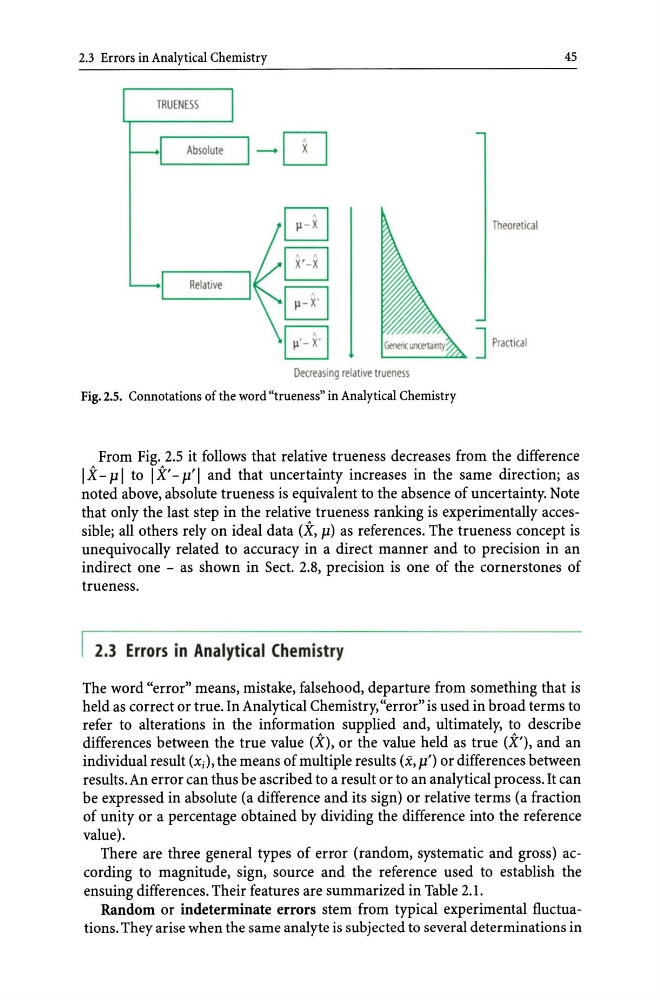
Fig.2.5. Connotations of the word "trueness" in Analytical Chemistry
45
From Fig. 2.5 it follows that relative trueness decreases from the difference
I X - pi to I X' - p' I and that uncertainty increases in the same direction; as
noted above, absolute trueness is equivalent to the absence of uncertainty. Note
that only the last step in the relative trueness ranking is experimentally accessible; all others rely on ideal data (X, p) as references. The trueness concept is
unequivocally related to accuracy in a direct manner and to precision in an
indirect one - as shown in Sect. 2.8, precision is one of the cornerstones of
trueness.
2.3 Errors in Analytical Chemistry
The word "error" means, mistake, falsehood, departure from something that is
held as correct or true. In Analytical Chemistry, "error" is used in broad terms to
refer to alterations in the information supplied and, ultimately, to describe
differences between the true value (X), or the value held as true (X'), and an
individual result (x;), the means of multiple results (x, p') or differences between
results. An error can thus be ascribed to a result or to an analytical process. It can
be expressed in absolute (a difference and its sign) or relative terms (a fraction
of unity or a percentage obtained by dividing the difference into the reference
value).
There are three general types of error (random, systematic and gross) according to magnitude, sign, source and the reference used to establish the
ensuing differences. Their features are summarized in Table 2.1.
Random or indeterminate errors stem from typical experimental fluctuations. They arise when the same analyte is subjected to several determinations in
TRUENESS
Absolute
I - 0
Relative
B
I x'-x I
Theoretical
EJ
I ~'- x· 1
L...-_ _ ---.£..c.a. ] Practical
Decreasing relative trueness
Fig.2.5. Connotations of the word "trueness" in Analytical Chemistry
45
From Fig. 2.5 it follows that relative trueness decreases from the difference
I X - pi to I X' - p' I and that uncertainty increases in the same direction; as
noted above, absolute trueness is equivalent to the absence of uncertainty. Note
that only the last step in the relative trueness ranking is experimentally accessible; all others rely on ideal data (X, p) as references. The trueness concept is
unequivocally related to accuracy in a direct manner and to precision in an
indirect one - as shown in Sect. 2.8, precision is one of the cornerstones of
trueness.
2.3 Errors in Analytical Chemistry
The word "error" means, mistake, falsehood, departure from something that is
held as correct or true. In Analytical Chemistry, "error" is used in broad terms to
refer to alterations in the information supplied and, ultimately, to describe
differences between the true value (X), or the value held as true (X'), and an
individual result (x;), the means of multiple results (x, p') or differences between
results. An error can thus be ascribed to a result or to an analytical process. It can
be expressed in absolute (a difference and its sign) or relative terms (a fraction
of unity or a percentage obtained by dividing the difference into the reference
value).
There are three general types of error (random, systematic and gross) according to magnitude, sign, source and the reference used to establish the
ensuing differences. Their features are summarized in Table 2.1.
Random or indeterminate errors stem from typical experimental fluctuations. They arise when the same analyte is subjected to several determinations in