

2.2 The Chemical Metrological Hierarchy: Uncertainty and Trueness
41
properties support capital properties. In addition, analytical properties bear
complementary and contradictory relationships that are discussed later on in
this chapter, following a concise description of each analytical property. A prior,
brief definition of errors in Analytical Chemistry may be of help to better define
the properties. Thus, analytical chemical errors arise from the so-called
"chemical metrological hierarchy", which allows one to define such analytical
features as uncertainty and trueness, which are not included in the scheme of
Fig. 2.1 but are obviously related to classical analytical properties.
I 2.2 The Chemical Metrological Hierarchy: Uncertainty and Trueness
Subjecting n aliquots of the same sample to an analytical process provides n
results. Obviously, the quality of the information obtained will increase with
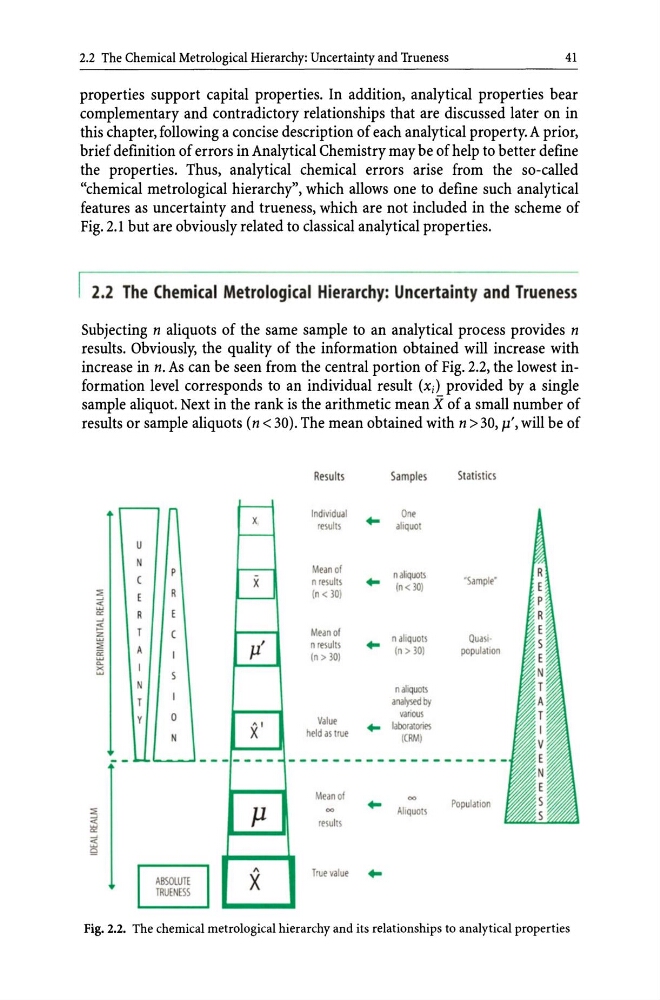
increase in n. As can be seen from the central portion of Fig. 2.2, the lowest information level corresponds to an individual result (Xi) provided by a single
sample aliquot. Next in the rank is the arithmetic mean X of a small number of
results or sample aliquots (n < 30). The mean obtained with n > 30, p', will be of
Results
Samples
Statistics
t--x
IndIVidual
..
One
lesults
aliquot
r-U
N
C
~
~
X
' - - -
Meanor
naioquots
n results
.. ' Sample'
(n < 30)
(n < 30)
~
-'
~
z
~
A
ffi
...
]1'
Meanor
n aliquots
QuasI
n results
..
(n> 30)
(n> 30)
populauon
~
nallquotl
analysed by
0
N
X '
Value
vanous
. . laboratories
held as true
(CRM)
----- ------------------P
Mean or
.. Ahquots
PopulatIon
reluls
1\
X
True value
..
Fig. 2.2. The chemical metrological hierarchy and its relationships to analytical properties
41
properties support capital properties. In addition, analytical properties bear
complementary and contradictory relationships that are discussed later on in
this chapter, following a concise description of each analytical property. A prior,
brief definition of errors in Analytical Chemistry may be of help to better define
the properties. Thus, analytical chemical errors arise from the so-called
"chemical metrological hierarchy", which allows one to define such analytical
features as uncertainty and trueness, which are not included in the scheme of
Fig. 2.1 but are obviously related to classical analytical properties.
I 2.2 The Chemical Metrological Hierarchy: Uncertainty and Trueness
Subjecting n aliquots of the same sample to an analytical process provides n
results. Obviously, the quality of the information obtained will increase with
increase in n. As can be seen from the central portion of Fig. 2.2, the lowest information level corresponds to an individual result (Xi) provided by a single
sample aliquot. Next in the rank is the arithmetic mean X of a small number of
results or sample aliquots (n < 30). The mean obtained with n > 30, p', will be of
Results
Samples
Statistics
t--x
IndIVidual
..
One
lesults
aliquot
r-U
N
C
~
~
X
' - - -
Meanor
naioquots
n results
.. ' Sample'
(n < 30)
(n < 30)
~
-'
~
z
~
A
ffi
...
]1'
Meanor
n aliquots
QuasI
n results
..
(n> 30)
(n> 30)
populauon
~
nallquotl
analysed by
0
N
X '
Value
vanous
. . laboratories
held as true
(CRM)
----- ------------------P
Mean or
.. Ahquots
PopulatIon
reluls
1\
X
True value
..
Fig. 2.2. The chemical metrological hierarchy and its relationships to analytical properties