

332
8 Analytical Chemistry and Quality
sponsor creates a constructive atmosphere for discussions, where all participants should preferably be present, the quantitative information derived will be highly valuable as it could
hardly be found in the analytical literature.
Participation in interlaboratory exercises is usually voluntary. However, it can be made
compulsory by the Quality Manual or an accreditation scheme.
Box 8.11
Improving the Quality of Results Via Interlaboratory Exercises
The benefits gained in participating in intercomparison exercises are undeniable. In addition
to establishing a network of laboratories with which experience can be exchanged, the
exercises provide results that improve substantially when several of them are carried out in
sequence following discussion of any discrepancies and pinpointing of their sources. The
European Union's BCR provides a number of applicable examples. One is described below.
Ilg/kg
1.50 - r - - - - - - - - - - - - - - - - - - - ,
1.25
1.00 +--~-----L-...... __ii~--------I
0.75
1l9/kg
1.50 - r - - - - - - - - - - - - - - - - - - - ,
1.25
1.00 +-'II~~-...... ____r----.:L-___ ....... ___,,..._L-...,.....----1
0.75
2
4
6
8 9 10 11 12 13
Laboratory
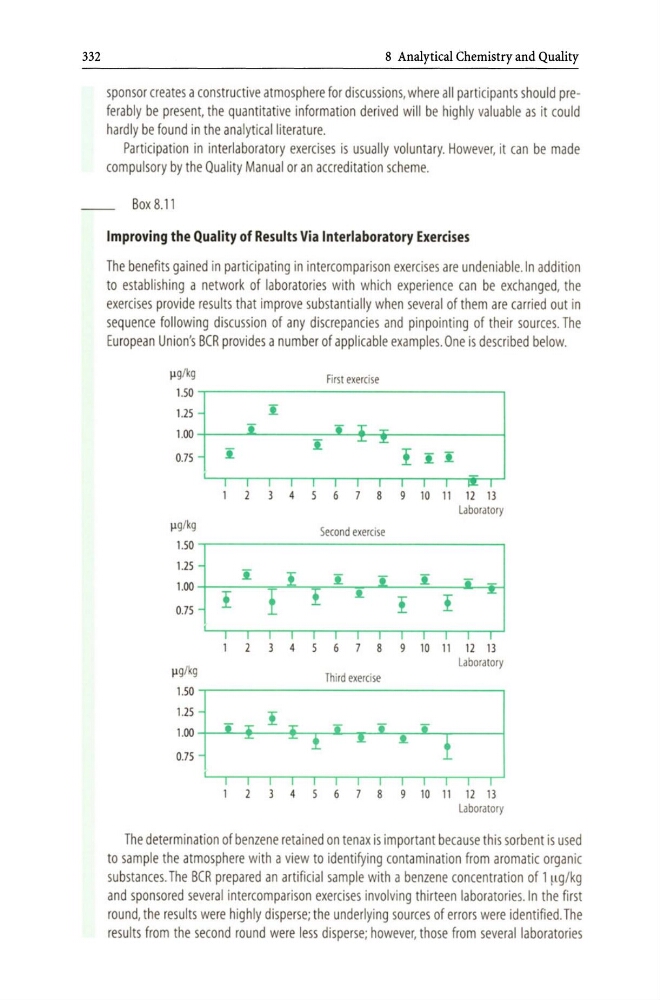
The determination of benzene retained on tenax is important because this sorbent is used
to sample the atmosphere with a view to identifying contamination from aromatic organic
substances. The BCR prepared an artificial sample with a benzene concentration of 1 ~lg/kg
and sponsored several intercomparison exercises involving thirteen laboratories. In the first
round, the results were highly disperse; the underlying sources of errors were identified. The
results from the second round were less disperse; however, those from several laboratories
8 Analytical Chemistry and Quality
sponsor creates a constructive atmosphere for discussions, where all participants should preferably be present, the quantitative information derived will be highly valuable as it could
hardly be found in the analytical literature.
Participation in interlaboratory exercises is usually voluntary. However, it can be made
compulsory by the Quality Manual or an accreditation scheme.
Box 8.11
Improving the Quality of Results Via Interlaboratory Exercises
The benefits gained in participating in intercomparison exercises are undeniable. In addition
to establishing a network of laboratories with which experience can be exchanged, the
exercises provide results that improve substantially when several of them are carried out in
sequence following discussion of any discrepancies and pinpointing of their sources. The
European Union's BCR provides a number of applicable examples. One is described below.
Ilg/kg
1.50 - r - - - - - - - - - - - - - - - - - - - ,
1.25
1.00 +--~-----L-...... __ii~--------I
0.75
1l9/kg
1.50 - r - - - - - - - - - - - - - - - - - - - ,
1.25
1.00 +-'II~~-...... ____r----.:L-___ ....... ___,,..._L-...,.....----1
0.75
2
4
6
8 9 10 11 12 13
Laboratory
The determination of benzene retained on tenax is important because this sorbent is used
to sample the atmosphere with a view to identifying contamination from aromatic organic
substances. The BCR prepared an artificial sample with a benzene concentration of 1 ~lg/kg
and sponsored several intercomparison exercises involving thirteen laboratories. In the first
round, the results were highly disperse; the underlying sources of errors were identified. The
results from the second round were less disperse; however, those from several laboratories