

8.6 Assessment of Analytical Quality
331
process; as a rule, however, the mutual knowledge of both parties relieves the
task to some extent. The aspects to be considered during the accreditation
process are very similar to the contents of the Quality Manual. Current accreditation bodies tend to perform purely qualitative audits; there is, however, a trend
to instituting integral audits, which entails assessing results too and provides a
more global picture of laboratory quality. Results can be audited by having
the laboratory analyse certified reference materials provided by the auditor
or requesting, on a regular basis, the results obtained by the laboratory in
proficiency testing schemes.
I 8.6.3 Proficiency Testing
This is a somewhat special form of external-external quality assessment activity. The laboratory takes part in an interlaboratory study (see Boxes 8.10-8.12)
where all participants analyse the same specimen for the same analyte(s) in
order to have their proficiency evaluated. Through comparison, the results
produced by each laboratory are assessed in a quantitative manner.
_ _ Box 8.10
Interlaboratory Exercises
An interlaboratory exercise is a series of laboratory processes conducted on aliquots of the
same specimen in order to have the same analytes determined independently by various
laboratories. The main goal is to compare, in a critical, well-founded manner, the results
produced and their uncertainties. The reference can be the mean of the results (with its
uncertainty) or the reference value for the specimen (and its uncertainty) if this is an RM or
CRM. For the exercise to be creditable, it should be designed, planned, executed and directed
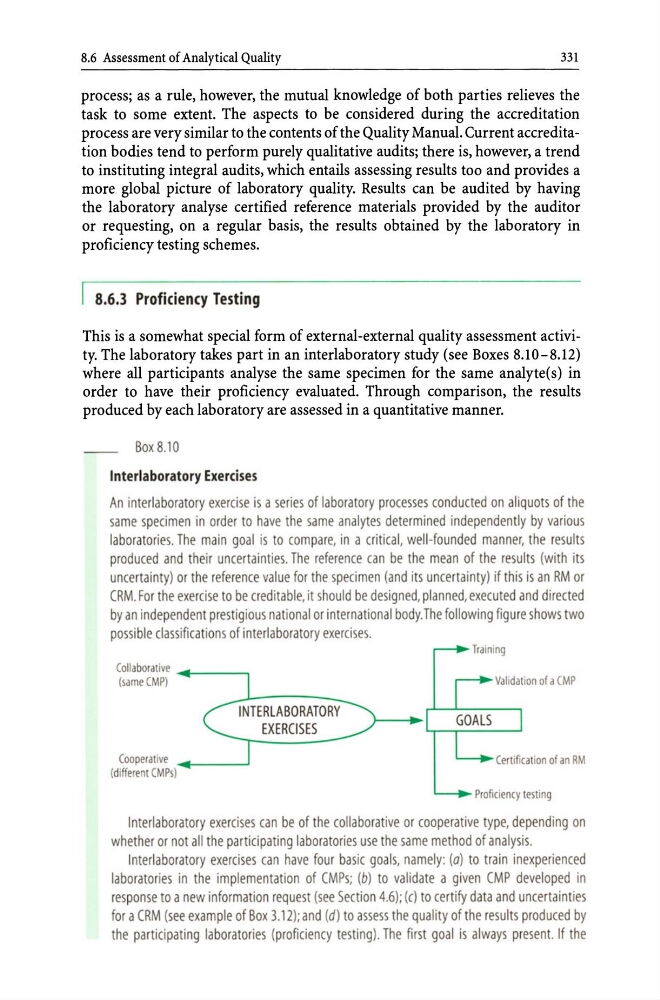
by an independent prestigious national or international body.The following figure shows two
possible classifications of interlaboratory exercises.
Collaborative .... _ _ ---,
(same CMP)
Cooperative
(different CMPs)
INTERLABORATORY
EXERCISES
Training
Certification of an RM
Proficiency testing
Interlaboratory exercises can be of the collaborative or cooperative type, depending on
whether or not all the participating laboratories use the same method of analysis.
Interlaboratory exercises can have four basic goals, namely: (a) to train inexperienced
laboratories in the implementation of CMPs; (b) to validate a given CMP developed in
response to a new information request (see Section 4.6); (e) to certify data and uncertainties
for a CRM (see example of Box 3.12); and (d) to assess the quality of the results produced by
the participating laboratories (proficiency testing). The first goal is always present. If the
331
process; as a rule, however, the mutual knowledge of both parties relieves the
task to some extent. The aspects to be considered during the accreditation
process are very similar to the contents of the Quality Manual. Current accreditation bodies tend to perform purely qualitative audits; there is, however, a trend
to instituting integral audits, which entails assessing results too and provides a
more global picture of laboratory quality. Results can be audited by having
the laboratory analyse certified reference materials provided by the auditor
or requesting, on a regular basis, the results obtained by the laboratory in
proficiency testing schemes.
I 8.6.3 Proficiency Testing
This is a somewhat special form of external-external quality assessment activity. The laboratory takes part in an interlaboratory study (see Boxes 8.10-8.12)
where all participants analyse the same specimen for the same analyte(s) in
order to have their proficiency evaluated. Through comparison, the results
produced by each laboratory are assessed in a quantitative manner.
_ _ Box 8.10
Interlaboratory Exercises
An interlaboratory exercise is a series of laboratory processes conducted on aliquots of the
same specimen in order to have the same analytes determined independently by various
laboratories. The main goal is to compare, in a critical, well-founded manner, the results
produced and their uncertainties. The reference can be the mean of the results (with its
uncertainty) or the reference value for the specimen (and its uncertainty) if this is an RM or
CRM. For the exercise to be creditable, it should be designed, planned, executed and directed
by an independent prestigious national or international body.The following figure shows two
possible classifications of interlaboratory exercises.
Collaborative .... _ _ ---,
(same CMP)
Cooperative
(different CMPs)
INTERLABORATORY
EXERCISES
Training
Certification of an RM
Proficiency testing
Interlaboratory exercises can be of the collaborative or cooperative type, depending on
whether or not all the participating laboratories use the same method of analysis.
Interlaboratory exercises can have four basic goals, namely: (a) to train inexperienced
laboratories in the implementation of CMPs; (b) to validate a given CMP developed in
response to a new information request (see Section 4.6); (e) to certify data and uncertainties
for a CRM (see example of Box 3.12); and (d) to assess the quality of the results produced by
the participating laboratories (proficiency testing). The first goal is always present. If the