

6.2 Calculable Quantitation Methods
263
where Wa is the weight of analyte present in the sample, MW the molecular (or
atomic) weight of the analyte, n the number of electrons exchanged, F the
Faraday constant, Q the amount of electricity used (in coulombs), I the current
intensity (in amperes) and t time (in seconds). The experimental assembly used
to implement the coulometric technique is of the potentiostatic type; the potential of the electrode where the analyte is oxidized or reduced is kept constant
during the electrolysis. The amount of electricity used is usually measured by
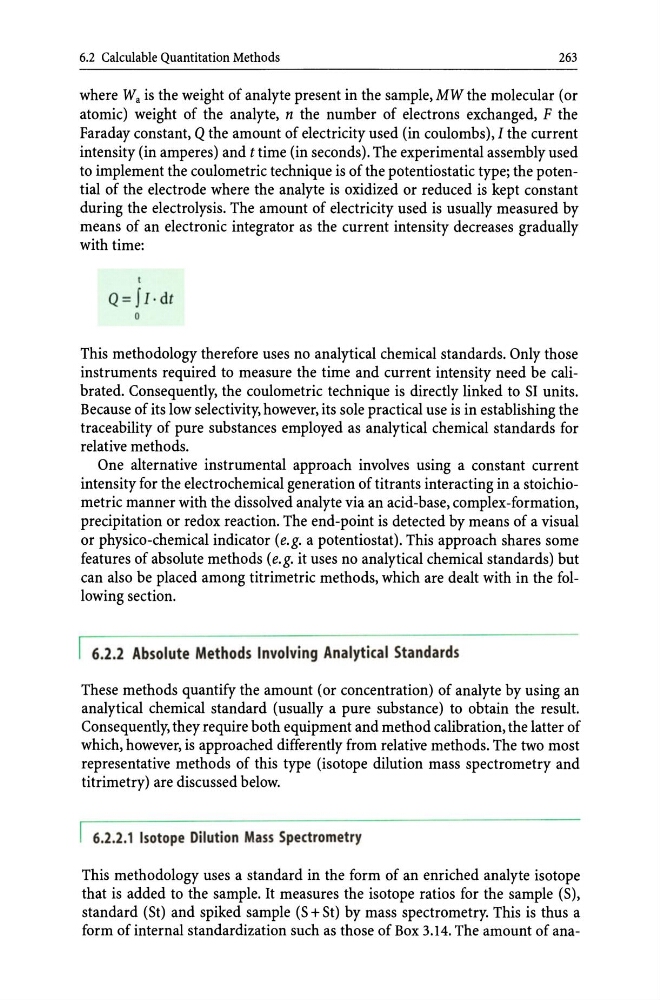
means of an electronic integrator as the current intensity decreases gradually
with time:
Q = J I· dt
o
This methodology therefore uses no analytical chemical standards. Only those
instruments required to measure the time and current intensity need be calibrated. Consequently, the coulometric technique is directly linked to SI units.
Because of its low selectivity, however, its sole practical use is in establishing the
traceability of pure substances employed as analytical chemical standards for
relative methods.
One alternative instrumental approach involves using a constant current
intensity for the electrochemical generation of titrants interacting in a stoichiometric manner with the dissolved analyte via an acid-base, complex-formation,
precipitation or redox reaction. The end-point is detected by means of a visual
or physico-chemical indicator (e.g. a potentiostat). This approach shares some
features of absolute methods (e.g. it uses no analytical chemical standards) but
can also be placed among titrimetric methods, which are dealt with in the following section.
I 6.2.2 Absolute Methods Involving Analytical Standards
These methods quantify the amount (or concentration) of analyte by using an
analytical chemical standard (usually a pure substance) to obtain the result.
Consequently, they require both equipment and method calibration, the latter of
which, however, is approached differently from relative methods. The two most
representative methods of this type (isotope dilution mass spectrometry and
titrimetry) are discussed below.
I 6.2.2.1 Isotope Dilution Mass Spectrometry
This methodology uses a standard in the form of an enriched analyte isotope
that is added to the sample. It measures the isotope ratios for the sample (S),
standard (St) and spiked sample (S + St) by mass spectrometry. This is thus a
form of internal standardization such as those of Box 3.14. The amount of ana-
263
where Wa is the weight of analyte present in the sample, MW the molecular (or
atomic) weight of the analyte, n the number of electrons exchanged, F the
Faraday constant, Q the amount of electricity used (in coulombs), I the current
intensity (in amperes) and t time (in seconds). The experimental assembly used
to implement the coulometric technique is of the potentiostatic type; the potential of the electrode where the analyte is oxidized or reduced is kept constant
during the electrolysis. The amount of electricity used is usually measured by
means of an electronic integrator as the current intensity decreases gradually
with time:
Q = J I· dt
o
This methodology therefore uses no analytical chemical standards. Only those
instruments required to measure the time and current intensity need be calibrated. Consequently, the coulometric technique is directly linked to SI units.
Because of its low selectivity, however, its sole practical use is in establishing the
traceability of pure substances employed as analytical chemical standards for
relative methods.
One alternative instrumental approach involves using a constant current
intensity for the electrochemical generation of titrants interacting in a stoichiometric manner with the dissolved analyte via an acid-base, complex-formation,
precipitation or redox reaction. The end-point is detected by means of a visual
or physico-chemical indicator (e.g. a potentiostat). This approach shares some
features of absolute methods (e.g. it uses no analytical chemical standards) but
can also be placed among titrimetric methods, which are dealt with in the following section.
I 6.2.2 Absolute Methods Involving Analytical Standards
These methods quantify the amount (or concentration) of analyte by using an
analytical chemical standard (usually a pure substance) to obtain the result.
Consequently, they require both equipment and method calibration, the latter of
which, however, is approached differently from relative methods. The two most
representative methods of this type (isotope dilution mass spectrometry and
titrimetry) are discussed below.
I 6.2.2.1 Isotope Dilution Mass Spectrometry
This methodology uses a standard in the form of an enriched analyte isotope
that is added to the sample. It measures the isotope ratios for the sample (S),
standard (St) and spiked sample (S + St) by mass spectrometry. This is thus a
form of internal standardization such as those of Box 3.14. The amount of ana-