

264
Sample (5)
mIl
6 Quantitative Aspects of Analytical Chemistry
Standard (St)
mIl
Enriched sample
(5+ St)
mIl
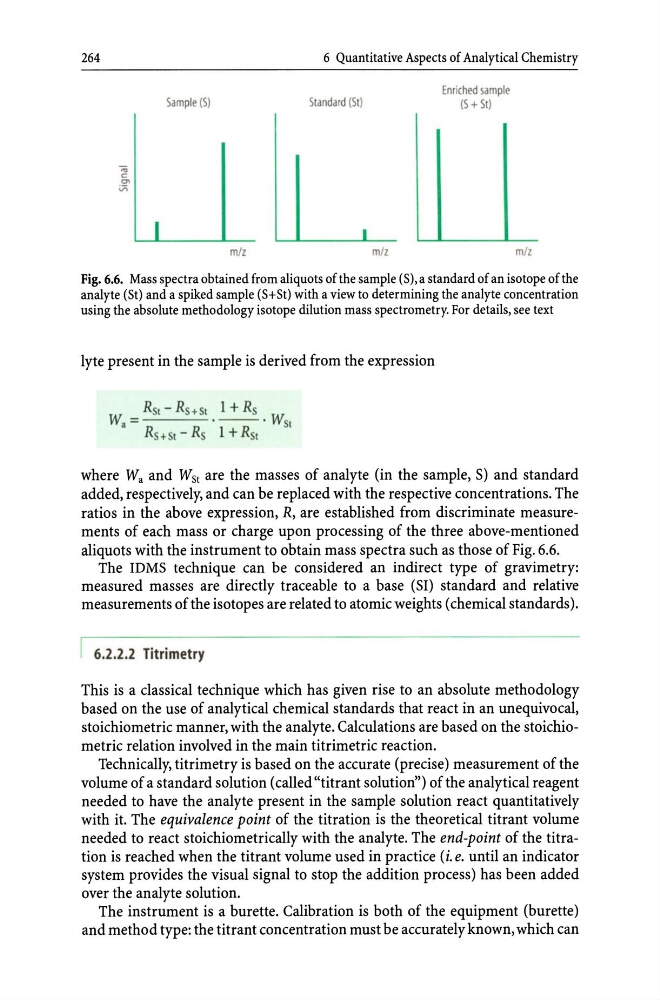
Fig. 6.6. Mass spectra obtained from aliquots of the sample (S), a standard of an isotope of the
analyte (St) and a spiked sample (S+St) with a view to determining the analyte concentration
using the absolute methodology isotope dilution mass spectrometry. For details, see text
lyte present in the sample is derived from the expression
Rst - Rs+st 1 + Rs
Wa=
. - - . W S1
Rs+s! - Rs 1 + R SI
where Wa and WSt are the masses of analyte (in the sample, S) and standard
added, respectively, and can be replaced with the respective concentrations. The
ratios in the above expression, R, are established from discriminate measurements of each mass or charge upon processing of the three above-mentioned
aliquots with the instrument to obtain mass spectra such as those of Fig. 6.6.
The IDMS technique can be considered an indirect type of gravimetry:
measured masses are directly traceable to a base (SI) standard and relative
measurements of the isotopes are related to atomic weights (chemical standards).
I 6.2.2.2 Titrimetry
This is a classical technique which has given rise to an absolute methodology
based on the use of analytical chemical standards that react in an unequivocal,
stoichiometric manner, with the analyte. Calculations are based on the stoichiometric relation involved in the main titrimetric reaction.
Technically, titrimetry is based on the accurate (precise) measurement of the
volume of a standard solution (called "titrant solution") of the analytical reagent
needed to have the analyte present in the sample solution react quantitatively
with it. The equivalence point of the titration is the theoretical titrant volume
needed to react stoichiometrically with the analyte. The end-point of the titration is reached when the titrant volume used in practice (i. e. until an indicator
system provides the visual signal to stop the addition process) has been added
over the analyte solution.
The instrument is a burette. Calibration is both of the equipment (burette)
and method type: the titrant concentration must be accurately known, which can
Sample (5)
mIl
6 Quantitative Aspects of Analytical Chemistry
Standard (St)
mIl
Enriched sample
(5+ St)
mIl
Fig. 6.6. Mass spectra obtained from aliquots of the sample (S), a standard of an isotope of the
analyte (St) and a spiked sample (S+St) with a view to determining the analyte concentration
using the absolute methodology isotope dilution mass spectrometry. For details, see text
lyte present in the sample is derived from the expression
Rst - Rs+st 1 + Rs
Wa=
. - - . W S1
Rs+s! - Rs 1 + R SI
where Wa and WSt are the masses of analyte (in the sample, S) and standard
added, respectively, and can be replaced with the respective concentrations. The
ratios in the above expression, R, are established from discriminate measurements of each mass or charge upon processing of the three above-mentioned
aliquots with the instrument to obtain mass spectra such as those of Fig. 6.6.
The IDMS technique can be considered an indirect type of gravimetry:
measured masses are directly traceable to a base (SI) standard and relative
measurements of the isotopes are related to atomic weights (chemical standards).
I 6.2.2.2 Titrimetry
This is a classical technique which has given rise to an absolute methodology
based on the use of analytical chemical standards that react in an unequivocal,
stoichiometric manner, with the analyte. Calculations are based on the stoichiometric relation involved in the main titrimetric reaction.
Technically, titrimetry is based on the accurate (precise) measurement of the
volume of a standard solution (called "titrant solution") of the analytical reagent
needed to have the analyte present in the sample solution react quantitatively
with it. The equivalence point of the titration is the theoretical titrant volume
needed to react stoichiometrically with the analyte. The end-point of the titration is reached when the titrant volume used in practice (i. e. until an indicator
system provides the visual signal to stop the addition process) has been added
over the analyte solution.
The instrument is a burette. Calibration is both of the equipment (burette)
and method type: the titrant concentration must be accurately known, which can