

262
6 Quantitative Aspects of Analytical Chemistry
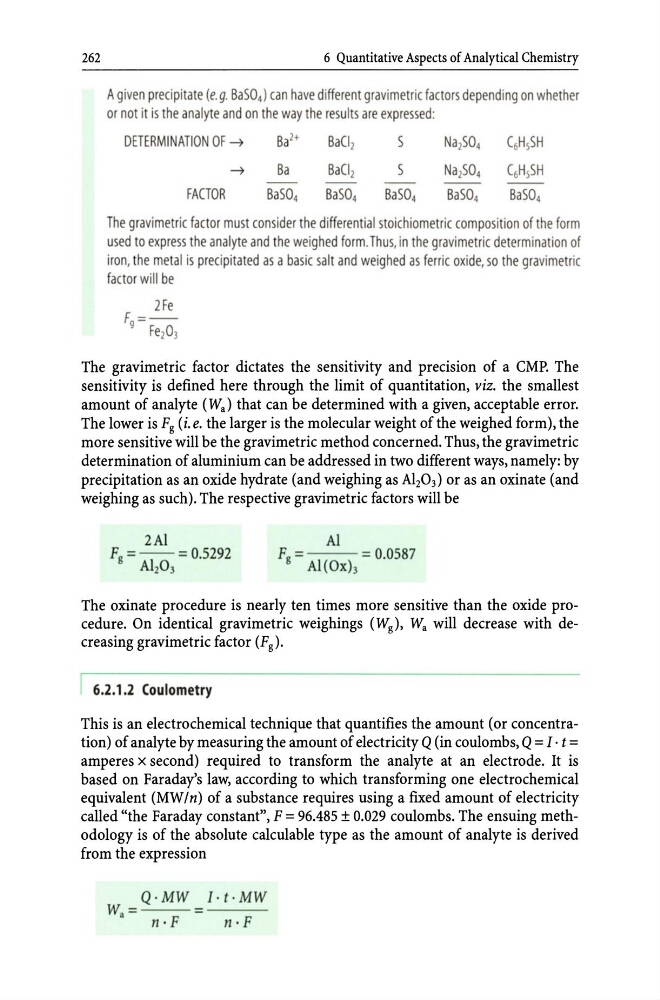
A given precipitate (e.g. BaS04) can have different gravimetric factors depending on whether
or not it is the analyte and on the way the results are expressed:
DETERMINATION OF 4
Ba2+
BaCI2
5
Na2S04
C6HsSH
4
Ba
BaCl2
5
Na2S04
C6HsSH
- - - -
- -
FACTOR
BaS04
BaS04
BaS04
BaS04
BaS04
The gravimetric factor must consider the differential stoichiometric composition of the form
used to express the ana lyte and the weighed form. Thus, in the gravimetric determination of
iron, the metal is precipitated as a basic salt and weighed as ferric oxide, so the gravimetric
factor will be
2 Fe
F 9 = - -
Fe201
The gravimetric factor dictates the sensitivity and precision of a CMP. The
sensitivity is defined here through the limit of quantitation, viz. the smallest
amount of analyte (Wa ) that can be determined with a given, acceptable error.
The lower is Fg (i. e. the larger is the molecular weight of the weighed form), the
more sensitive will be the gravimetric method concerned. Thus, the gravimetric
determination of aluminium can be addressed in two different ways, namely: by
precipitation as an oxide hydrate (and weighing as A120 3 ) or as an oxinate (and
weighing as such). The respective gravimetric factors will be
2Al
Fg = - - = 0.5292
AI20 )
Al
Fg =
= 0.0587
AI(Oxh
The oxinate procedure is nearly ten times more sensitive than the oxide procedure. On identical gravimetric weighings (W g ), Wa will decrease with decreasing gravimetric factor (F g ) .
I 6.2.1.2 (oulometry
This is an electrochemical technique that quantifies the amount (or concentration) of analyte by measuring the amount of electricity Q (in coulombs, Q = I· t =
amperes x second) required to transform the analyte at an electrode. It is
based on Faraday's law, according to which transforming one electrochemical
equivalent (MWln) of a substance requires using a fixed amount of electricity
called "the Faraday constant", F = 96.485 ± 0.029 coulombs. The ensuing methodology is of the absolute calculable type as the amount of analyte is derived
from the expression
Q · MW j·t · MW
w- - - -
.- n · F -
n·F
6 Quantitative Aspects of Analytical Chemistry
A given precipitate (e.g. BaS04) can have different gravimetric factors depending on whether
or not it is the analyte and on the way the results are expressed:
DETERMINATION OF 4
Ba2+
BaCI2
5
Na2S04
C6HsSH
4
Ba
BaCl2
5
Na2S04
C6HsSH
- - - -
- -
FACTOR
BaS04
BaS04
BaS04
BaS04
BaS04
The gravimetric factor must consider the differential stoichiometric composition of the form
used to express the ana lyte and the weighed form. Thus, in the gravimetric determination of
iron, the metal is precipitated as a basic salt and weighed as ferric oxide, so the gravimetric
factor will be
2 Fe
F 9 = - -
Fe201
The gravimetric factor dictates the sensitivity and precision of a CMP. The
sensitivity is defined here through the limit of quantitation, viz. the smallest
amount of analyte (Wa ) that can be determined with a given, acceptable error.
The lower is Fg (i. e. the larger is the molecular weight of the weighed form), the
more sensitive will be the gravimetric method concerned. Thus, the gravimetric
determination of aluminium can be addressed in two different ways, namely: by
precipitation as an oxide hydrate (and weighing as A120 3 ) or as an oxinate (and
weighing as such). The respective gravimetric factors will be
2Al
Fg = - - = 0.5292
AI20 )
Al
Fg =
= 0.0587
AI(Oxh
The oxinate procedure is nearly ten times more sensitive than the oxide procedure. On identical gravimetric weighings (W g ), Wa will decrease with decreasing gravimetric factor (F g ) .
I 6.2.1.2 (oulometry
This is an electrochemical technique that quantifies the amount (or concentration) of analyte by measuring the amount of electricity Q (in coulombs, Q = I· t =
amperes x second) required to transform the analyte at an electrode. It is
based on Faraday's law, according to which transforming one electrochemical
equivalent (MWln) of a substance requires using a fixed amount of electricity
called "the Faraday constant", F = 96.485 ± 0.029 coulombs. The ensuing methodology is of the absolute calculable type as the amount of analyte is derived
from the expression
Q · MW j·t · MW
w- - - -
.- n · F -
n·F