

5.6 Instrumental Qualitative Analysis
237
Box 5,17
General principles of capillary electrophoresis
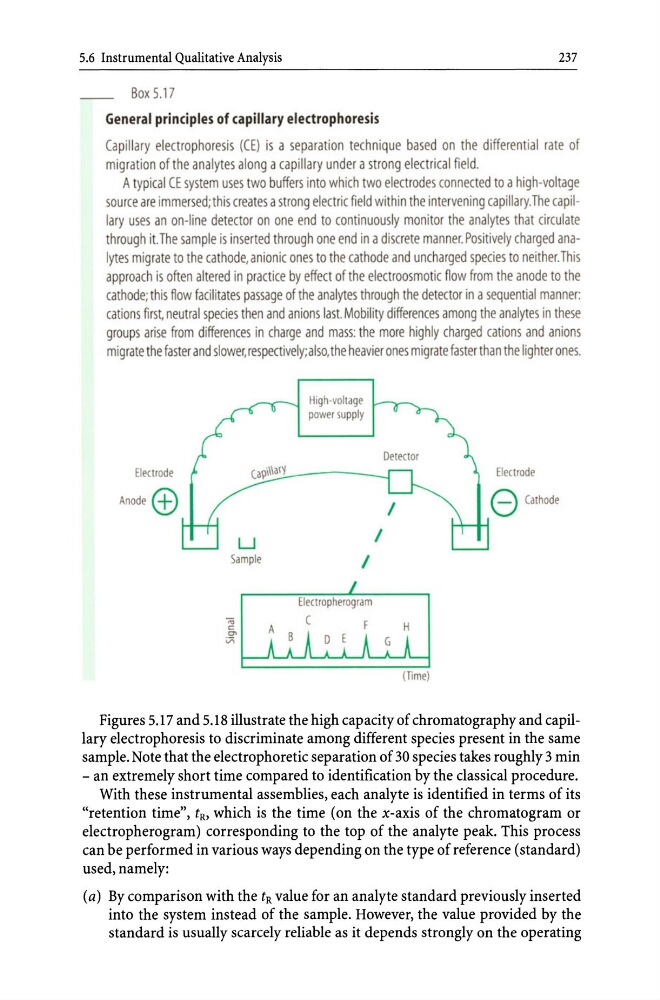
Capillary electrophoresis (CE) is a separation technique based on the differential rate of
migration of the analytes along a capillary under a strong electrical field,
A typical CE system uses two buffers into which two electrodes connected to a high-voltage
source are immersed;this creates a strong electric field within the intervening capillary.The capillary uses an on-line detector on one end to continuously monitor the analytes that circulate
through it.The sample is inserted through one end in a discrete manner. Positively charged anaIytes migrate to the cathode, anionic ones to the cathode and uncharged species to neither, This
approach is often altered in practice by effect of the electroosmotic flow from the anode to the
cathode; this flow facilitates passage of the analytes through the detector in a sequential manner:
cations first, neutral species then and anions last. Mobility differences among the analytes in these
groups arise from differences in charge and mass: the more highly charged cations and anions
migrate the faster and slower, respectively; also, the heavier ones migrate faster than the lighter ones,
Electrode
Anode (±)
Sample
High-voltage
power supply
/
/
Electropherogram
C
H
(Time)
Eleclrode
e Calhode
Figures 5.17 and 5.18 illustrate the high capacity of chromatography and capillary electrophoresis to discriminate among different species present in the same
sample. Note that the electrophoretic separation of 30 species takes roughly 3 min
- an extremely short time compared to identification by the classical procedure.
With these instrumental assemblies, each analyte is identified in terms of its
"retention time", tR, which is the time (on the x-axis of the chromatogram or
electropherogram) corresponding to the top of the analyte peak. This process
can be performed in various ways depending on the type of reference (standard)
used, namely:
(a) By comparison with the tR value for an analyte standard previously inserted
into the system instead of the sample. However, the value provided by the
standard is usually scarcely reliable as it depends strongly on the operating
237
Box 5,17
General principles of capillary electrophoresis
Capillary electrophoresis (CE) is a separation technique based on the differential rate of
migration of the analytes along a capillary under a strong electrical field,
A typical CE system uses two buffers into which two electrodes connected to a high-voltage
source are immersed;this creates a strong electric field within the intervening capillary.The capillary uses an on-line detector on one end to continuously monitor the analytes that circulate
through it.The sample is inserted through one end in a discrete manner. Positively charged anaIytes migrate to the cathode, anionic ones to the cathode and uncharged species to neither, This
approach is often altered in practice by effect of the electroosmotic flow from the anode to the
cathode; this flow facilitates passage of the analytes through the detector in a sequential manner:
cations first, neutral species then and anions last. Mobility differences among the analytes in these
groups arise from differences in charge and mass: the more highly charged cations and anions
migrate the faster and slower, respectively; also, the heavier ones migrate faster than the lighter ones,
Electrode
Anode (±)
Sample
High-voltage
power supply
/
/
Electropherogram
C
H
(Time)
Eleclrode
e Calhode
Figures 5.17 and 5.18 illustrate the high capacity of chromatography and capillary electrophoresis to discriminate among different species present in the same
sample. Note that the electrophoretic separation of 30 species takes roughly 3 min
- an extremely short time compared to identification by the classical procedure.
With these instrumental assemblies, each analyte is identified in terms of its
"retention time", tR, which is the time (on the x-axis of the chromatogram or
electropherogram) corresponding to the top of the analyte peak. This process
can be performed in various ways depending on the type of reference (standard)
used, namely:
(a) By comparison with the tR value for an analyte standard previously inserted
into the system instead of the sample. However, the value provided by the
standard is usually scarcely reliable as it depends strongly on the operating