

236
5 Qualitative Aspects of Analytical Chemistry
Box S.16
General principles of column chromatography
Time
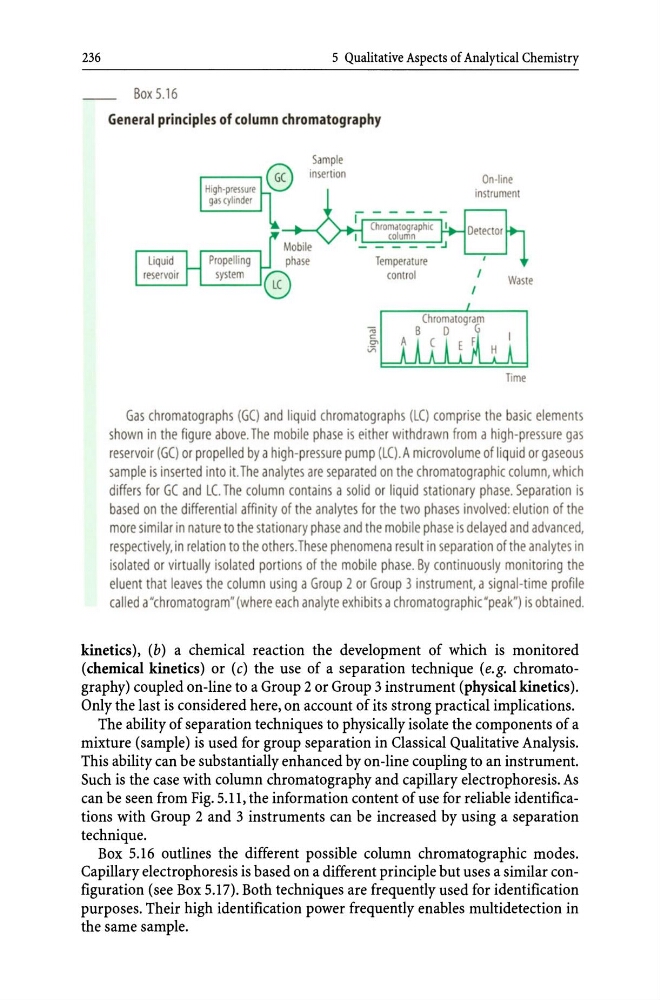
Gas chromatographs (GCl and liquid chromatographs (LCl comprise the basic elements
shown in the figure above. The mobile phase is either withdrawn from a high-pressure gas
reservoir (GCl or propelled by a high-pressure pump (LC). A microvolume of liquid or gaseous
sample is inserted into it. The analytes are separated on the chromatographic column, which
differs for GC and LC. The column contains a solid or liquid stationary phase. Separation is
based on the differential affinity of the analytes for the two phases involved: elution of the
more similar in nature to the stationary phase and the mobile phase is delayed and advanced,
respectively. in relation to the others. These phenomena result in separation of the analytes in
isolated or virtually isolated portions of the mobile phase. By continuously monitoring the
eluent that leaves the column using a Group 2 or Group 3 instrument, a signal-time profile
called a "chromatogram" (where each analyte exhibits a chromatographic"peak") is obtained.
kinetics), (b) a chemical reaction the development of which is monitored
(chemical kinetics) or (c) the use of a separation technique (e.g. chromatography) coupled on-line to a Group 2 or Group 3 instrument (physical kinetics).
Only the last is considered here, on account of its strong practical implications.
The ability of separation techniques to physically isolate the components of a
mixture (sample) is used for group separation in Classical Qualitative Analysis.
This ability can be substantially enhanced by on-line coupling to an instrument.
Such is the case with column chromatography and capillary electrophoresis. As
can be seen from Fig. 5.11, the information content of use for reliable identifications with Group 2 and 3 instruments can be increased by using a separation
technique.
Box 5.16 outlines the different possible column chromatographic modes.
Capillary electrophoresis is based on a different principle but uses a similar configuration (see Box 5.17). Both techniques are frequently used for identification
purposes. Their high identification power frequently enables multidetection in
the same sample.
5 Qualitative Aspects of Analytical Chemistry
Box S.16
General principles of column chromatography
Time
Gas chromatographs (GCl and liquid chromatographs (LCl comprise the basic elements
shown in the figure above. The mobile phase is either withdrawn from a high-pressure gas
reservoir (GCl or propelled by a high-pressure pump (LC). A microvolume of liquid or gaseous
sample is inserted into it. The analytes are separated on the chromatographic column, which
differs for GC and LC. The column contains a solid or liquid stationary phase. Separation is
based on the differential affinity of the analytes for the two phases involved: elution of the
more similar in nature to the stationary phase and the mobile phase is delayed and advanced,
respectively. in relation to the others. These phenomena result in separation of the analytes in
isolated or virtually isolated portions of the mobile phase. By continuously monitoring the
eluent that leaves the column using a Group 2 or Group 3 instrument, a signal-time profile
called a "chromatogram" (where each analyte exhibits a chromatographic"peak") is obtained.
kinetics), (b) a chemical reaction the development of which is monitored
(chemical kinetics) or (c) the use of a separation technique (e.g. chromatography) coupled on-line to a Group 2 or Group 3 instrument (physical kinetics).
Only the last is considered here, on account of its strong practical implications.
The ability of separation techniques to physically isolate the components of a
mixture (sample) is used for group separation in Classical Qualitative Analysis.
This ability can be substantially enhanced by on-line coupling to an instrument.
Such is the case with column chromatography and capillary electrophoresis. As
can be seen from Fig. 5.11, the information content of use for reliable identifications with Group 2 and 3 instruments can be increased by using a separation
technique.
Box 5.16 outlines the different possible column chromatographic modes.
Capillary electrophoresis is based on a different principle but uses a similar configuration (see Box 5.17). Both techniques are frequently used for identification
purposes. Their high identification power frequently enables multidetection in
the same sample.