

234
5 Qualitative Aspects of Analytical Chemistry
function exhibits a peculiar spectral profile; as a result, organic compounds have
highly characteristic IR spectra. By comparing an IR spectrum with those for a
collection of standards, the unknown compound that produced the former can
be readily identified in some cases. The comparison can be made visually or by
using chemometric software. IR spectral libraries usually contain the spectra for
5000 to 100000 organic compounds; once the spectrum for the unknown species
is acquired, the computer compares it with those for the filed standards. The
response is a positive or negative identification with a given probability. Figure
5.14 shows a straightforward example where benzene was identified with a
probability of 98 % (the spectra for the sample and standard were highly similar).
In atomic emission spectroscopies, the sample is atomized and atoms are
excited by means of a powerful energy source (arc, spark, plasma). Light emitted
by the atoms in returning to their ground state possesses high spectral purity and
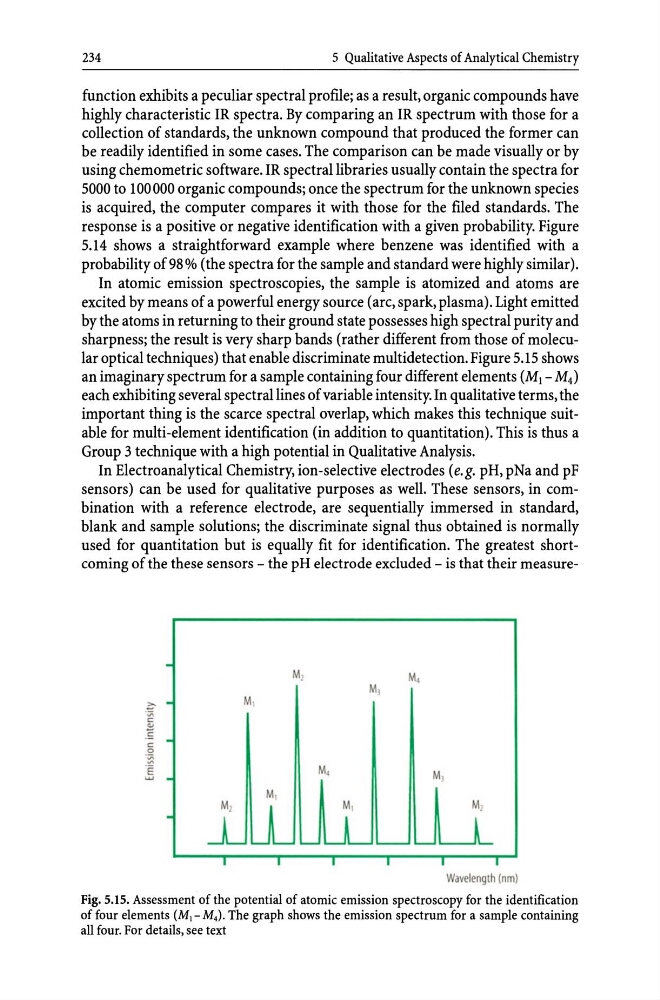
sharpness; the result is very sharp bands (rather different from those of molecular optical techniques) that enable discriminate multidetection. Figure 5.15 shows
an imaginary spectrum for a sample containing four different elements (M, - M4 )
each exhibiting several spectral lines of variable intensity. In qualitative terms, the
important thing is the scarce spectral overlap, which makes this technique suitable for multi-element identification (in addition to quantitation). This is thus a
Group 3 technique with a high potential in Qualitative Analysis.
In Electroanalytical Chemistry, ion-selective electrodes (e.g. pH, pNa and pF
sensors) can be used for qualitative purposes as well. These sensors, in combination with a reference electrode, are sequentially immersed in standard,
blank and sample solutions; the discriminate signal thus obtained is normally
used for quantitation but is equally fit for identification. The greatest shortcoming of the these sensors - the pH electrode excluded - is that their measure?:'
"V;
c:
cu
. s
c:
o
. ~
§
Wavelength (nm)
Fig. 5.15. Assessment of the potential of atomic emission spectroscopy for the identification
of four elements (M1- M4)' The graph shows the emission spectrum for a sample containing
all four. For details, see text
5 Qualitative Aspects of Analytical Chemistry
function exhibits a peculiar spectral profile; as a result, organic compounds have
highly characteristic IR spectra. By comparing an IR spectrum with those for a
collection of standards, the unknown compound that produced the former can
be readily identified in some cases. The comparison can be made visually or by
using chemometric software. IR spectral libraries usually contain the spectra for
5000 to 100000 organic compounds; once the spectrum for the unknown species
is acquired, the computer compares it with those for the filed standards. The
response is a positive or negative identification with a given probability. Figure
5.14 shows a straightforward example where benzene was identified with a
probability of 98 % (the spectra for the sample and standard were highly similar).
In atomic emission spectroscopies, the sample is atomized and atoms are
excited by means of a powerful energy source (arc, spark, plasma). Light emitted
by the atoms in returning to their ground state possesses high spectral purity and
sharpness; the result is very sharp bands (rather different from those of molecular optical techniques) that enable discriminate multidetection. Figure 5.15 shows
an imaginary spectrum for a sample containing four different elements (M, - M4 )
each exhibiting several spectral lines of variable intensity. In qualitative terms, the
important thing is the scarce spectral overlap, which makes this technique suitable for multi-element identification (in addition to quantitation). This is thus a
Group 3 technique with a high potential in Qualitative Analysis.
In Electroanalytical Chemistry, ion-selective electrodes (e.g. pH, pNa and pF
sensors) can be used for qualitative purposes as well. These sensors, in combination with a reference electrode, are sequentially immersed in standard,
blank and sample solutions; the discriminate signal thus obtained is normally
used for quantitation but is equally fit for identification. The greatest shortcoming of the these sensors - the pH electrode excluded - is that their measure?:'
"V;
c:
cu
. s
c:
o
. ~
§
Wavelength (nm)
Fig. 5.15. Assessment of the potential of atomic emission spectroscopy for the identification
of four elements (M1- M4)' The graph shows the emission spectrum for a sample containing
all four. For details, see text