

220
5 Qualitative Aspects of Analytical Chemistry
The high selectivity of immunoreagents has opened up previously unimaginable
avenues for Classical and Instrumental Qualitative Analysis. Box 5.8 illustrates
selected qualitative identifications based on immunoassays; the analytical signal
can be detected either by the human senses or by a straightforward instrument
(e.g. a photometer or fluorimeter).
Masking reagents are added to the reaction medium in order to prevent
sample components other than the analyte from interfering with the qualitative
test - whether by exhibiting the same effect as the analyte or by hindering it.
Masking reagents should never significantly disturb the main analytical reaction
(i. e. that between the analyte and its identification reagent), so they should interact with neither its ingredients nor its product. The masking reagents used in
classical qualitative analyses for inorganic species are normally ligands that
form stable, soluble or colourless chelates with the potential interferents
accompanying the analyte in the sample. Box 5.9 presents a typical example.
Box 5.8
Immunoassay methods, particularly heterogeneous immunoassay (which is commonly
known as "enzyme-linked immunosorbent assay' : ELISA), are widely used in food analysis. In
addition to quantitative immunoassay methods, a number of commercially available kits are
used for qualitative screening with a view to the rapid detection of food contaminants and
adulterants. Typical examples include the following:
• The detection of toxic contaminants such as aflatoxins (fungal metabolites) in dried fruits,
cereals, spices, coffee, etc.
• The identification of meat types (beef, pork, ewe, horse, chicken, rabbit) as a means of
fighting the fraudulent replacement of some meat products with others of poorer quality.
• The detection of soy protein, which is frequently added to meat products to improve
texture, increase water and fat retention, and replace meat protein.
• Microbiological analyses for pathogens such as salmonella and listeria. Available immunoassays provide results within a few hours and thus save substantial time relative to classical culturing methods, which take no less than 3- 4 days to complete.
Sandwich ELISA, one of the more widely used modes of this technique, comprises the fol -
lowing steps:
(1 ) Adsorption of the analyte-specific antibody (Y) onto a solid phase (a plastic tube, latex
particles, nylon mesh, nitrocellulose paper, fibre glass).
IYYYYY I
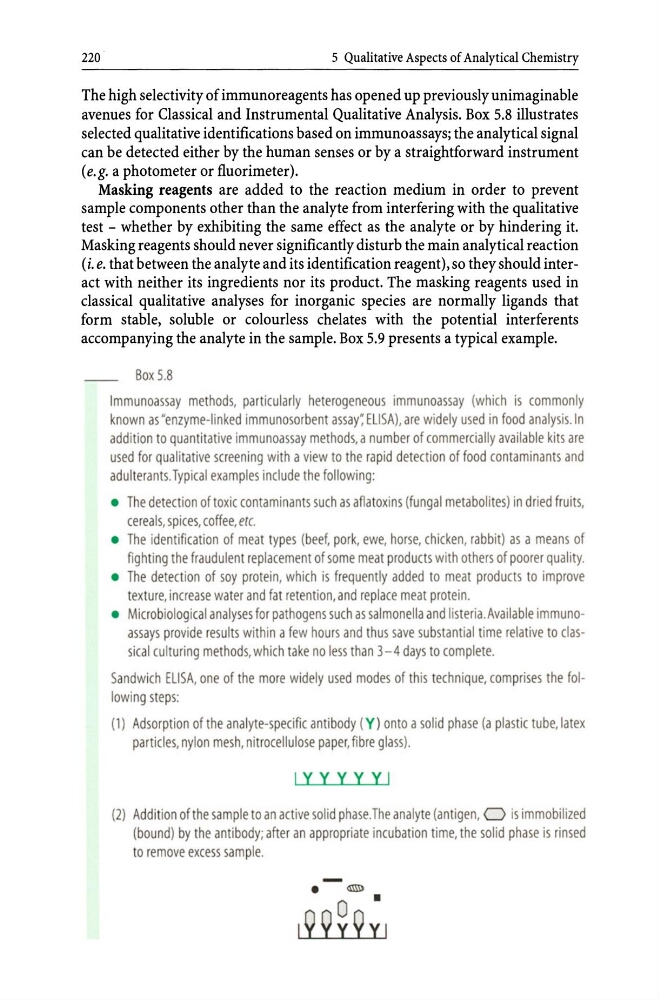
(2) Addition of the sample to an active solid phase.The analyte (antigen, 0 is immobilized
(bound) by the antibody; after an appropriate incubation time, the solid phase is rinsed
to remove excess sample.
5 Qualitative Aspects of Analytical Chemistry
The high selectivity of immunoreagents has opened up previously unimaginable
avenues for Classical and Instrumental Qualitative Analysis. Box 5.8 illustrates
selected qualitative identifications based on immunoassays; the analytical signal
can be detected either by the human senses or by a straightforward instrument
(e.g. a photometer or fluorimeter).
Masking reagents are added to the reaction medium in order to prevent
sample components other than the analyte from interfering with the qualitative
test - whether by exhibiting the same effect as the analyte or by hindering it.
Masking reagents should never significantly disturb the main analytical reaction
(i. e. that between the analyte and its identification reagent), so they should interact with neither its ingredients nor its product. The masking reagents used in
classical qualitative analyses for inorganic species are normally ligands that
form stable, soluble or colourless chelates with the potential interferents
accompanying the analyte in the sample. Box 5.9 presents a typical example.
Box 5.8
Immunoassay methods, particularly heterogeneous immunoassay (which is commonly
known as "enzyme-linked immunosorbent assay' : ELISA), are widely used in food analysis. In
addition to quantitative immunoassay methods, a number of commercially available kits are
used for qualitative screening with a view to the rapid detection of food contaminants and
adulterants. Typical examples include the following:
• The detection of toxic contaminants such as aflatoxins (fungal metabolites) in dried fruits,
cereals, spices, coffee, etc.
• The identification of meat types (beef, pork, ewe, horse, chicken, rabbit) as a means of
fighting the fraudulent replacement of some meat products with others of poorer quality.
• The detection of soy protein, which is frequently added to meat products to improve
texture, increase water and fat retention, and replace meat protein.
• Microbiological analyses for pathogens such as salmonella and listeria. Available immunoassays provide results within a few hours and thus save substantial time relative to classical culturing methods, which take no less than 3- 4 days to complete.
Sandwich ELISA, one of the more widely used modes of this technique, comprises the fol -
lowing steps:
(1 ) Adsorption of the analyte-specific antibody (Y) onto a solid phase (a plastic tube, latex
particles, nylon mesh, nitrocellulose paper, fibre glass).
IYYYYY I
(2) Addition of the sample to an active solid phase.The analyte (antigen, 0 is immobilized
(bound) by the antibody; after an appropriate incubation time, the solid phase is rinsed
to remove excess sample.