

5.5 Classical Qualitative Analysis
219
The analytical schemes discussed below use one or more of these types of
reagents in a sequential manner to gather species in different groups by precipitation-based separations. Cations are usually separated with S2-, CO~-, Cl-,
sOi- or NH 3 , and anions with Ca2+, Ba2+ or Ag+.
Identification reagents are reagents that give a reaction the externally apparent effect of which (e.g. formation of a precipitate or gas, a colour change)
can be readily detected by the human senses. Their primary use is in the identification of individual analytes, whether in the starting sample (ideal situation)
or in a group. Obviously, these reagents should provide tests of adequate sensitivity and selectivity; both properties, however, are indirectly improved by the
separations included in an analytical scheme. Identification reagents can be of
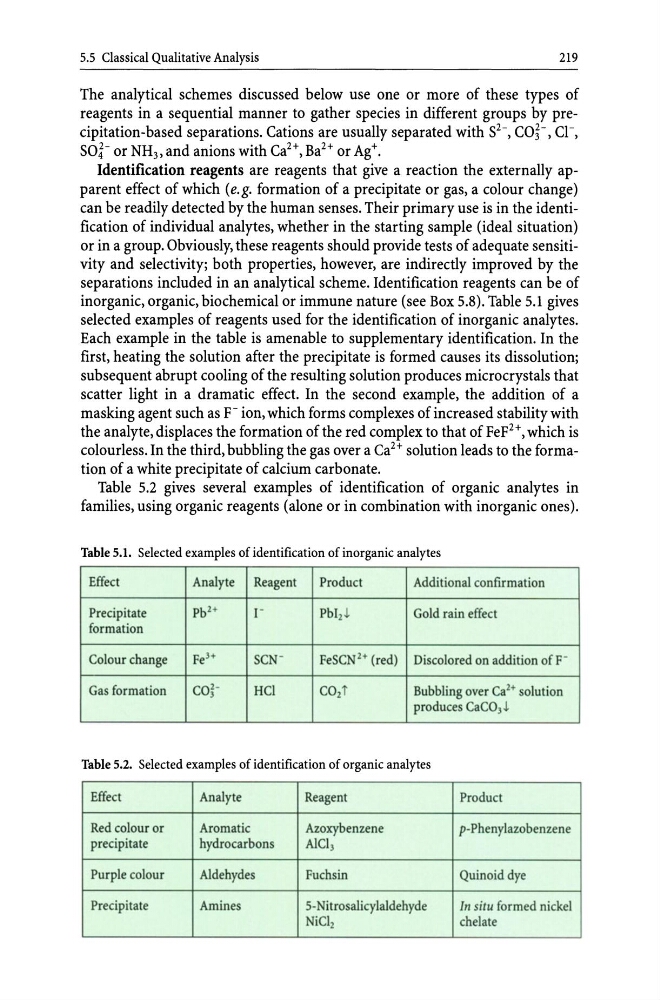
inorganic, organic, biochemical or immune nature (see Box 5.8). Table 5.1 gives
selected examples of reagents used for the identification of inorganic analytes.
Each example in the table is amenable to supplementary identification. In the
first, heating the solution after the precipitate is formed causes its dissolution;
subsequent abrupt cooling of the resulting solution produces microcrystals that
scatter light in a dramatic effect. In the second example, the addition of a
masking agent such as F - ion, which forms complexes of increased stability with
the analyte, displaces the formation of the red complex to that of FeF2+, which is
colourless. In the third, bubbling the gas over a Ca 2 + solution leads to the formation of a white precipitate of calcium carbonate.
Table 5.2 gives several examples of identification of organic analytes in
families, using organic reagents (alone or in combination with inorganic ones).
Table 5.1. Selected examples of identification of inorganic analytes
Effect
Analyte Reagent
Product
Additional confirmation
Precipitate
Pb l +
r
PbI2.!.
Gold rain effect
formation
Colour change
Fel+
SCW
FeSCN 2+ (red) Discolored on addition of FGas formation
colHCl
COli
Bubbling over Ca 2 + solution
produces CaCO) J.
Table 5.2. Selected examples of identification of organic analytes
Effect
Analyte
Reagent
Product
Red colour or
Aromatic
Azoxybenzene
p-Phenylazobenzene
precipitate
hydrocarbons
AlCI)
Purple colour
Aldehydes
Fuchsin
Quinoid dye
Precipitate
Amines
5-NitrosalicyJaldehyde
In situ formed nickel
NiCh
chelate
219
The analytical schemes discussed below use one or more of these types of
reagents in a sequential manner to gather species in different groups by precipitation-based separations. Cations are usually separated with S2-, CO~-, Cl-,
sOi- or NH 3 , and anions with Ca2+, Ba2+ or Ag+.
Identification reagents are reagents that give a reaction the externally apparent effect of which (e.g. formation of a precipitate or gas, a colour change)
can be readily detected by the human senses. Their primary use is in the identification of individual analytes, whether in the starting sample (ideal situation)
or in a group. Obviously, these reagents should provide tests of adequate sensitivity and selectivity; both properties, however, are indirectly improved by the
separations included in an analytical scheme. Identification reagents can be of
inorganic, organic, biochemical or immune nature (see Box 5.8). Table 5.1 gives
selected examples of reagents used for the identification of inorganic analytes.
Each example in the table is amenable to supplementary identification. In the
first, heating the solution after the precipitate is formed causes its dissolution;
subsequent abrupt cooling of the resulting solution produces microcrystals that
scatter light in a dramatic effect. In the second example, the addition of a
masking agent such as F - ion, which forms complexes of increased stability with
the analyte, displaces the formation of the red complex to that of FeF2+, which is
colourless. In the third, bubbling the gas over a Ca 2 + solution leads to the formation of a white precipitate of calcium carbonate.
Table 5.2 gives several examples of identification of organic analytes in
families, using organic reagents (alone or in combination with inorganic ones).
Table 5.1. Selected examples of identification of inorganic analytes
Effect
Analyte Reagent
Product
Additional confirmation
Precipitate
Pb l +
r
PbI2.!.
Gold rain effect
formation
Colour change
Fel+
SCW
FeSCN 2+ (red) Discolored on addition of FGas formation
colHCl
COli
Bubbling over Ca 2 + solution
produces CaCO) J.
Table 5.2. Selected examples of identification of organic analytes
Effect
Analyte
Reagent
Product
Red colour or
Aromatic
Azoxybenzene
p-Phenylazobenzene
precipitate
hydrocarbons
AlCI)
Purple colour
Aldehydes
Fuchsin
Quinoid dye
Precipitate
Amines
5-NitrosalicyJaldehyde
In situ formed nickel
NiCh
chelate