

5.5 Classical Qualitative Analysis
221
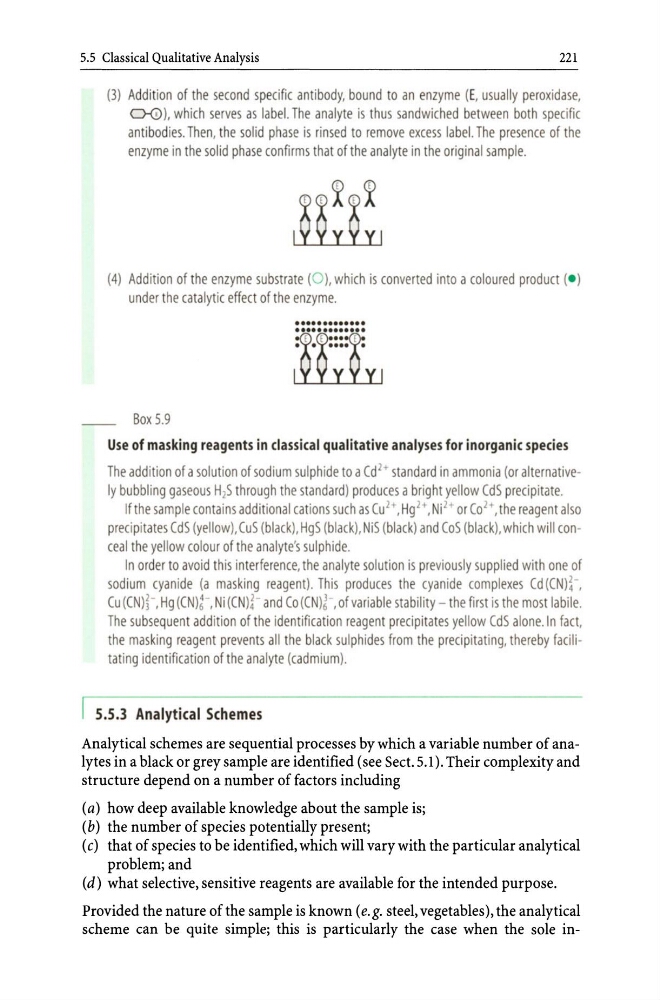
(3) Addition of the second specific antibody, bound to an enzyme (E, usually peroxidase,
0-0), which serves as label. The analyte is thus sandwiched between both specific
antibodies. Then, the solid phase is rinsed to remove excess label. The presence of the
enzyme in the solid phase confirms that of the analyte in the original sample.
(4) Add ition of the enzyme substrate (0 ), which is converted into a coloured product (e )
under the catalytic effect of the enzyme.
__ Box 5.9
Use of masking reagents in classical qualitative analyses for inorganic species
The addition of a solution of sodium sulphide to a Cd 2 + standard in ammonia (or alternatively bubbling gaseous H2S through the standard) produces a bright yellow CdS precipitate.
If the sample contains additional cations such as Cu 2 +, Hg 2+ , Ni 2 or C0 2 +, the reagent also
precipitates CdS (yellow). CuS (black). HgS (black). NiS (black) and CoS (black). which will conceal the yellow colour of the analyte's sulphide.
In order to avoid this interference, the analyte solution is previously supplied with one of
sodium cyanide (a masking reagent). This produces the cyanide complexes Cd (CN) ~ ,
Cu (CN) ~-, Hg (CN): ,Ni (CN)~- and Co (CN)l ,of variable stability - the first is the most labile.
The subsequent addition of the identification reagent precipitates yellow CdS alone. In fact,
the masking reagent prevents all the black sulphides from the precipitating, thereby faCilitating identification of the analyte (cadmium).
5.5.3 Analytical Schemes
Analytical schemes are sequential processes by which a variable number of analytes in a black or grey sample are identified (see Sect. 5.1). Their complexity and
structure depend on a number of factors including
(a) how deep available knowledge about the sample is;
(b) the number of species potentially present;
(c) that of species to be identified, which will vary with the particular analytical
problem; and
(d) what selective, sensitive reagents are available for the intended purpose.
Provided the nature of the sample is known (e. g. steel, vegetables), the analytical
scheme can be quite simple; this is particularly the case when the sole in-
221
(3) Addition of the second specific antibody, bound to an enzyme (E, usually peroxidase,
0-0), which serves as label. The analyte is thus sandwiched between both specific
antibodies. Then, the solid phase is rinsed to remove excess label. The presence of the
enzyme in the solid phase confirms that of the analyte in the original sample.
(4) Add ition of the enzyme substrate (0 ), which is converted into a coloured product (e )
under the catalytic effect of the enzyme.
__ Box 5.9
Use of masking reagents in classical qualitative analyses for inorganic species
The addition of a solution of sodium sulphide to a Cd 2 + standard in ammonia (or alternatively bubbling gaseous H2S through the standard) produces a bright yellow CdS precipitate.
If the sample contains additional cations such as Cu 2 +, Hg 2+ , Ni 2 or C0 2 +, the reagent also
precipitates CdS (yellow). CuS (black). HgS (black). NiS (black) and CoS (black). which will conceal the yellow colour of the analyte's sulphide.
In order to avoid this interference, the analyte solution is previously supplied with one of
sodium cyanide (a masking reagent). This produces the cyanide complexes Cd (CN) ~ ,
Cu (CN) ~-, Hg (CN): ,Ni (CN)~- and Co (CN)l ,of variable stability - the first is the most labile.
The subsequent addition of the identification reagent precipitates yellow CdS alone. In fact,
the masking reagent prevents all the black sulphides from the precipitating, thereby faCilitating identification of the analyte (cadmium).
5.5.3 Analytical Schemes
Analytical schemes are sequential processes by which a variable number of analytes in a black or grey sample are identified (see Sect. 5.1). Their complexity and
structure depend on a number of factors including
(a) how deep available knowledge about the sample is;
(b) the number of species potentially present;
(c) that of species to be identified, which will vary with the particular analytical
problem; and
(d) what selective, sensitive reagents are available for the intended purpose.
Provided the nature of the sample is known (e. g. steel, vegetables), the analytical
scheme can be quite simple; this is particularly the case when the sole in-