

5.2 The Binary Response
207
It is interesting to note the sequence and distance between the references of Fig. 5.3.
Thus, the limit of detection, CLOD, must always be lower than the other two parameters - otherwise, detection (identification) will be impossible. Also, the cut-off
concentration, C c , must exceed the limit of detection as it involves a higher probability level that detection will be error-free. Finally, any externally imposed limit or
threshold, CL, should be greater than Cc - and inevitably greater than CLOD as well -
if an error-free response is to be assured. The greater the difference (CC-CLOD) or
(CL -Cc) is, the more reliable will be the qualitative identification achieved.
The concentration of the target analyte, CA , may lie in different zones of the
imaginary scale of Fig. 5.3. For the most simple binary question to have a reliable
answer, CA must be greater than the limit of detection (CA > CLOD), i. e. it must fall
in zone 2. With CA > Cc (zone 3 of the scale), a given probability exists that the
analyte will be detected. Derivation of the YES/NO binary response can rest on
two different references, namely: an internal reference (the cut-off concentration, Cd and an external one (the limiting concentration, Cd produced outside
the laboratory, with which the analyte concentration, CA , is compared. The internal reference can always be established; the external one mayor may not exist,
or even differ with applicable legislation or the client's specific needs. The two
coincide in some instances; also, Cc may exceed CL, in which case the ensuing
binary response will be scarcely reliable. The limiting concentration, CL , is the
most significant reference in practice as it allows one to determine whether the
sample (or object) has the required quality, is fit for the intended purpose, etc.
These considerations are based on comparisons between concentrations. An
alternative, more appropriate approach is to consider their respective specific
uncertainties in order to compare concentration ranges rather than individual
data points.
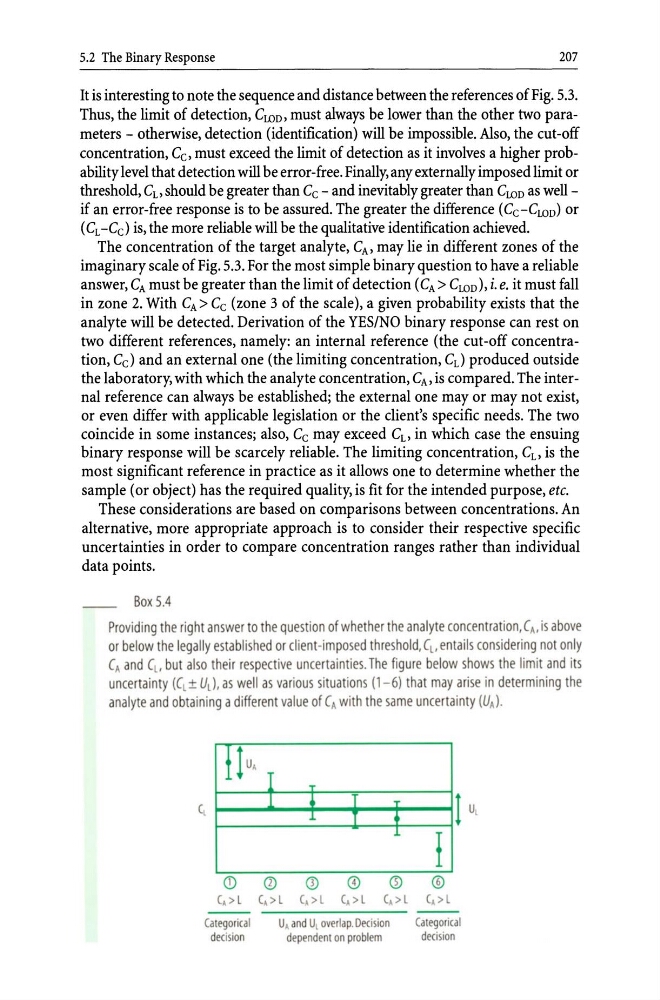
Box 5.4
Providing the right answer to the question of whether the analyte concentration, CA. is above
or below the legally established or client-imposed threshold, C L• entails considering not only
C A and C l , but also their respective uncertainties. The figure below shows the limit and its
uncertainty (C l ± Uti. as well as various situations (1- 6) that may arise in determining the
analyte and obtaining a different value of C" with the same uncertainty (VA)'
II U
A
I
T
1
~
T
T
l.
T
+
l.
I
o
Categorical
decision
UA and Ul overlap. Decision
dependent on problem
Categorical
decision
207
It is interesting to note the sequence and distance between the references of Fig. 5.3.
Thus, the limit of detection, CLOD, must always be lower than the other two parameters - otherwise, detection (identification) will be impossible. Also, the cut-off
concentration, C c , must exceed the limit of detection as it involves a higher probability level that detection will be error-free. Finally, any externally imposed limit or
threshold, CL, should be greater than Cc - and inevitably greater than CLOD as well -
if an error-free response is to be assured. The greater the difference (CC-CLOD) or
(CL -Cc) is, the more reliable will be the qualitative identification achieved.
The concentration of the target analyte, CA , may lie in different zones of the
imaginary scale of Fig. 5.3. For the most simple binary question to have a reliable
answer, CA must be greater than the limit of detection (CA > CLOD), i. e. it must fall
in zone 2. With CA > Cc (zone 3 of the scale), a given probability exists that the
analyte will be detected. Derivation of the YES/NO binary response can rest on
two different references, namely: an internal reference (the cut-off concentration, Cd and an external one (the limiting concentration, Cd produced outside
the laboratory, with which the analyte concentration, CA , is compared. The internal reference can always be established; the external one mayor may not exist,
or even differ with applicable legislation or the client's specific needs. The two
coincide in some instances; also, Cc may exceed CL, in which case the ensuing
binary response will be scarcely reliable. The limiting concentration, CL , is the
most significant reference in practice as it allows one to determine whether the
sample (or object) has the required quality, is fit for the intended purpose, etc.
These considerations are based on comparisons between concentrations. An
alternative, more appropriate approach is to consider their respective specific
uncertainties in order to compare concentration ranges rather than individual
data points.
Box 5.4
Providing the right answer to the question of whether the analyte concentration, CA. is above
or below the legally established or client-imposed threshold, C L• entails considering not only
C A and C l , but also their respective uncertainties. The figure below shows the limit and its
uncertainty (C l ± Uti. as well as various situations (1- 6) that may arise in determining the
analyte and obtaining a different value of C" with the same uncertainty (VA)'
II U
A
I
T
1
~
T
T
l.
T
+
l.
I
o
Categorical
decision
UA and Ul overlap. Decision
dependent on problem
Categorical
decision