

208
5 Qualitative Aspects of Analytical Chemistry
Only in the extreme situations (1 and 6) is the binary response absolutely reliable and can
the analyte be said to be absent or present. In the intermediate situations (2 - 5}, the uncertainty ranges overlap and the YES/NO decision depends on the particular connotations of the
analytical problem concerned.
The figure above is purely theoretical as, in practice, the threshold concentration imposed
by leg islation or required by the client is rarely accompanied by its uncertainty.
5.2.3 Analytical Features of the Binary Response
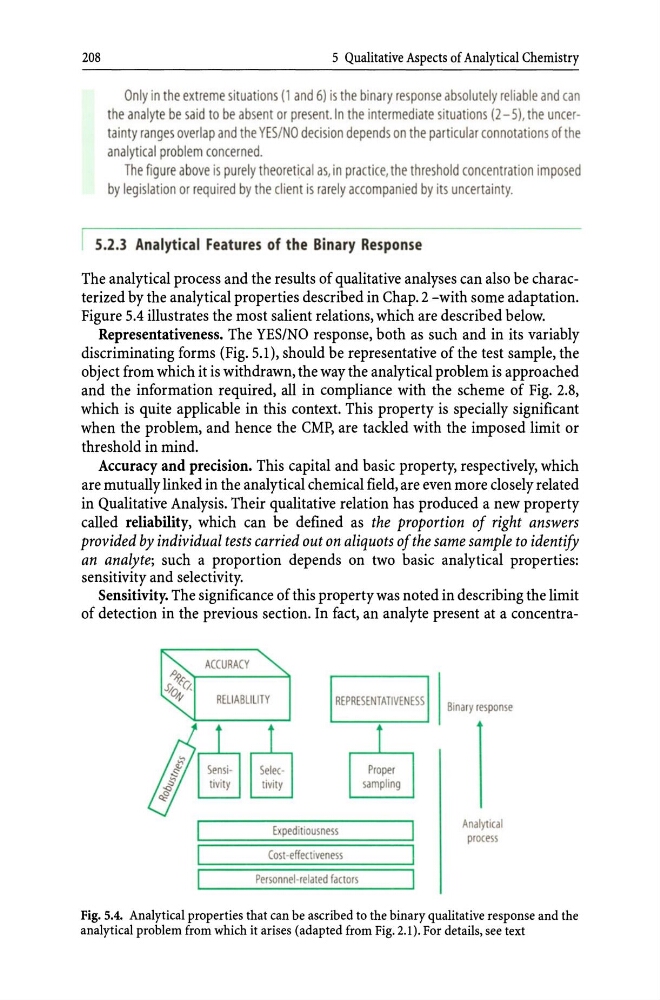
The analytical process and the results of qualitative analyses can also be characterized by the analytical properties described in Chap. 2 -with some adaptation.
Figure 5.4 illustrates the most salient relations, which are described below.
Representativeness. The YES/NO response, both as such and in its variably
discriminating forms (Fig. 5.1), should be representative of the test sample, the
object from which it is withdrawn, the way the analytical problem is approached
and the information required, all in compliance with the scheme of Fig. 2.8,
which is quite applicable in this context. This property is specially significant
when the problem, and hence the CMP, are tackled with the imposed limit or
threshold in mind.
Accuracy and precision. This capital and basic property, respectively, which
are mutually linked in the analytical chemical field, are even more closely related
in Qualitative Analysis. Their qualitative relation has produced a new property
called reliability, which can be defined as the proportion of right answers
provided by individual tests carried out on aliquots of the same sample to identify
an analyte; such a proportion depends on two basic analytical properties:
sensitivity and selectivity.
Sensitivity. The significance of this property was noted in describing the limit
of detection in the previous section. In fact, an analyte present at a concentraREPRESENTATIVENESS
i
Proper
sampling
Expeditiousness
Cost-effectiveness
Personnel-related factors
Bmary response
I
Analytical
process
Fig. 5.4. Analytical properties that can be ascribed to the binary qualitative response and the
analytical problem from which it arises (adapted from Fig. 2.1). For details, see text
5 Qualitative Aspects of Analytical Chemistry
Only in the extreme situations (1 and 6) is the binary response absolutely reliable and can
the analyte be said to be absent or present. In the intermediate situations (2 - 5}, the uncertainty ranges overlap and the YES/NO decision depends on the particular connotations of the
analytical problem concerned.
The figure above is purely theoretical as, in practice, the threshold concentration imposed
by leg islation or required by the client is rarely accompanied by its uncertainty.
5.2.3 Analytical Features of the Binary Response
The analytical process and the results of qualitative analyses can also be characterized by the analytical properties described in Chap. 2 -with some adaptation.
Figure 5.4 illustrates the most salient relations, which are described below.
Representativeness. The YES/NO response, both as such and in its variably
discriminating forms (Fig. 5.1), should be representative of the test sample, the
object from which it is withdrawn, the way the analytical problem is approached
and the information required, all in compliance with the scheme of Fig. 2.8,
which is quite applicable in this context. This property is specially significant
when the problem, and hence the CMP, are tackled with the imposed limit or
threshold in mind.
Accuracy and precision. This capital and basic property, respectively, which
are mutually linked in the analytical chemical field, are even more closely related
in Qualitative Analysis. Their qualitative relation has produced a new property
called reliability, which can be defined as the proportion of right answers
provided by individual tests carried out on aliquots of the same sample to identify
an analyte; such a proportion depends on two basic analytical properties:
sensitivity and selectivity.
Sensitivity. The significance of this property was noted in describing the limit
of detection in the previous section. In fact, an analyte present at a concentraREPRESENTATIVENESS
i
Proper
sampling
Expeditiousness
Cost-effectiveness
Personnel-related factors
Bmary response
I
Analytical
process
Fig. 5.4. Analytical properties that can be ascribed to the binary qualitative response and the
analytical problem from which it arises (adapted from Fig. 2.1). For details, see text