

206
Relative scale of
increasing concentration
CD
Intrinsic
toCMP
•
LIMIT OF
DElEOION
No detection
5 Qualitative Aspects of Analytical Chemistry
Reference concentrations
Decided upon in the
analytical problem
•
CUT-OFF
CONCENTRATION
Detection
Imposed by cl ient or
legislation
~
THRESHOLD OR LIMITING
CONCENTRATION
I
Detection with a given I
I
probability level
C ,
:G>
L........
@:
@
---,
G>
Increasingly reliable detection of A
t>
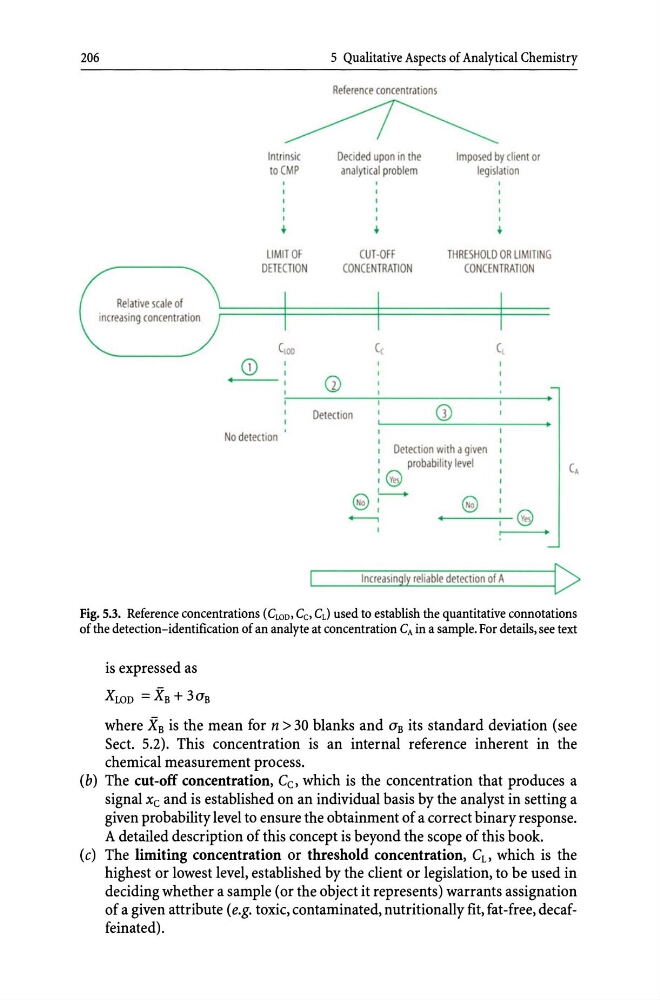
Fig. 5.3. Reference concentrations (Cwo, Cc, CL) used to establish the quantitative connotations
of the detection-identification of an analyte at concentration CA in a sample_ For details, see text
is expressed as
XWD =XB + 3aB
where XB is the mean for n > 30 blanks and aB its standard deviation (see
Sect. 5.2). This concentration is an internal reference inherent in the
chemical measurement process.
(b) The cut-off concentration, Ce, which is the concentration that produces a
signal Xc and is established on an individual basis by the analyst in setting a
given probability level to ensure the obtainment of a correct binary response.
A detailed description of this concept is beyond the scope of this book.
(c) The limiting concentration or threshold concentration, CL , which is the
highest or lowest level, established by the client or legislation, to be used in
deciding whether a sample (or the object it represents) warrants assignation
of a given attribute (e.g. toxic, contaminated, nutritionally fit, fat-free, decaffeinated).
Relative scale of
increasing concentration
CD
Intrinsic
toCMP
•
LIMIT OF
DElEOION
No detection
5 Qualitative Aspects of Analytical Chemistry
Reference concentrations
Decided upon in the
analytical problem
•
CUT-OFF
CONCENTRATION
Detection
Imposed by cl ient or
legislation
~
THRESHOLD OR LIMITING
CONCENTRATION
I
Detection with a given I
I
probability level
C ,
:G>
L........
@:
@
---,
G>
Increasingly reliable detection of A
t>
Fig. 5.3. Reference concentrations (Cwo, Cc, CL) used to establish the quantitative connotations
of the detection-identification of an analyte at concentration CA in a sample_ For details, see text
is expressed as
XWD =XB + 3aB
where XB is the mean for n > 30 blanks and aB its standard deviation (see
Sect. 5.2). This concentration is an internal reference inherent in the
chemical measurement process.
(b) The cut-off concentration, Ce, which is the concentration that produces a
signal Xc and is established on an individual basis by the analyst in setting a
given probability level to ensure the obtainment of a correct binary response.
A detailed description of this concept is beyond the scope of this book.
(c) The limiting concentration or threshold concentration, CL , which is the
highest or lowest level, established by the client or legislation, to be used in
deciding whether a sample (or the object it represents) warrants assignation
of a given attribute (e.g. toxic, contaminated, nutritionally fit, fat-free, decaffeinated).