

164
OPERATION
EFFICIENCY {PURPOSE
CONNECTION TO SECONO I
STEP OF CMP
4 The Measurement Process in Chemistry
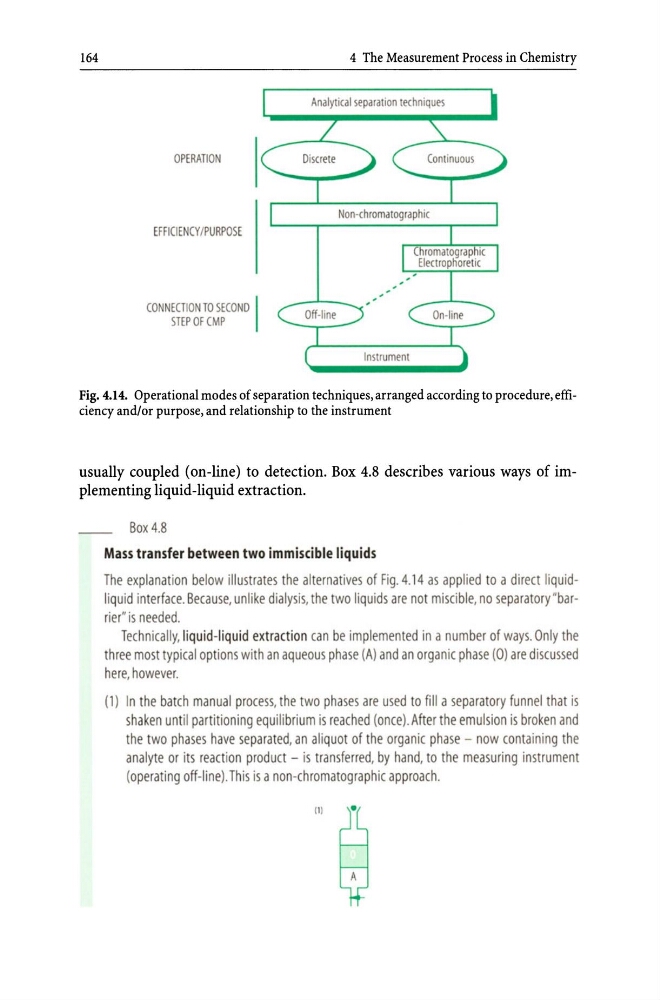
Fig.4.14. Operational modes of separation techniques, arranged according to procedure,efficiency and/or purpose, and relationship to the instrument
usually coupled (on-line) to detection. Box 4.8 describes various ways of implementing liquid-liquid extraction.
Box 4.8
Mass transfer between two immiscible liquids
The explanation below illustrates the alternatives of Fig. 4.14 as applied to a direct liquidliquid interface. Because, unlike dialysis, the two liquids are not miscible. no separatory"barrief" is needed.
Technically, liquid-liquid extraction can be implemented in a number of ways. Only the
three most typical options with an aqueous phase (A) and an organic phase (0) are discussed
here, however.
(1) In the batch manual process. the two phases are used to fill a separatory funnel that is
shaken until partitioning equilibrium is reached (once). After the emulsion is broken and
the two phases have separated, an aliquot of the organic phase - now containing the
analyte or its reaction product - is transferred, by hand. to the measuring instrument
(operating off-line). This is a non-chromatographic approach.
{II
•
A
OPERATION
EFFICIENCY {PURPOSE
CONNECTION TO SECONO I
STEP OF CMP
4 The Measurement Process in Chemistry
Fig.4.14. Operational modes of separation techniques, arranged according to procedure,efficiency and/or purpose, and relationship to the instrument
usually coupled (on-line) to detection. Box 4.8 describes various ways of implementing liquid-liquid extraction.
Box 4.8
Mass transfer between two immiscible liquids
The explanation below illustrates the alternatives of Fig. 4.14 as applied to a direct liquidliquid interface. Because, unlike dialysis, the two liquids are not miscible. no separatory"barrief" is needed.
Technically, liquid-liquid extraction can be implemented in a number of ways. Only the
three most typical options with an aqueous phase (A) and an organic phase (0) are discussed
here, however.
(1) In the batch manual process. the two phases are used to fill a separatory funnel that is
shaken until partitioning equilibrium is reached (once). After the emulsion is broken and
the two phases have separated, an aliquot of the organic phase - now containing the
analyte or its reaction product - is transferred, by hand. to the measuring instrument
(operating off-line). This is a non-chromatographic approach.
{II
•
A