

4.3 Preliminary Operations
PRINCIPAL SEPARATION TECHNIQUES
Adsorption
Adsorption, gas diffusion
Leaching
Supercritical fluid extraction
Dialysis
Liquid-liquid extraction
Adsorption, ion exchance (solid-phase extraction)
Precipitation
163
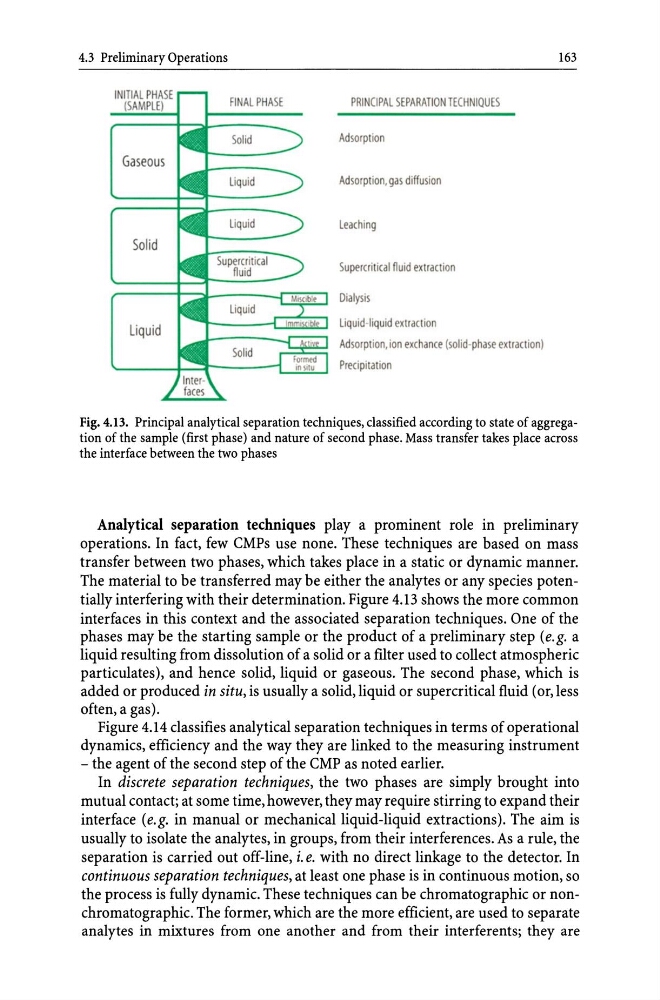
Fig. 4.13. Principal analytical separation techniques, classified according to state of aggregation of the sample (first phase) and nature of second phase. Mass transfer takes place across
the interface between the two phases
Analytical separation techniques play a prominent role in preliminary
operations. In fact, few CMPs use none. These techniques are based on mass
transfer between two phases, which takes place in a static or dynamic manner.
The material to be transferred may be either the analytes or any species potentially interfering with their determination. Figure 4.13 shows the more common
interfaces in this context and the associated separation techniques. One of the
phases may be the starting sample or the product of a preliminary step (e.g. a
liquid resulting from dissolution of a solid or a filter used to collect atmospheric
particulates), and hence solid, liquid or gaseous. The second phase, which is
added or produced in situ, is usually a solid, liquid or supercritical fluid (or, less
often, a gas).
Figure 4.14 classifies analytical separation techniques in terms of operational
dynamics, efficiency and the way they are linked to the measuring instrument
- the agent of the second step of the CMP as noted earlier.
In discrete separation techniques, the two phases are simply brought into
mutual contact; at some time, however, they may require stirring to expand their
interface (e.g. in manual or mechanical liquid-liquid extractions). The aim is
usually to isolate the analytes, in groups, from their interferences. As a rule, the
separation is carried out off-line, i. e. with no direct linkage to the detector. In
continuous separation techniques, at least one phase is in continuous motion, so
the process is fully dynamic. These techniques can be chromatographic or nonchromatographic. The former, which are the more efficient, are used to separate
analytes in mixtures from one another and from their interferents; they are
PRINCIPAL SEPARATION TECHNIQUES
Adsorption
Adsorption, gas diffusion
Leaching
Supercritical fluid extraction
Dialysis
Liquid-liquid extraction
Adsorption, ion exchance (solid-phase extraction)
Precipitation
163
Fig. 4.13. Principal analytical separation techniques, classified according to state of aggregation of the sample (first phase) and nature of second phase. Mass transfer takes place across
the interface between the two phases
Analytical separation techniques play a prominent role in preliminary
operations. In fact, few CMPs use none. These techniques are based on mass
transfer between two phases, which takes place in a static or dynamic manner.
The material to be transferred may be either the analytes or any species potentially interfering with their determination. Figure 4.13 shows the more common
interfaces in this context and the associated separation techniques. One of the
phases may be the starting sample or the product of a preliminary step (e.g. a
liquid resulting from dissolution of a solid or a filter used to collect atmospheric
particulates), and hence solid, liquid or gaseous. The second phase, which is
added or produced in situ, is usually a solid, liquid or supercritical fluid (or, less
often, a gas).
Figure 4.14 classifies analytical separation techniques in terms of operational
dynamics, efficiency and the way they are linked to the measuring instrument
- the agent of the second step of the CMP as noted earlier.
In discrete separation techniques, the two phases are simply brought into
mutual contact; at some time, however, they may require stirring to expand their
interface (e.g. in manual or mechanical liquid-liquid extractions). The aim is
usually to isolate the analytes, in groups, from their interferences. As a rule, the
separation is carried out off-line, i. e. with no direct linkage to the detector. In
continuous separation techniques, at least one phase is in continuous motion, so
the process is fully dynamic. These techniques can be chromatographic or nonchromatographic. The former, which are the more efficient, are used to separate
analytes in mixtures from one another and from their interferents; they are