

4.3 Preliminary Operations
165
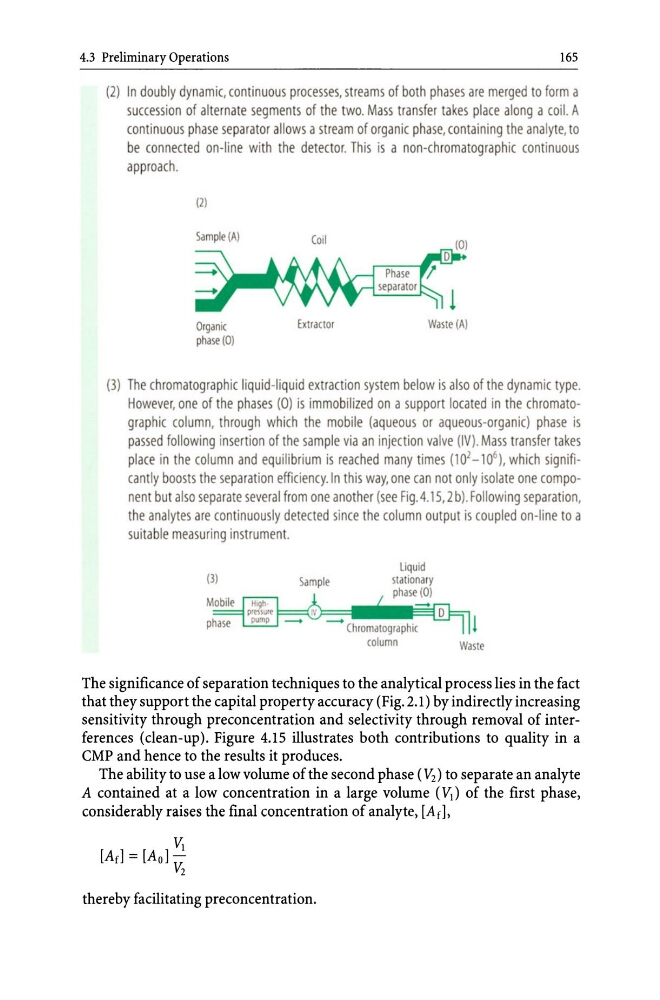
(2) In doubly dynamic, continuous processes, streams of both phases are merged to form a
succession of alternate segments of the two. Mass transfer takes place along a coil. A
continuous phase separator allows a stream of organic phase, containing the analyte, to
be connected on-line with the detector. This is a non-chromatographic contin uous
approach.
(2)
Sample (A)
Organic
phase (0)
(oil
Extractor
Waste (A)
(3) The chromatographic liquid-liquid extraction system below is also of the dynamic type.
However, one of the phases (0) is immobilized on a support located in the chromatographic column, through which the mobile (aqueous or aqueous-organic) phase is
passed following insertion of the sample via an injection valve (IV). Mass transfer takes
place in the column and equilibrium is reached many times (1 0 1 -10 6 ), which significantly boosts the separation efficiency. In this way, one can not only isolate one component but also separate several from one another (see Fig.4. 15, 2 b). Following separation,
the analytes are continuously detected since the column output is coupled on-line to a
suitable measuring instrument.
The significance of separation techniques to the analytical process lies in the fact
that they support the capital property accuracy (Fig. 2.1) by indirectly increasing
sensitivity through preconcentration and selectivity through removal of interferences (clean-up). Figure 4.15 illustrates both contributions to quality in a
eMP and hence to the results it produces.
The ability to use a low volume of the second phase (V1 ) to separate an analyte
A contained at a low concentration in a large volume (VI) of the first phase,
considerably raises the final concentration of analyte, [Afl,
VI
[Ad = [Aol- V1
thereby facilitating preconcentration.
165
(2) In doubly dynamic, continuous processes, streams of both phases are merged to form a
succession of alternate segments of the two. Mass transfer takes place along a coil. A
continuous phase separator allows a stream of organic phase, containing the analyte, to
be connected on-line with the detector. This is a non-chromatographic contin uous
approach.
(2)
Sample (A)
Organic
phase (0)
(oil
Extractor
Waste (A)
(3) The chromatographic liquid-liquid extraction system below is also of the dynamic type.
However, one of the phases (0) is immobilized on a support located in the chromatographic column, through which the mobile (aqueous or aqueous-organic) phase is
passed following insertion of the sample via an injection valve (IV). Mass transfer takes
place in the column and equilibrium is reached many times (1 0 1 -10 6 ), which significantly boosts the separation efficiency. In this way, one can not only isolate one component but also separate several from one another (see Fig.4. 15, 2 b). Following separation,
the analytes are continuously detected since the column output is coupled on-line to a
suitable measuring instrument.
The significance of separation techniques to the analytical process lies in the fact
that they support the capital property accuracy (Fig. 2.1) by indirectly increasing
sensitivity through preconcentration and selectivity through removal of interferences (clean-up). Figure 4.15 illustrates both contributions to quality in a
eMP and hence to the results it produces.
The ability to use a low volume of the second phase (V1 ) to separate an analyte
A contained at a low concentration in a large volume (VI) of the first phase,
considerably raises the final concentration of analyte, [Afl,
VI
[Ad = [Aol- V1
thereby facilitating preconcentration.