

160
4 The Measurement Process in Chemistry
,---------------,
I
,
~===='C=~
:
CD
Probe
o
o
Water -
0
o
I
l ______________ . 1
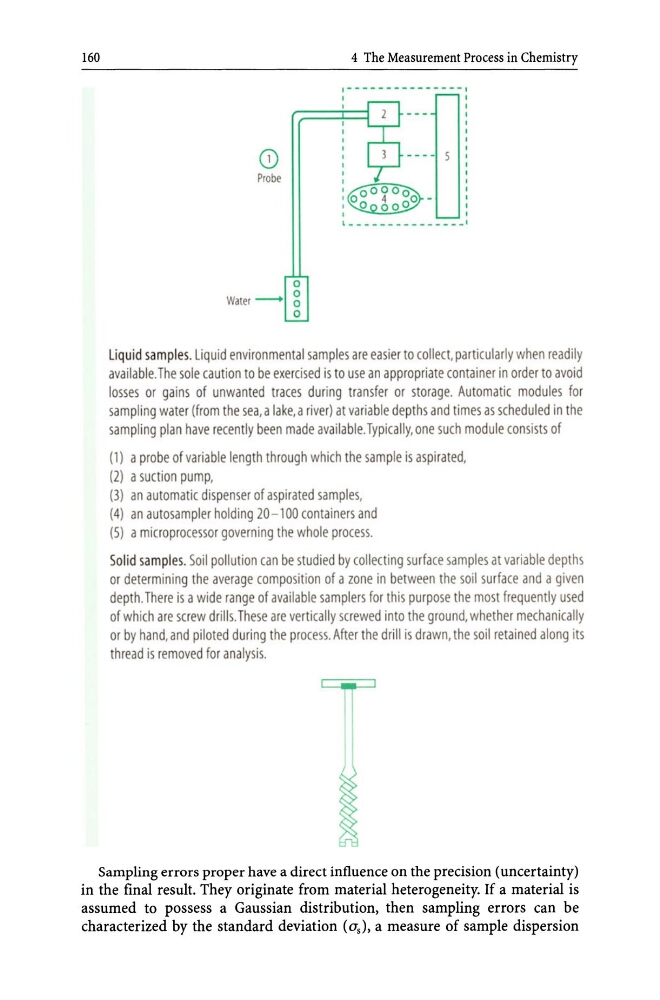
Liquid samples. Liquid environmental samples are easier to collect, particularly when readily
available.The sole caution to be exercised is to use an appropriate container in order to avoid
losses or gains of unwanted traces during transfer or storage. Automatic modules for
sampling water (from the sea,a lake, a river) at va riable depths and times as scheduled in the
sampling plan have recently been made available. Typica lly, one such module consists of
(1) a probe of variable length through which the sample is aspirated,
(2) a suction pump,
(3) an automatic dispenser of aspirated samples,
(4) an autosampler holding 20 - 100 containers and
(5) a microprocessor governing the whole process.
Solid samples. Soil pollution can be studied by collecting surface samples at variable depths
or determining the average composition of a zone in between the soil surface and a given
depth. There is a wide range of available samplers for this purpose the most frequently used
of which are screw drills. These are vertically screwed into the ground, whether mechanica lly
or by hand, and piloted during the process. After the drill is drawn, the soil retained along its
thread is removed for analysis.
Sampling errors proper have a direct influence on the precision (uncertainty)
in the final result. They originate from material heterogeneity. If a material is
assumed to possess a Gaussian distribution, then sampling errors can be
characterized by the standard deviation (as), a measure of sample dispersion
4 The Measurement Process in Chemistry
,---------------,
I
,
~===='C=~
:
CD
Probe
o
o
Water -
0
o
I
l ______________ . 1
Liquid samples. Liquid environmental samples are easier to collect, particularly when readily
available.The sole caution to be exercised is to use an appropriate container in order to avoid
losses or gains of unwanted traces during transfer or storage. Automatic modules for
sampling water (from the sea,a lake, a river) at va riable depths and times as scheduled in the
sampling plan have recently been made available. Typica lly, one such module consists of
(1) a probe of variable length through which the sample is aspirated,
(2) a suction pump,
(3) an automatic dispenser of aspirated samples,
(4) an autosampler holding 20 - 100 containers and
(5) a microprocessor governing the whole process.
Solid samples. Soil pollution can be studied by collecting surface samples at variable depths
or determining the average composition of a zone in between the soil surface and a given
depth. There is a wide range of available samplers for this purpose the most frequently used
of which are screw drills. These are vertically screwed into the ground, whether mechanica lly
or by hand, and piloted during the process. After the drill is drawn, the soil retained along its
thread is removed for analysis.
Sampling errors proper have a direct influence on the precision (uncertainty)
in the final result. They originate from material heterogeneity. If a material is
assumed to possess a Gaussian distribution, then sampling errors can be
characterized by the standard deviation (as), a measure of sample dispersion