

4.3 Preliminary Operations
161
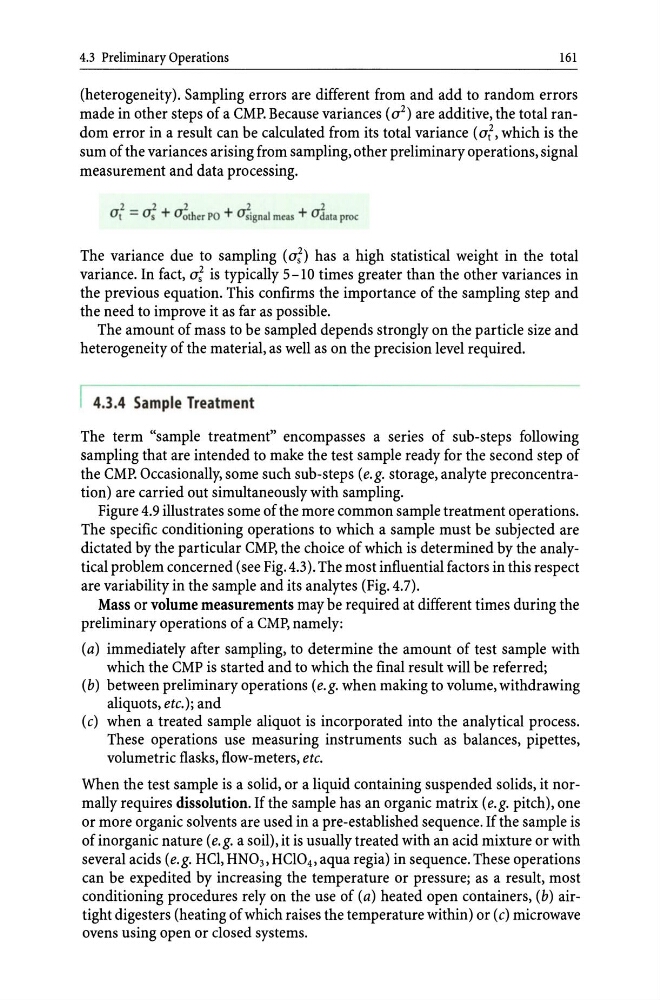
(heterogeneity). Sampling errors are different from and add to random errors
made in other steps of a CMP. Because variances (a 2 ) are additive, the total random error in a result can be calculated from its total variance (a;, which is the
sum of the variances arising from sampling, other preliminary operations, signal
measurement and data processing.
a t 2 = a~ + a~ther PO + a:ignal meas + aaata proc
The variance due to sampling (a;) has a high statistical weight in the total
variance. In fact, a; is typically 5 -10 times greater than the other variances in
the previous equation. This confirms the importance of the sampling step and
the need to improve it as far as possible.
The amount of mass to be sampled depends strongly on the particle size and
heterogeneity of the material, as well as on the precision level required.
~3.4 Sample Treatment
The term "sample treatment" encompasses a series of sub-steps following
sampling that are intended to make the test sample ready for the second step of
the CMP. Occasionally, some such sub-steps (e.g. storage, analyte preconcentration) are carried out simultaneously with sampling.
Figure 4.9 illustrates some of the more common sample treatment operations.
The specific conditioning operations to which a sample must be subjected are
dictated by the particular CMP, the choice of which is determined by the analytical problem concerned (see Fig. 4.3). The most influential factors in this respect
are variability in the sample and its analytes (Fig. 4.7).
Mass or volume measurements may be required at different times during the
preliminary operations of a CMP, namely:
(a) immediately after sampling, to determine the amount of test sample with
which the CMP is started and to which the final result will be referred;
(b) between preliminary operations (e. g. when making to volume, withdrawing
aliquots, etc.); and
(c) when a treated sample aliquot is incorporated into the analytical process.
These operations use measuring instruments such as balances, pipettes,
volumetric flasks, flow-meters, etc.
When the test sample is a solid, or a liquid containing suspended solids, it normally requires dissolution. If the sample has an organic matrix (e.g. pitch), one
or more organic solvents are used in a pre-established sequence. If the sample is
of inorganic nature (e. g. a soil), it is usually treated with an acid mixture or with
several acids (e.g. HCI, HN03 , HCI04 , aqua regia) in sequence. These operations
can be expedited by increasing the temperature or pressure; as a result, most
conditioning procedures rely on the use of (a) heated open containers, (b) airtight digesters (heating of which raises the temperature within) or (c) microwave
ovens using open or closed systems.
161
(heterogeneity). Sampling errors are different from and add to random errors
made in other steps of a CMP. Because variances (a 2 ) are additive, the total random error in a result can be calculated from its total variance (a;, which is the
sum of the variances arising from sampling, other preliminary operations, signal
measurement and data processing.
a t 2 = a~ + a~ther PO + a:ignal meas + aaata proc
The variance due to sampling (a;) has a high statistical weight in the total
variance. In fact, a; is typically 5 -10 times greater than the other variances in
the previous equation. This confirms the importance of the sampling step and
the need to improve it as far as possible.
The amount of mass to be sampled depends strongly on the particle size and
heterogeneity of the material, as well as on the precision level required.
~3.4 Sample Treatment
The term "sample treatment" encompasses a series of sub-steps following
sampling that are intended to make the test sample ready for the second step of
the CMP. Occasionally, some such sub-steps (e.g. storage, analyte preconcentration) are carried out simultaneously with sampling.
Figure 4.9 illustrates some of the more common sample treatment operations.
The specific conditioning operations to which a sample must be subjected are
dictated by the particular CMP, the choice of which is determined by the analytical problem concerned (see Fig. 4.3). The most influential factors in this respect
are variability in the sample and its analytes (Fig. 4.7).
Mass or volume measurements may be required at different times during the
preliminary operations of a CMP, namely:
(a) immediately after sampling, to determine the amount of test sample with
which the CMP is started and to which the final result will be referred;
(b) between preliminary operations (e. g. when making to volume, withdrawing
aliquots, etc.); and
(c) when a treated sample aliquot is incorporated into the analytical process.
These operations use measuring instruments such as balances, pipettes,
volumetric flasks, flow-meters, etc.
When the test sample is a solid, or a liquid containing suspended solids, it normally requires dissolution. If the sample has an organic matrix (e.g. pitch), one
or more organic solvents are used in a pre-established sequence. If the sample is
of inorganic nature (e. g. a soil), it is usually treated with an acid mixture or with
several acids (e.g. HCI, HN03 , HCI04 , aqua regia) in sequence. These operations
can be expedited by increasing the temperature or pressure; as a result, most
conditioning procedures rely on the use of (a) heated open containers, (b) airtight digesters (heating of which raises the temperature within) or (c) microwave
ovens using open or closed systems.