

144
4 The Measurement Process in Chemistry
I 4.1 Definition of Chemical Measurement Process
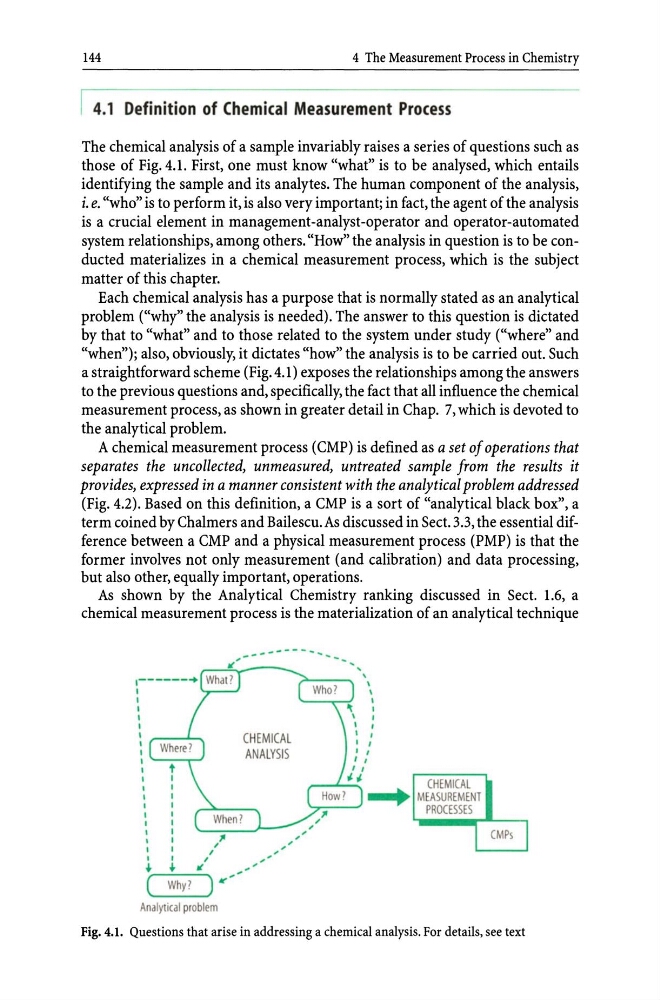
The chemical analysis of a sample invariably raises a series of questions such as
those of Fig. 4.1. First, one must know "what" is to be analysed, which entails
identifying the sample and its analytes. The human component of the analysis,
i. e. "who" is to perform it, is also very important; in fact, the agent of the analysis
is a crucial element in management-analyst-operator and operator-automated
system relationships, among others. "How" the analysis in question is to be conducted materializes in a chemical measurement process, which is the subject
matter of this chapter.
Each chemical analysis has a purpose that is normally stated as an analytical
problem ("why" the analysis is needed). The answer to this question is dictated
by that to "what" and to those related to the system under study ("where" and
"when"); also, obviously, it dictates "how" the analysis is to be carried out. Such
a straightforward scheme (Fig. 4.1) exposes the relationships among the answers
to the previous questions and, specifically, the fact that all influence the chemical
measurement process, as shown in greater detail in Chap. 7, which is devoted to
the analytical problem.
A chemical measurement process (CMP) is defined as a set of operations that
separates the uncollected, unmeasured, untreated sample from the results it
provides, expressed in a manner consistent with the analytical problem addressed
(Fig. 4.2). Based on this definition, a CMP is a sort of "analytical black box", a
term coined by Chalmers and Bailescu. As discussed in Sect. 3.3, the essential difference between a CMP and a physical measurement process (PMP) is that the
former involves not only measurement (and calibration) and data processing,
but also other, equally important, operations.
As shown by the Analytical Chemistry ranking discussed in Sect. 1.6, a
chemical measurement process is the materialization of an analytical technique
... ----... - -
...... -
CHEMICAL
ANALYSIS
,
"
I
I
J''''
•
•
II
,"
( Why ? ) ~"
Analytica l problem
,
,
,
~
~
Fig.4.1. Questions that arise in addressing a chemical analysis. For details, see text
4 The Measurement Process in Chemistry
I 4.1 Definition of Chemical Measurement Process
The chemical analysis of a sample invariably raises a series of questions such as
those of Fig. 4.1. First, one must know "what" is to be analysed, which entails
identifying the sample and its analytes. The human component of the analysis,
i. e. "who" is to perform it, is also very important; in fact, the agent of the analysis
is a crucial element in management-analyst-operator and operator-automated
system relationships, among others. "How" the analysis in question is to be conducted materializes in a chemical measurement process, which is the subject
matter of this chapter.
Each chemical analysis has a purpose that is normally stated as an analytical
problem ("why" the analysis is needed). The answer to this question is dictated
by that to "what" and to those related to the system under study ("where" and
"when"); also, obviously, it dictates "how" the analysis is to be carried out. Such
a straightforward scheme (Fig. 4.1) exposes the relationships among the answers
to the previous questions and, specifically, the fact that all influence the chemical
measurement process, as shown in greater detail in Chap. 7, which is devoted to
the analytical problem.
A chemical measurement process (CMP) is defined as a set of operations that
separates the uncollected, unmeasured, untreated sample from the results it
provides, expressed in a manner consistent with the analytical problem addressed
(Fig. 4.2). Based on this definition, a CMP is a sort of "analytical black box", a
term coined by Chalmers and Bailescu. As discussed in Sect. 3.3, the essential difference between a CMP and a physical measurement process (PMP) is that the
former involves not only measurement (and calibration) and data processing,
but also other, equally important, operations.
As shown by the Analytical Chemistry ranking discussed in Sect. 1.6, a
chemical measurement process is the materialization of an analytical technique
... ----... - -
...... -
CHEMICAL
ANALYSIS
,
"
I
I
J''''
•
•
II
,"
( Why ? ) ~"
Analytica l problem
,
,
,
~
~
Fig.4.1. Questions that arise in addressing a chemical analysis. For details, see text