

3.4 Types of Standards and their Traceability
III
Box 3.6
The word "standard" bears a number of meanings that are frequently misleading. Thus, it can
be used to refer to written documents; to codes, signs and languages used for communication
between systems; to behavioral or operational patterns; etc In the measurement domain, a
"standard" is used (a) to define the minimum acceptable specifications (attributes) of an
object or service (e. g. technical specifications, instructions of use or operation, safety levels,
quality criteria) or (b) to establish references such as currencies for international trade.
STANDARD
English
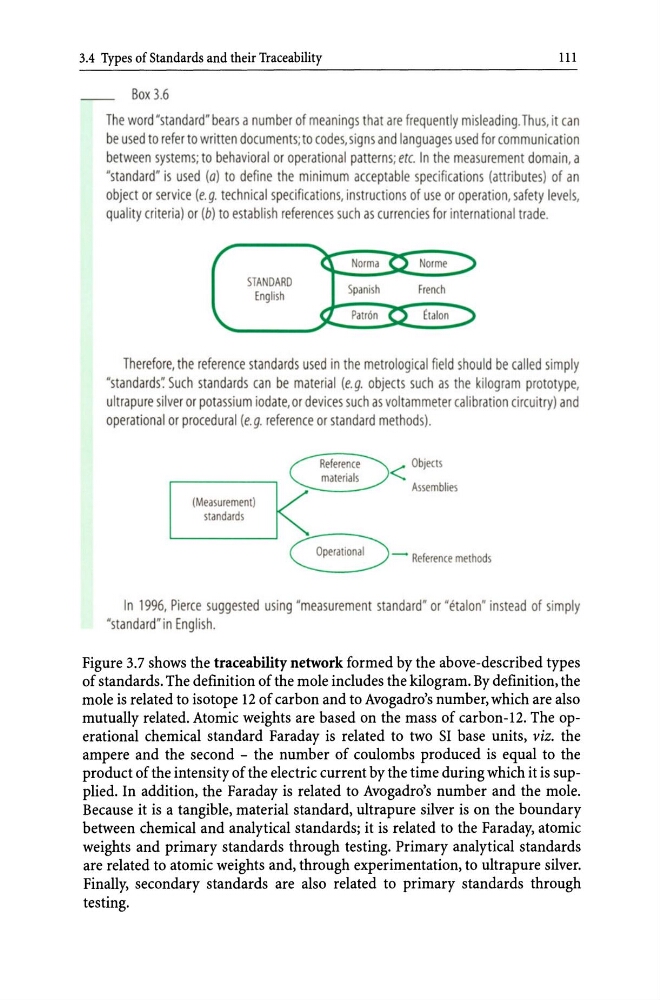
Therefore, the reference standards used in the metrological field should be called simply
"standards'~ Such standards can be material (e.g. objects such as the kilogram prototype,
ultrapure silver or potassium iodate,or devices such as voltammeter calibration circuitry) and
operational or procedural (e.g. reference or standard methods).
(Measu rement)
standards
< Objects
Assemblies
- Reference methods
In 1996, Pierce suggested using "measurement standard" or "eta Ion" instead of simply
"standard" in English.
Figure 3.7 shows the traceability network formed by the above-described types
of standards. The definition of the mole includes the kilogram. By definition, the
mole is related to isotope 12 of carbon and to Avogadro's number, which are also
mutually related. Atomic weights are based on the mass of carbon-12. The operational chemical standard Faraday is related to two SI base units, viz. the
ampere and the second - the number of coulombs produced is equal to the
product of the intensity of the electric current by the time during which it is supplied. In addition, the Faraday is related to Avogadro's number and the mole.
Because it is a tangible, material standard, ultrapure silver is on the boundary
between chemical and analytical standards; it is related to the Faraday, atomic
weights and primary standards through testing. Primary analytical standards
are related to atomic weights and, through experimentation, to ultrapure silver.
Finally, secondary standards are also related to primary standards through
testing.
III
Box 3.6
The word "standard" bears a number of meanings that are frequently misleading. Thus, it can
be used to refer to written documents; to codes, signs and languages used for communication
between systems; to behavioral or operational patterns; etc In the measurement domain, a
"standard" is used (a) to define the minimum acceptable specifications (attributes) of an
object or service (e. g. technical specifications, instructions of use or operation, safety levels,
quality criteria) or (b) to establish references such as currencies for international trade.
STANDARD
English
Therefore, the reference standards used in the metrological field should be called simply
"standards'~ Such standards can be material (e.g. objects such as the kilogram prototype,
ultrapure silver or potassium iodate,or devices such as voltammeter calibration circuitry) and
operational or procedural (e.g. reference or standard methods).
(Measu rement)
standards
< Objects
Assemblies
- Reference methods
In 1996, Pierce suggested using "measurement standard" or "eta Ion" instead of simply
"standard" in English.
Figure 3.7 shows the traceability network formed by the above-described types
of standards. The definition of the mole includes the kilogram. By definition, the
mole is related to isotope 12 of carbon and to Avogadro's number, which are also
mutually related. Atomic weights are based on the mass of carbon-12. The operational chemical standard Faraday is related to two SI base units, viz. the
ampere and the second - the number of coulombs produced is equal to the
product of the intensity of the electric current by the time during which it is supplied. In addition, the Faraday is related to Avogadro's number and the mole.
Because it is a tangible, material standard, ultrapure silver is on the boundary
between chemical and analytical standards; it is related to the Faraday, atomic
weights and primary standards through testing. Primary analytical standards
are related to atomic weights and, through experimentation, to ultrapure silver.
Finally, secondary standards are also related to primary standards through
testing.