

3.3 Physical and Chemical Traceability
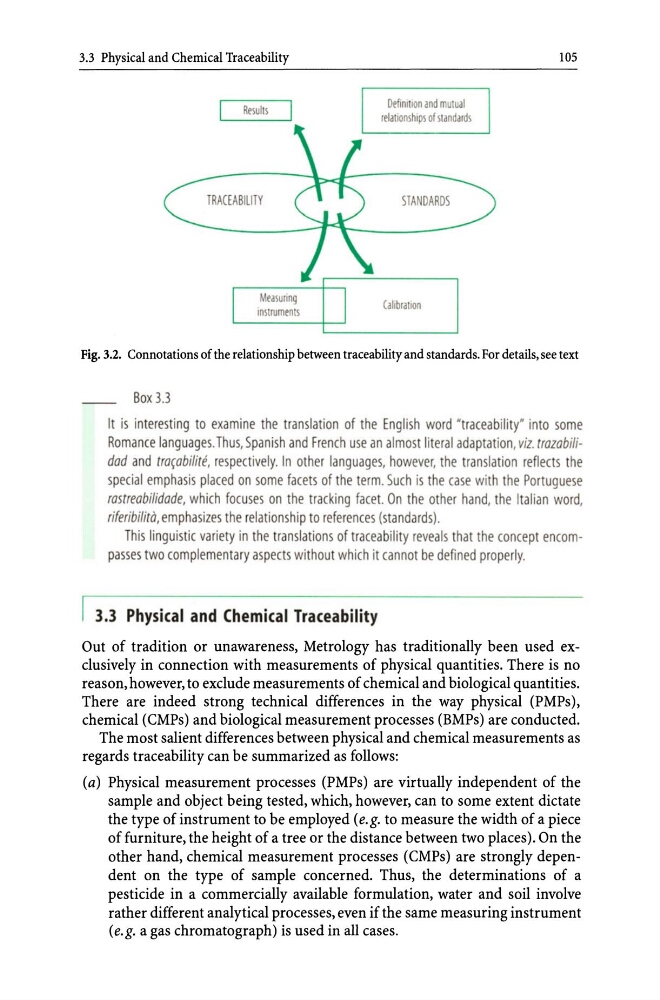
Resulls
De Inillon and mutual
relationships of m ndalds
STANDARDS
Calibration
105
Fig. 3.2. Connotations of the relationship between traceability and standards. For details, see text
Box 3.3
It is interesting to examine the translation of the English word "traceability" into some
Romance lang uages. Thus, Spanish and French use an almost literal adaptation, viz. trazabilidad and tra(abi/ite, respectively. In other languages, however, the translation reflects the
special emphasis placed on some facets of the term. Such is the case with the Portuguese
rastreabi/idade, which focuses on the tracking facet. On the other hand, the Italian word,
riferibilita, emphasizes the relationship to references (standards).
This linguistic variety in the translations of traceability reveals that the concept encompasses two complementary aspects without which it cannot be defined properly.
3.3 Physical and Chemical Traceability
Out of tradition or unawareness, Metrology has traditionally been used exclusively in connection with measurements of physical quantities. There is no
reason, however, to exclude measurements of chemical and biological quantities.
There are indeed strong technical differences in the way physical (PMPs),
chemical (CMPs) and biological measurement processes (BMPs) are conducted.
The most salient differences between physical and chemical measurements as
regards traceability can be summarized as follows:
(a) Physical measurement processes (PMPs) are virtually independent of the
sample and object being tested, which, however, can to some extent dictate
the type of instrument to be employed (e. g. to measure the width of a piece
of furniture, the height of a tree or the distance between two places). On the
other hand, chemical measurement processes (CMPs) are strongly dependent on the type of sample concerned. Thus, the determinations of a
pesticide in a commercially available formulation, water and soil involve
rather different analytical processes, even if the same measuring instrument
(e.g. a gas chromatograph) is used in all cases.
Resulls
De Inillon and mutual
relationships of m ndalds
STANDARDS
Calibration
105
Fig. 3.2. Connotations of the relationship between traceability and standards. For details, see text
Box 3.3
It is interesting to examine the translation of the English word "traceability" into some
Romance lang uages. Thus, Spanish and French use an almost literal adaptation, viz. trazabilidad and tra(abi/ite, respectively. In other languages, however, the translation reflects the
special emphasis placed on some facets of the term. Such is the case with the Portuguese
rastreabi/idade, which focuses on the tracking facet. On the other hand, the Italian word,
riferibilita, emphasizes the relationship to references (standards).
This linguistic variety in the translations of traceability reveals that the concept encompasses two complementary aspects without which it cannot be defined properly.
3.3 Physical and Chemical Traceability
Out of tradition or unawareness, Metrology has traditionally been used exclusively in connection with measurements of physical quantities. There is no
reason, however, to exclude measurements of chemical and biological quantities.
There are indeed strong technical differences in the way physical (PMPs),
chemical (CMPs) and biological measurement processes (BMPs) are conducted.
The most salient differences between physical and chemical measurements as
regards traceability can be summarized as follows:
(a) Physical measurement processes (PMPs) are virtually independent of the
sample and object being tested, which, however, can to some extent dictate
the type of instrument to be employed (e. g. to measure the width of a piece
of furniture, the height of a tree or the distance between two places). On the
other hand, chemical measurement processes (CMPs) are strongly dependent on the type of sample concerned. Thus, the determinations of a
pesticide in a commercially available formulation, water and soil involve
rather different analytical processes, even if the same measuring instrument
(e.g. a gas chromatograph) is used in all cases.