

104
Calibration
Results
3 Traceability: Reference Materials
Harmonrza Ion
Comparability
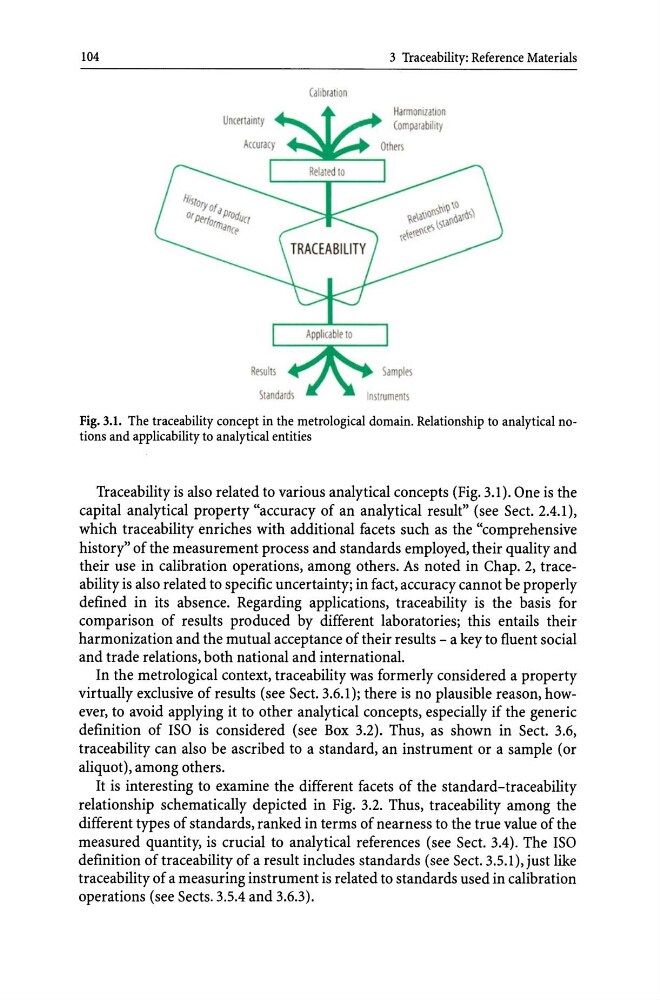
Fig. 3.1. The traceability concept in the metrological domain. Relationship to analytical notions and applicability to analytical entities
Traceability is also related to various analytical concepts (Fig. 3.1). One is the
capital analytical property "accuracy of an analytical result" (see Sect. 2.4.1),
which traceability enriches with additional facets such as the "comprehensive
history" of the measurement process and standards employed, their quality and
their use in calibration operations, among others. As noted in Chap. 2, traceability is also related to specific uncertainty; in fact, accuracy cannot be properly
defined in its absence. Regarding applications, traceability is the basis for
comparison of results produced by different laboratories; this entails their
harmonization and the mutual acceptance of their results - a key to fluent social
and trade relations, both national and international.
In the metrological context, traceability was formerly considered a property
virtually exclusive of results (see Sect. 3.6.1); there is no plausible reason, however, to avoid applying it to other analytical concepts, especially if the generic
definition of ISO is considered (see Box 3.2). Thus, as shown in Sect. 3.6,
traceability can also be ascribed to a standard, an instrument or a sample (or
aliquot), among others.
It is interesting to examine the different facets of the standard-traceability
relationship schematically depicted in Fig. 3.2. Thus, traceability among the
different types of standards, ranked in terms of nearness to the true value of the
measured quantity, is crucial to analytical references (see Sect. 3.4). The ISO
definition of traceability of a result includes standards (see Sect. 3.5.1), just like
traceability of a measuring instrument is related to standards used in calibration
operations (see Sects. 3.5.4 and 3.6.3).
Calibration
Results
3 Traceability: Reference Materials
Harmonrza Ion
Comparability
Fig. 3.1. The traceability concept in the metrological domain. Relationship to analytical notions and applicability to analytical entities
Traceability is also related to various analytical concepts (Fig. 3.1). One is the
capital analytical property "accuracy of an analytical result" (see Sect. 2.4.1),
which traceability enriches with additional facets such as the "comprehensive
history" of the measurement process and standards employed, their quality and
their use in calibration operations, among others. As noted in Chap. 2, traceability is also related to specific uncertainty; in fact, accuracy cannot be properly
defined in its absence. Regarding applications, traceability is the basis for
comparison of results produced by different laboratories; this entails their
harmonization and the mutual acceptance of their results - a key to fluent social
and trade relations, both national and international.
In the metrological context, traceability was formerly considered a property
virtually exclusive of results (see Sect. 3.6.1); there is no plausible reason, however, to avoid applying it to other analytical concepts, especially if the generic
definition of ISO is considered (see Box 3.2). Thus, as shown in Sect. 3.6,
traceability can also be ascribed to a standard, an instrument or a sample (or
aliquot), among others.
It is interesting to examine the different facets of the standard-traceability
relationship schematically depicted in Fig. 3.2. Thus, traceability among the
different types of standards, ranked in terms of nearness to the true value of the
measured quantity, is crucial to analytical references (see Sect. 3.4). The ISO
definition of traceability of a result includes standards (see Sect. 3.5.1), just like
traceability of a measuring instrument is related to standards used in calibration
operations (see Sects. 3.5.4 and 3.6.3).