

266
S. Breitenlechner, P. Selig, T. Bach
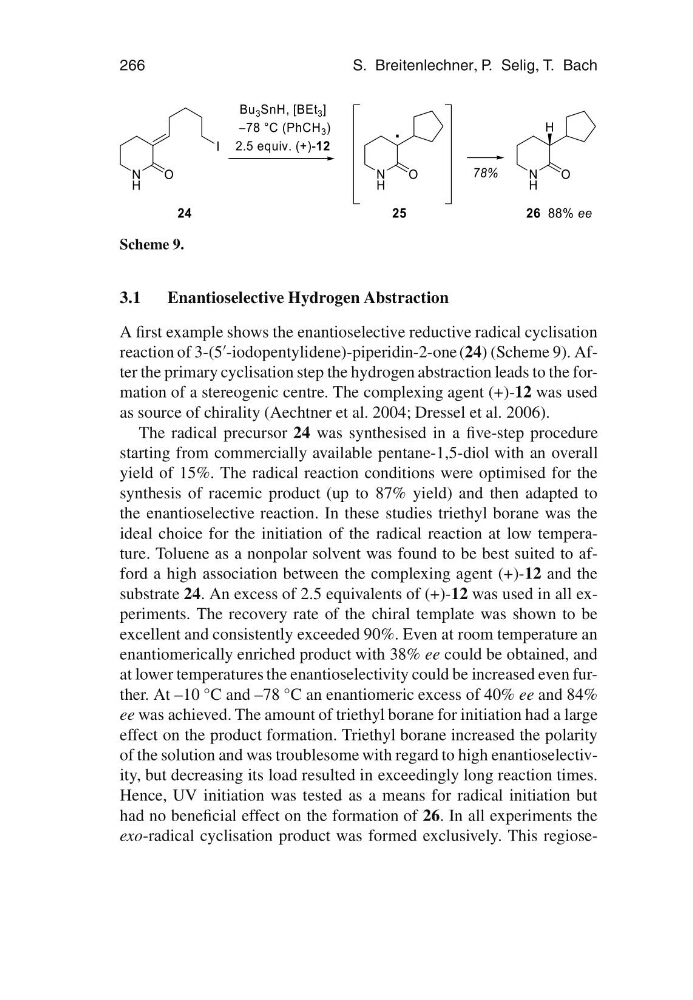
Scheme 9.
3.1
Enantioselective Hydrogen Abstraction
A first example shows the enantioselective reductive radical cyclisation
reaction of 3-(5
-iodopentylidene)-piperidin-2-one (24) (Scheme 9). After the primary cyclisation step the hydrogen abstraction leads to the formation of a stereogenic centre. The complexing agent (+)-12 was used
as source of chirality (Aechtner et al. 2004; Dressel et al. 2006).
The radical precursor 24 was synthesised in a five-step procedure
starting from commercially available pentane-1,5-diol with an overall
yield of 15%. The radical reaction conditions were optimised for the
synthesis of racemic product (up to 87% yield) and then adapted to
the enantioselective reaction. In these studies triethyl borane was the
ideal choice for the initiation of the radical reaction at low temperature. Toluene as a nonpolar solvent was found to be best suited to afford a high association between the complexing agent (+)-12 and the
substrate 24. An excess of 2.5 equivalents of (+)-12 was used in all experiments. The recovery rate of the chiral template was shown to be
excellent and consistently exceeded 90%. Even at room temperature an
enantiomerically enriched product with 38% ee could be obtained, and
at lower temperatures the enantioselectivity could be increased even further. At –10 °C and –78 °C an enantiomeric excess of 40% ee and 84%
ee was achieved. The amount of triethyl borane for initiation had a large
effect on the product formation. Triethyl borane increased the polarity
of the solution and was troublesome with regard to high enantioselectivity, but decreasing its load resulted in exceedingly long reaction times.
Hence, UV initiation was tested as a means for radical initiation but
had no beneficial effect on the formation of 26. In all experiments the
exo-radical cyclisation product was formed exclusively. This regiose-