

Enantioselective Photochemistry
267
lectivity can be explained by the excellent overlap of the interacting
π-orbitals of the terminal radical and the exo carbon atom of the olefin
in the transition state, and the stabilisation of the newly formed radical
by the carbonyl group in α-position. The hydrogen abstraction step is
crucial for inducing enantioselectivity. The face differentiation occurs
supposedly in the complex of the intermediate radical 25 and the template (+)-12. A job plot
1 H NMR analysis confirmed the assumed 1:1
stoichiometry between complexing agent (+)-12 and substrate 24.
3.2
Cyclisation Reactions
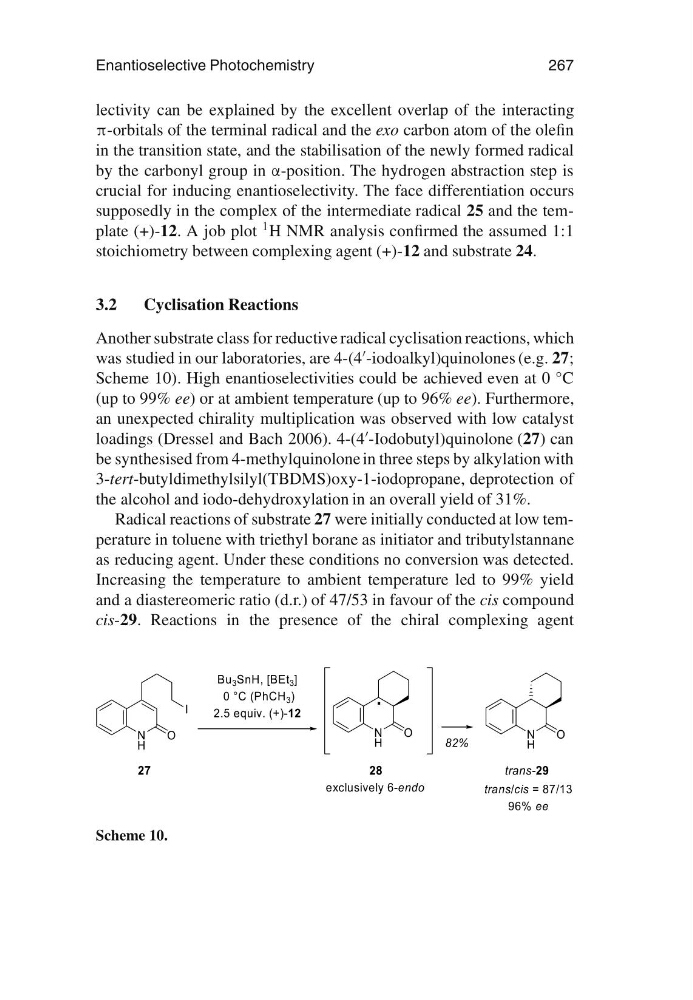
Another substrate class for reductive radical cyclisation reactions, which
was studied in our laboratories, are 4-(4
-iodoalkyl)quinolones (e.g. 27;
Scheme 10). High enantioselectivities could be achieved even at 0 °C
(up to 99% ee) or at ambient temperature (up to 96% ee). Furthermore,
an unexpected chirality multiplication was observed with low catalyst
loadings (Dressel and Bach 2006). 4-(4
-Iodobutyl)quinolone (27) can
be synthesised from 4-methylquinolone in three steps by alkylation with
3-tert-butyldimethylsilyl(TBDMS)oxy-1-iodopropane, deprotection of
the alcohol and iodo-dehydroxylation in an overall yield of 31%.
Radical reactions of substrate 27 were initially conducted at low temperature in toluene with triethyl borane as initiator and tributylstannane
as reducing agent. Under these conditions no conversion was detected.
Increasing the temperature to ambient temperature led to 99% yield
and a diastereomeric ratio (d.r.) of 47/53 in favour of the cis compound
cis-29. Reactions in the presence of the chiral complexing agent
Scheme 10.