

Enantioselective Photochemistry
265
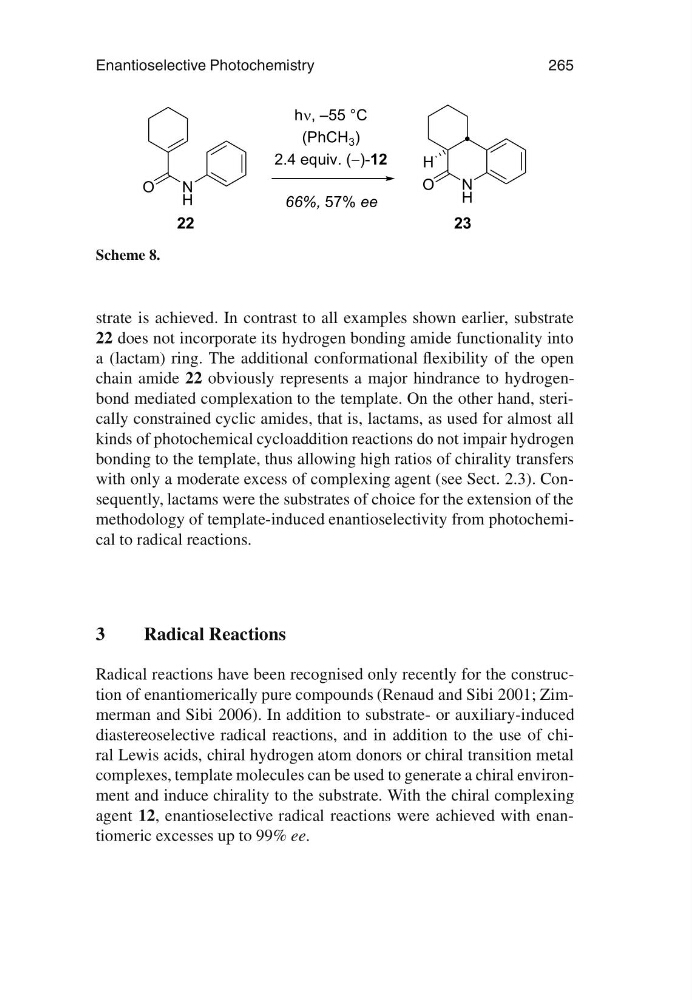
Scheme 8.
strate is achieved. In contrast to all examples shown earlier, substrate
22 does not incorporate its hydrogen bonding amide functionality into
a (lactam) ring. The additional conformational flexibility of the open
chain amide 22 obviously represents a major hindrance to hydrogenbond mediated complexation to the template. On the other hand, sterically constrained cyclic amides, that is, lactams, as used for almost all
kinds of photochemical cycloaddition reactions do not impair hydrogen
bonding to the template, thus allowing high ratios of chirality transfers
with only a moderate excess of complexing agent (see Sect. 2.3). Consequently, lactams were the substrates of choice for the extension of the
methodology of template-induced enantioselectivity from photochemical to radical reactions.
3
Radical Reactions
Radical reactions have been recognised only recently for the construction of enantiomerically pure compounds (Renaud and Sibi 2001; Zimmerman and Sibi 2006). In addition to substrate- or auxiliary-induced
diastereoselective radical reactions, and in addition to the use of chiral Lewis acids, chiral hydrogen atom donors or chiral transition metal
complexes, template molecules can be used to generate a chiral environment and induce chirality to the substrate. With the chiral complexing
agent 12, enantioselective radical reactions were achieved with enantiomeric excesses up to 99% ee.