

264
S. Breitenlechner, P. Selig, T. Bach
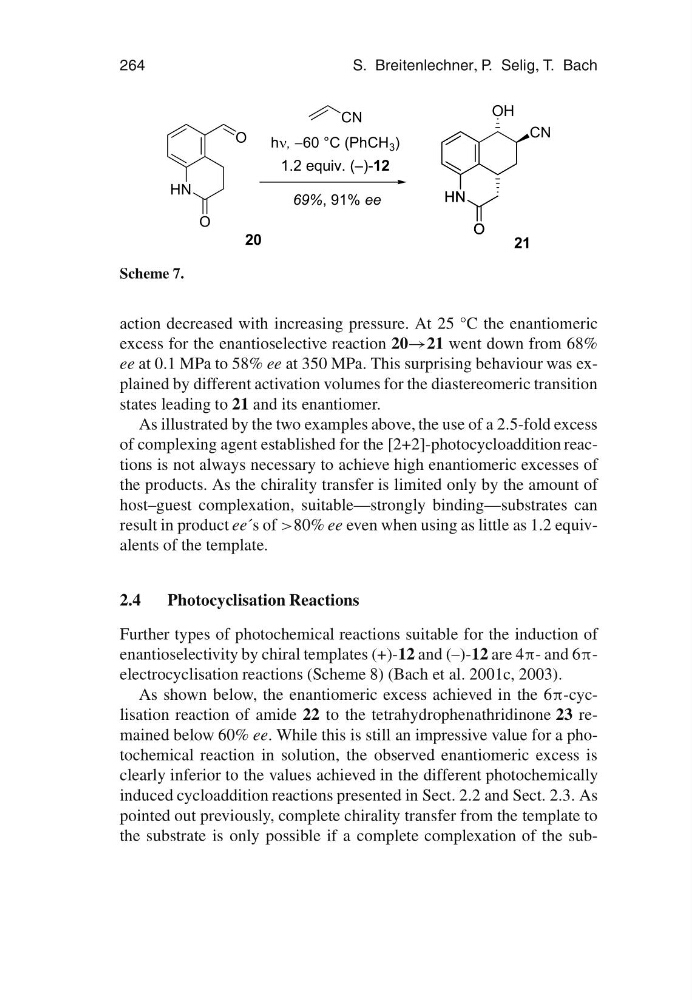
Scheme 7.
action decreased with increasing pressure. At 25 °C the enantiomeric
excess for the enantioselective reaction 20→21 went down from 68%
ee at 0.1 MPa to 58% ee at 350 MPa. This surprising behaviour was explained by different activation volumes for the diastereomeric transition
states leading to 21 and its enantiomer.
As illustrated by the two examples above, the use of a 2.5-fold excess
of complexing agent established for the [2+2]-photocycloaddition reactions is not always necessary to achieve high enantiomeric excesses of
the products. As the chirality transfer is limited only by the amount of
host–guest complexation, suitable—strongly binding—substrates can
result in product ee´s of >80% ee even when using as little as 1.2 equivalents of the template.
2.4
Photocyclisation Reactions
Further types of photochemical reactions suitable for the induction of
enantioselectivity by chiral templates (+)-12 and (–)-12 are 4π- and 6πelectrocyclisation reactions (Scheme 8) (Bach et al. 2001c, 2003).
As shown below, the enantiomeric excess achieved in the 6π-cyclisation reaction of amide 22 to the tetrahydrophenathridinone 23 remained below 60% ee. While this is still an impressive value for a photochemical reaction in solution, the observed enantiomeric excess is
clearly inferior to the values achieved in the different photochemically
induced cycloaddition reactions presented in Sect. 2.2 and Sect. 2.3. As
pointed out previously, complete chirality transfer from the template to
the substrate is only possible if a complete complexation of the sub-