

258
S. Breitenlechner, P. Selig, T. Bach
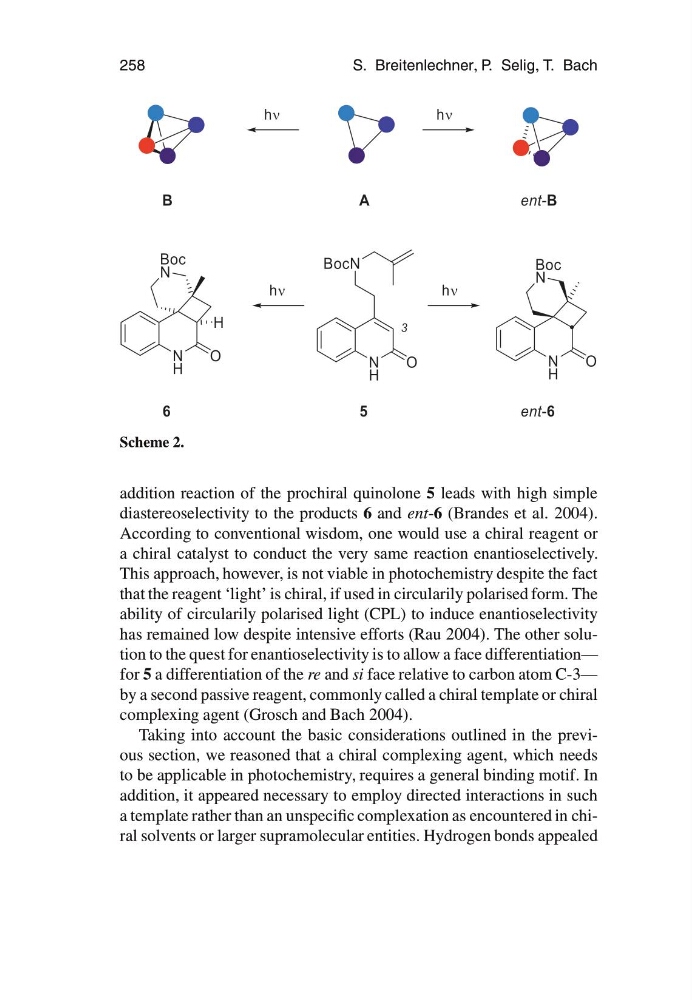
Scheme 2.
addition reaction of the prochiral quinolone 5 leads with high simple
diastereoselectivity to the products 6 and ent-6 (Brandes et al. 2004).
According to conventional wisdom, one would use a chiral reagent or
a chiral catalyst to conduct the very same reaction enantioselectively.
This approach, however, is not viable in photochemistry despite the fact
that the reagent ‘light’ is chiral, if used in circularily polarised form. The
ability of circularily polarised light (CPL) to induce enantioselectivity
has remained low despite intensive efforts (Rau 2004). The other solution to the quest for enantioselectivity is to allow a face differentiation—
for 5 a differentiation of the re and si face relative to carbon atom C-3—
by a second passive reagent, commonly called a chiral template or chiral
complexing agent (Grosch and Bach 2004).
Taking into account the basic considerations outlined in the previous section, we reasoned that a chiral complexing agent, which needs
to be applicable in photochemistry, requires a general binding motif. In
addition, it appeared necessary to employ directed interactions in such
a template rather than an unspecific complexation as encountered in chiral solvents or larger supramolecular entities. Hydrogen bonds appealed