

Enantioselective Photochemistry
257
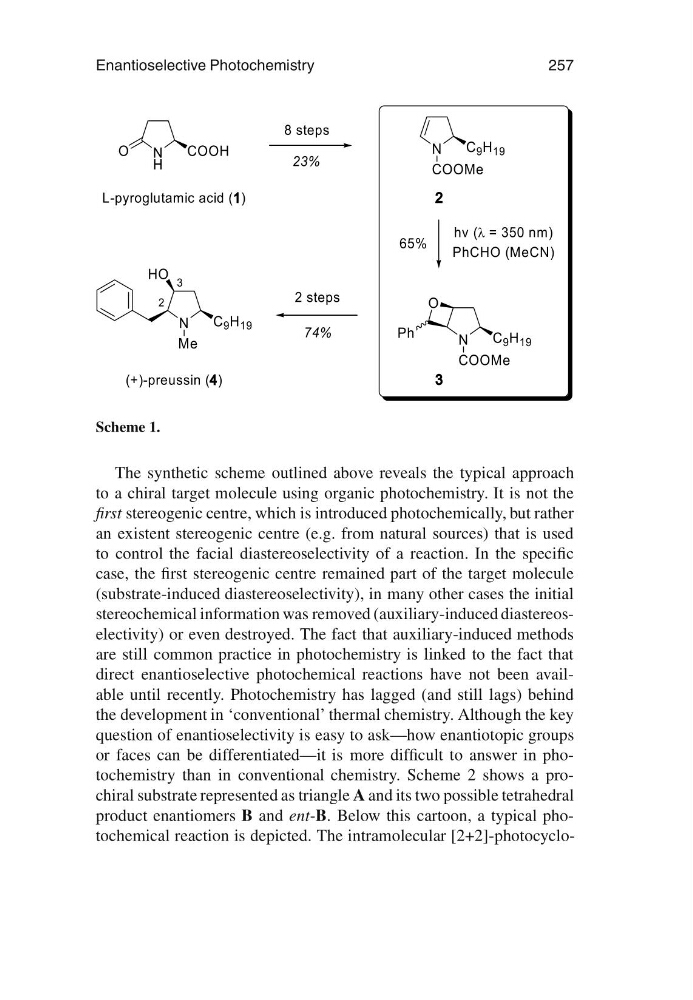
Scheme 1.
The synthetic scheme outlined above reveals the typical approach
to a chiral target molecule using organic photochemistry. It is not the
first stereogenic centre, which is introduced photochemically, but rather
an existent stereogenic centre (e.g. from natural sources) that is used
to control the facial diastereoselectivity of a reaction. In the specific
case, the first stereogenic centre remained part of the target molecule
(substrate-induced diastereoselectivity), in many other cases the initial
stereochemical information was removed (auxiliary-induced diastereoselectivity) or even destroyed. The fact that auxiliary-induced methods
are still common practice in photochemistry is linked to the fact that
direct enantioselective photochemical reactions have not been available until recently. Photochemistry has lagged (and still lags) behind
the development in ‘conventional’ thermal chemistry. Although the key
question of enantioselectivity is easy to ask—how enantiotopic groups
or faces can be differentiated—it is more difficult to answer in photochemistry than in conventional chemistry. Scheme 2 shows a prochiral substrate represented as triangle A and its two possible tetrahedral
product enantiomers B and ent-B. Below this cartoon, a typical photochemical reaction is depicted. The intramolecular [2+2]-photocyclo-