

Enantioselective Photochemistry
259
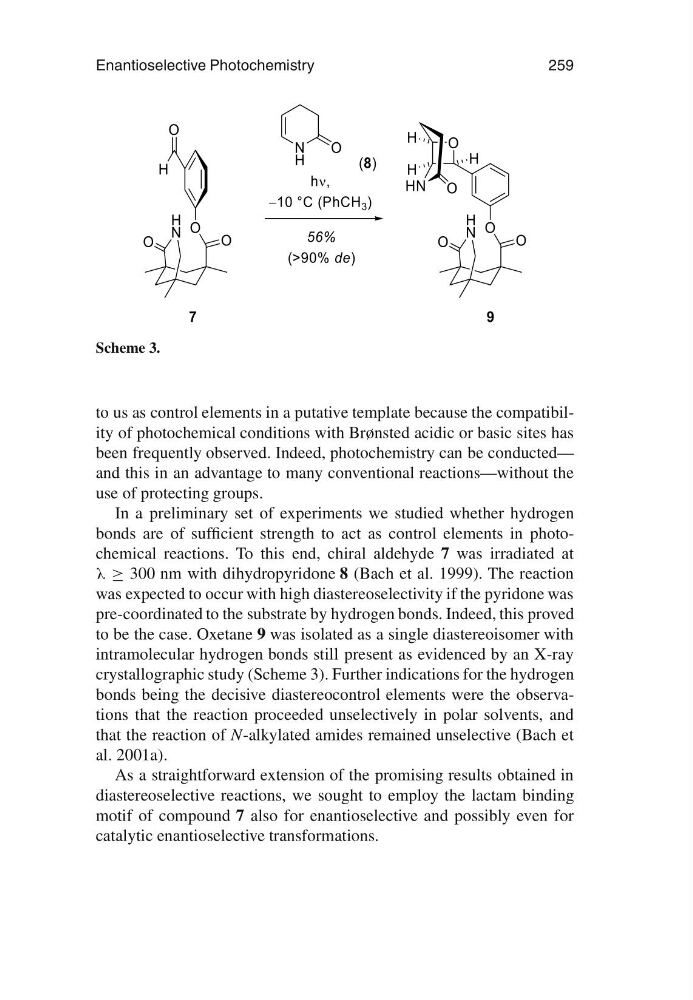
Scheme 3.
to us as control elements in a putative template because the compatibility of photochemical conditions with Brønsted acidic or basic sites has
been frequently observed. Indeed, photochemistry can be conducted—
and this in an advantage to many conventional reactions—without the
use of protecting groups.
In a preliminary set of experiments we studied whether hydrogen
bonds are of sufficient strength to act as control elements in photochemical reactions. To this end, chiral aldehyde 7 was irradiated at
λ ≥ 300 nm with dihydropyridone 8 (Bach et al. 1999). The reaction
was expected to occur with high diastereoselectivity if the pyridone was
pre-coordinated to the substrate by hydrogen bonds. Indeed, this proved
to be the case. Oxetane 9 was isolated as a single diastereoisomer with
intramolecular hydrogen bonds still present as evidenced by an X-ray
crystallographic study (Scheme 3). Further indications for the hydrogen
bonds being the decisive diastereocontrol elements were the observations that the reaction proceeded unselectively in polar solvents, and
that the reaction of N-alkylated amides remained unselective (Bach et
al. 2001a).
As a straightforward extension of the promising results obtained in
diastereoselective reactions, we sought to employ the lactam binding
motif of compound 7 also for enantioselective and possibly even for
catalytic enantioselective transformations.