

238
M. Rueping, E. Sugiono
10
Cooperative Co-Catalysis: The Effective Interplay
of Two Brønsted Acids in the Enantioselective
Synthesis of Isoquinuclidines
Isoquinuclidines 28 (aza-bicyclo [2.2.2]octanes) consist of N-bicyclic
structures which are the structural element of numerous natural occurring alkaloids with interesting biological properties (Sundberg and
Smith 2002). Furthermore, these products can be readily converted to
the biologically active pipecolic acids (Krow et al. 1982, 1999; Holmes
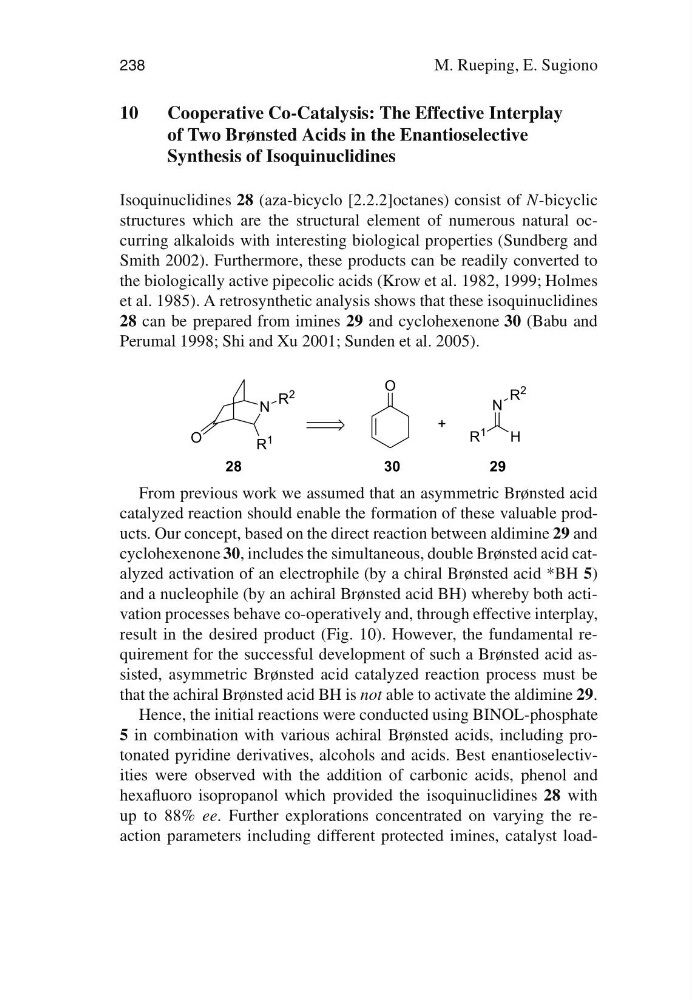
et al. 1985). A retrosynthetic analysis shows that these isoquinuclidines
28 can be prepared from imines 29 and cyclohexenone 30 (Babu and
Perumal 1998; Shi and Xu 2001; Sunden et al. 2005).
From previous work we assumed that an asymmetric Brønsted acid
catalyzed reaction should enable the formation of these valuable products. Our concept, based on the direct reaction between aldimine 29 and
cyclohexenone 30, includes the simultaneous, double Brønsted acid catalyzed activation of an electrophile (by a chiral Brønsted acid *BH 5)
and a nucleophile (by an achiral Brønsted acid BH) whereby both activation processes behave co-operatively and, through effective interplay,
result in the desired product (Fig. 10). However, the fundamental requirement for the successful development of such a Brønsted acid assisted, asymmetric Brønsted acid catalyzed reaction process must be
that the achiral Brønsted acid BH is not able to activate the aldimine 29.
Hence, the initial reactions were conducted using BINOL-phosphate
5 in combination with various achiral Brønsted acids, including protonated pyridine derivatives, alcohols and acids. Best enantioselectivities were observed with the addition of carbonic acids, phenol and
hexafluoro isopropanol which provided the isoquinuclidines 28 with
up to 88% ee. Further explorations concentrated on varying the reaction parameters including different protected imines, catalyst load-